
Nepal Travel Guide — Himalayan Treks, Real Costs & What to Know Before You Go
The most dramatic mountain scenery on earth, teahouse beds for $15 a night, and dal bhat for $3. Nepal is the world’s greatest adventure bargain — if you plan the flights and permits right.
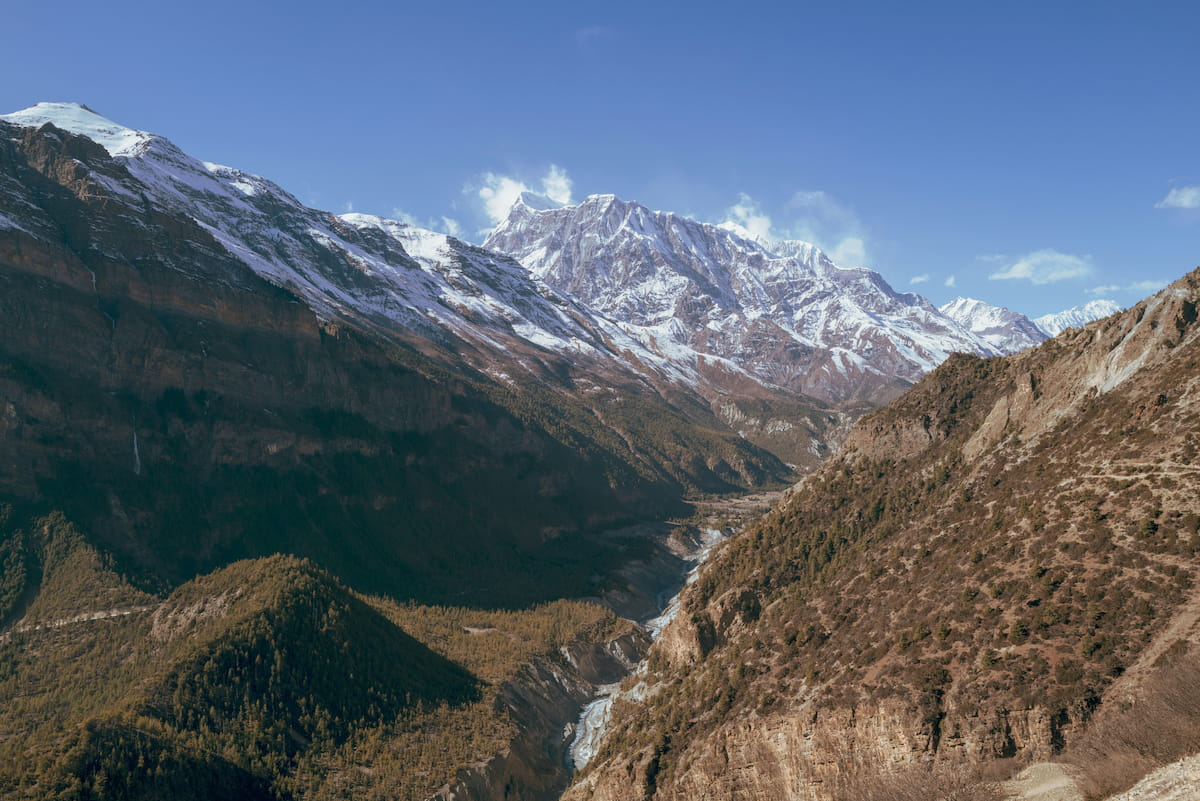
You’re eating a plate of dal bhat in a teahouse at 11,000 feet. The cook brings a second serving — refills are always free — and through the window, Annapurna South fills the sky like a wall of ice. The meal cost $4. You’ve been walking for four days. This is Nepal.
Nepal sits at an odd intersection: some of the highest costs to get to and some of the lowest costs to be there. Once you land in Kathmandu, your dollar stretches in ways that feel almost unfair — $20/night teahouses on world-famous trails, food that costs less than a gas station coffee back home, guides who’ve summited the same peaks they’ll walk you through. The math works out to a 10-night Himalayan trek — including flights from the US — for under $4,000 per person on a careful budget. This guide breaks down every number and tells you where the gotchas hide.
What’s In This Guide
📅 Best Time to Visit Nepal
October and November are the gold standard — clear Himalayan views, comfortable daytime temperatures, and post-monsoon trails in peak condition. March and April deliver the bonus of rhododendron forests in bloom and are equally valid for most treks. Avoid June through August entirely for anything involving high-altitude routes.
Where to Stay in Kathmandu
Thamel, Kathmandu’s traveler hub, is where most visitors base themselves — it’s chaotic, loud at night, and packed with gear shops, but it puts you within walking distance of every permit office, tour operator, and departure point you’ll need. For a quieter stay, the Patan neighborhood across the river offers better air quality and a more local feel. Rates below reflect standard adult pricing verified April 2026; note that Nepal’s 13% tourism levy and 13% VAT are sometimes added on top of advertised rates — confirm the all-in total when booking.
Zostel is the most reliable budget brand in Nepal — consistent cleanliness, hot showers, and a common area where solo travelers routinely find trek partners. Private rooms run $30–40/night; dorm beds from $10–14. The Thamel location puts permit offices, trek outfitters, and the tourist bus park all within a 10-minute walk. This isn’t glamour — it’s a smart operational base for getting your trek organized efficiently.
Kantipur Temple House is built in the style of a traditional Newari courtyard, with carved wood screens, brick walls, and a garden that feels remarkably peaceful given its central Thamel location. Rooms are comfortable without being fussy, and the rooftop restaurant has honest Nepali and continental options. The in-house trek desk can sort permits, guides, and gear rental without the pressure of a standalone outfitter shop.
Dwarika’s isn’t simply a hotel — it’s a decades-long preservation project. The late Dwarika Das Shrestha spent his life rescuing medieval woodcarvings and architectural fragments from demolition sites across Kathmandu; the hotel was built around them. Every corridor, courtyard, and room incorporates original Newari craftsmanship dating back 500+ years. The Krishnarpan restaurant serves a traditional Nepali feast across 22 or 30 courses that ranks among the most distinctive dining experiences in Asia.
Nepal Planning Checklist — Free Download
Permits, gear, altitude prep, and itinerary frameworks for EBC, Annapurna, and Poon Hill. Straight to your inbox.
15 Best Nepal Experiences
Nepal splits naturally into two travel worlds: Kathmandu’s ancient temple circuit and the mountain trails that begin a short flight or bus ride away. The free experiences here require nothing more than showing up; the paid tier covers sites and day activities worth every rupee; the Signature tier holds the treks and helicopter journeys that most people come to Nepal specifically to do. All prices below are standard adult non-resident rates verified April 2026.
Pokhara’s hillside suburb of Sarangkot sits at 5,400 feet and faces the full arc of the Annapurna and Dhaulagiri ranges directly across the valley. On a clear morning — which is most mornings outside monsoon — you’ll watch Machapuchare (Fishtail Mountain), Annapurna South, and Hiunchuli catch the first light while the valley below is still dark. The hike up from Pokhara’s lakeside takes 60–90 minutes on a well-maintained trail; there’s also a road if you’d prefer a taxi at 4:30 AM.
💡 Bring a headlamp and extra layers — summit temperatures at dawn run 15–20°F colder than Pokhara town, even in spring.
Phewa is Nepal’s second-largest lake and one of the few places on earth where you can sit at a lakeside café for $2 and look directly at a 26,000-foot peak. The promenade running along the lake’s eastern shore is entirely walkable — cafes, kayak rentals, and open-air restaurants line the route. The Barahi Temple sits on a small island accessible by rowboat, and the reflection of Machhapuchhre on a still morning is the shot that ends up on every Nepal travel blog for good reason.
💡 The rowboat across to Barahi Island charges a small fee (~$1–2) — keep this in mind if your budget is tight, though the exterior view from shore is nearly as good.
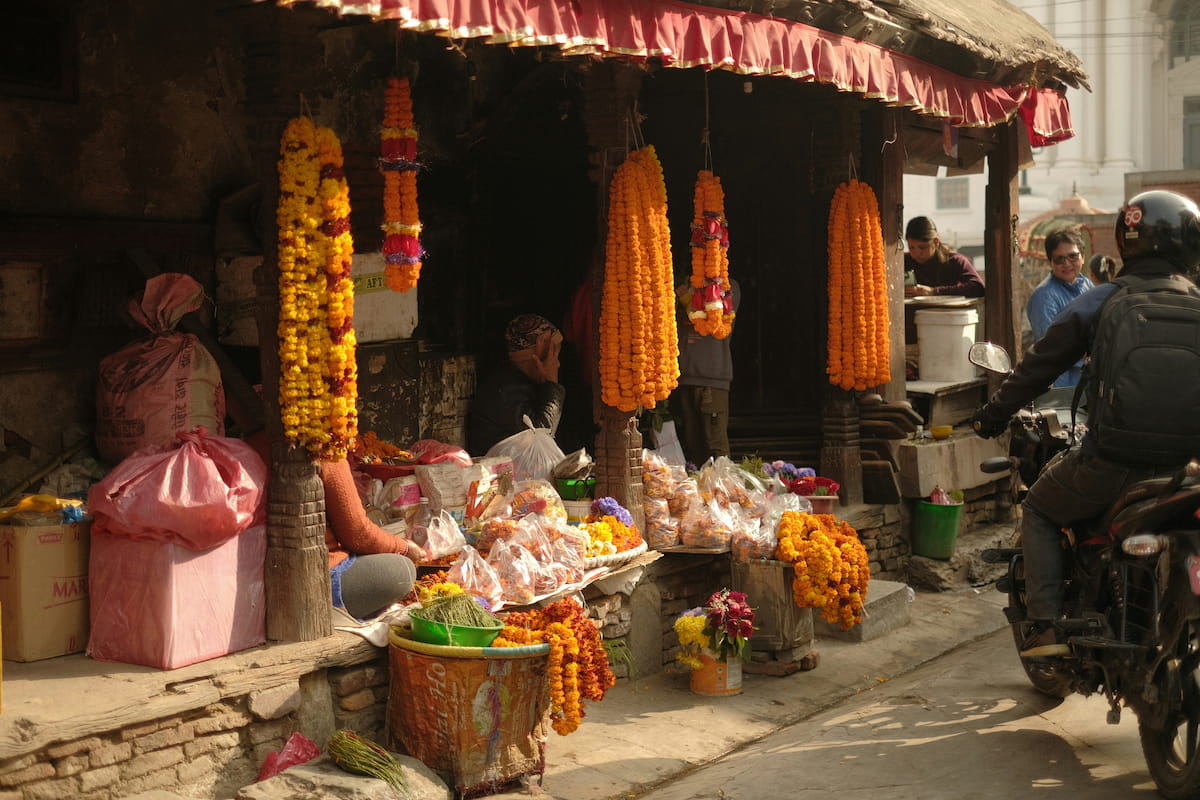
Asan Bazaar is the living trading heart of old Kathmandu — a warren of alleys where saffron merchants, brass-pot sellers, and spice traders have operated from the same spots for centuries. It connects to a network of courtyards (chowks) and smaller temples that most visitors walk past without realizing what they’ve missed. An afternoon starting at Indra Chowk and working north through Asan and into Thamel covers thousands of years of urban continuity in about two square miles.
💡 The best time to wander Asan is mid-morning on a weekday — traders are fully set up, the light filters beautifully through the narrow alleys, and it’s before the afternoon heat.
On the northern edge of Kathmandu sits one of Nepal’s most striking sacred sculptures: a 1,500-year-old reclining Vishnu carved from a single black stone, lying in a shallow pool surrounded by coiled serpents. The craftsmanship is extraordinary and the setting — an open-air courtyard with resident priests, pilgrims, and marigold offerings — is entirely genuine rather than touristic. This is an active place of worship, not a museum piece. The site is free for all visitors to approach and observe respectfully.
💡 The statue is most active with pilgrims in the early morning. The site is 8 km north of central Kathmandu — a straightforward $5–6 taxi ride each way.
Boudhanath is one of the largest Buddhist stupas in the world and the spiritual center of Tibetan Buddhism in exile. The enormous white dome — 120 feet high, painted with the famous all-seeing eyes — is encircled by a wide stone path where monks, pilgrims, and visitors walk clockwise throughout the day. The surrounding streets are dense with monasteries, thangka painting workshops, and excellent Tibetan restaurants. The 400 NPR (~$3) entrance fee for foreigners is collected at the entry gate.
💡 Visit around 7 AM when the morning puja ceremonies fill the circuit with chanting and butter-lamp smoke — this is when Boudhanath feels most alive.
Perched on a hill rising 200 feet above the Kathmandu Valley, Swayambhunath is one of the oldest religious sites in Nepal — estimates date parts of the complex to the 5th century AD. The climb up 365 stone steps rewards you with panoramic valley views, the stupa’s enormous gilded spire, and several dozen rhesus monkeys who have claimed the hilltop as their own territory. The site blends Buddhist and Hindu shrines in a way that feels genuinely syncretic rather than curated.
💡 The resident monkeys are curious and occasionally aggressive about food — don’t carry anything visibly edible in your hands while climbing the stairs.
Pashupatinath is Hinduism’s most sacred site in Nepal and one of the most important Shiva temples in the world. The tiered pagoda-style temple itself is accessible to Hindus only, but the surrounding complex — including the open-air cremation ghats on the Bagmati River — is one of the most viscerally real places a traveler can spend an hour. Cremations happen in the open alongside ordinary temple life; the combination of grief, prayer, incense, and daily ritual feels unlike anywhere else in the world.
💡 Approach the ghats with genuine respect — funerals are taking place. Photographs of cremations are deeply inappropriate. The complex is most active and atmospheric in the evening during the Aarti ceremony.
Across the Bagmati River from Kathmandu, Patan (Lalitpur) is the valley’s most refined city — its Durbar Square is a UNESCO World Heritage Site containing some of the finest medieval Newari architecture in existence. The Krishna Mandir temple, built entirely from stone without mortar, and the Patan Museum (widely considered Nepal’s best) make this the most intellectually rewarding site in the Kathmandu Valley. The surrounding streets are quieter and less touristy than Thamel, with excellent local restaurants a few alleys in.
💡 Budget at least 3 hours — rushing Patan feels genuinely wasteful. The on-site Patan Museum alone merits 90 minutes.
The Trishuli is Nepal’s most accessible whitewater river — it runs alongside the main Kathmandu-to-Pokhara highway, making it easy to combine with a transit day between the two cities. Class III–IV rapids make it suitable for first-timers while still delivering enough adrenaline to feel legitimate. Most day trips run 3–4 hours on the water with all equipment provided. Multi-day rafting and camping packages on the Trishuli or the more remote Seti River are available from $100–180/person and are worth serious consideration if rivers are your thing.
💡 The water level is highest and fastest in September–October, right after monsoon. March–April offers lower, clearer water and warmer air temperatures — better for beginners.
Pokhara has become one of the best paragliding destinations in the world — the thermal conditions created by the Annapurna range rising directly from the valley floor are exceptional, and the backdrop of Machhapuchhre and the Annapurna massif while you’re suspended above Phewa Lake is objectively outrageous. Tandem flights (no experience required) typically last 25–40 minutes and launch from Sarangkot hill. Multiple operators compete for business in the lakeside area; prices have been stable at $80–100 including pickup, equipment, and a GoPro video package.
💡 Book a morning flight — afternoon thermals can produce turbulence that first-timers find uncomfortable. Morning conditions are consistently smoother.
Poon Hill is the ideal entry point for anyone curious about Himalayan trekking without committing to a 10-day expedition. The route runs through rhododendron forest and Gurung villages to a 10,500-foot viewpoint with a 180-degree panorama of the Annapurna and Dhaulagiri ranges — the kind of sunrise view that ends up on the covers of mountaineering books. The all-in cost covers the ACAP permit (~$30), a TIMS card (~$20), a local guide, teahouse accommodation, and meals for three to four days. No technical skills or prior trekking experience required.
💡 March brings rhododendrons in full bloom along the Ghorepani trail — a rare combination of wildflower forest and Himalayan panorama that makes this specific month-and-route pairing exceptional.
Nepal’s wildlife story is almost as remarkable as its mountains. Chitwan is one of Asia’s best conservation success stories — Bengal tiger and one-horned rhinoceros populations have both grown substantially in recent decades. A two-day safari package from a reputable lodge in Sauraha includes jeep safaris, a dugout canoe trip along the Rapti River, jungle walks with armed naturalists, and a traditional Tharu cultural program in the evening. This isn’t a side note to a Nepal trip — for many visitors, Chitwan becomes the highlight they didn’t expect.
💡 Early morning jeep safaris (departing at 6 AM) have the highest rhino and elephant sighting rates. Book through your lodge directly rather than through a Kathmandu middleman — it’s cheaper and they know the park better.
The ABC trek climbs through subtropical forest, past terraced rice paddies and Gurung villages, up through bamboo and rhododendron zones, to a stone bowl at 13,500 feet surrounded entirely by a full 360-degree ring of 7,000–8,000-meter peaks. It’s one of the most theatrical mountain environments on earth — you camp or sleep at teahouses inside a natural amphitheater of the highest mountains in the Annapurna sanctuary. All-in cost covers the ACAP permit, TIMS card, private guide, porter, and teahouse accommodation and meals for the full circuit.
💡 Build in at least one extra acclimatization day, ideally at Deurali (11,483 ft), before pushing to base camp. The altitude gain in the final two days is aggressive — altitude sickness is a genuine risk if you rush it.
The EBC route is one of the most famous walks in the world, and it earns that status. The Lukla flight alone — 9 minutes through a mountain corridor to a cliff-edge airstrip — is a memorable beginning. The trail to base camp climbs through Namche Bazaar, the Tengboche monastery, and the Khumbu glacier to a rocky moraine at 17,600 feet where Everest expeditions stage their acclimatization camps. This isn’t a casual undertaking — the altitude is serious, the logistics require planning, and the best experience requires hiring a reputable licensed guide rather than going alone.
💡 Factor two acclimatization days into your itinerary — one at Namche Bazaar (11,286 ft) and one at Dingboche (14,470 ft). Skipping these is the most common reason trekkers have to turn back before base camp.
For travelers who want the Everest experience without 12 days of trekking, the helicopter option is genuinely extraordinary — not a consolation prize. A dawn departure from Kathmandu reaches base camp as the sun clears the Khumbu ridge, landing briefly for photographs before continuing to the Kala Patthar viewpoint at 18,200 feet, where Everest’s summit pyramid appears closer than it seems possible. The entire flight lasts 3–4 hours. Prices vary by group size; sharing a helicopter with 4–5 passengers brings it to the lower end of the range. Most operators include a stop at a luxury mountain lodge for breakfast at altitude.
💡 Weather windows for helicopter flights are narrow — operators typically require flexibility in your schedule (a 2-day window is standard) and can cancel on the morning of departure for cloud cover. Build this into your itinerary planning rather than treating it as a fixed-time commitment.
Worth It / Skip It
Don’t Make These Mistakes
The single most common reason trekkers have to turn back before their goal is moving too fast at altitude. Altitude sickness (AMS) doesn’t respect fitness level — elite athletes get it and couch potatoes sometimes don’t. Above 10,000 feet, the standard rule is to ascend no more than 1,000 feet per sleeping altitude per day, with a rest day every 3,000 feet. Build your itinerary around this, not around a flight home you’ve already booked. Most EBC and ABC operators offer standard itineraries that technically meet this requirement; insist on them even if guides or group members push for a faster pace.
ATMs end in Namche Bazaar (for EBC) and Pokhara or Jomsom (for Annapurna) — there are none on the trail beyond those points. Teahouses operate entirely on cash; tips for guides and porters are cash; emergency supplies are cash. The current recommendation is to carry at minimum $40–60 per person per trail day in Nepali rupees, plus a buffer of $200–300 USD for emergencies. Exchange at a Kathmandu bank before you leave the city — rates at trail-head exchange booths are noticeably worse.
October is the busiest trekking month on earth by Himalayan trail traffic, and many guide services and teahouses fill up 2–3 months in advance. TIMS cards and national park permits can be obtained in Kathmandu with 1–2 days’ notice, but licensed guides get booked out well before peak season. Book your guide first, then your Kathmandu hotel, then your flights — in that order. Permits are the last thing to sort; they’re bureaucratic but not scarce. Your guide is the scarce resource.
Kathmandu sits at 4,600 feet — arriving from sea level and immediately booking a Lukla flight produces a dangerous altitude jump for your body. Spend at least 1–2 nights in Kathmandu first; this starts the acclimatization process while you handle permits, meet your guide, and adjust to Nepal’s timezone (5.75 hours ahead of UTC — yes, Nepal has a genuinely unusual 15-minute offset). Treat these Kathmandu days as productive, not wasted: Patan, Boudhanath, and Pashupatinath are legitimately worth your time.
VacayValue Scorecard — Nepal & the Himalayas
Packing List — Nepal & the Himalayas
Going to Nepal? Don’t Leave Without This.
Trek planning frameworks, permit checklists, and destination breakdowns delivered free to your inbox.
The World’s Greatest Adventure Per Dollar — Once You Survive the Flights
Nepal is where the value equation flips in the most dramatic way possible. The flights are long, expensive, and the one genuine weakness in this destination’s case — most Americans will spend $850–1,550 per person just to get there. But the moment you land, the math reverses completely. Teahouses at $20 a night. Dal bhat for $4 with unlimited refills. A private licensed mountain guide for $30 a day. This is a country where the most awe-inspiring landscapes on earth are accessible to people traveling on a careful budget.
The activity column carries a moderate score because trekking in Nepal has genuine costs — permits, guides (now legally required on major routes), and porter fees add up. But these costs are moderate by global adventure standards, and they come with something that matters: the money flows directly into Sherpa and mountain community livelihoods in a way that almost no other tourism economy achieves. Hiring a local guide here isn’t just smart logistics. It’s the right thing to do.
Nepal rewards planning and patience. Travelers who show up in October without a guide booking confirmed will scramble; those who booked in August will walk into the best two weeks of their lives. The Himalayas are not a spontaneous destination — they’re a deliberate one. And for travelers willing to prepare, the return on that investment is unlike anywhere else on earth.