
Marrakech 2026: Africa’s Most Sensory City
Riad stays for $35 a night. Tagines for $5. One of the world’s most visually stunning cities — and one of the most honest travel bargains left on the planet.
You push through a door in a blank alley wall and suddenly you’re standing in a courtyard full of orange trees, mosaic tile, and the smell of mint tea. Outside: the roar of the souks. Inside: complete stillness. That’s a riad in Marrakech. And it costs less than a Comfort Inn in Tulsa.
Marrakech is the city that makes you feel like you’ve time-traveled. Ancient medina walls, labyrinthine markets, and the nightly spectacle of Jemaa el-Fnaa — all of it completely intact. But here’s what surprises most American travelers: Marrakech is extraordinarily affordable once you know where to look. We’re talking budget riad stays from $35 a night, tagines from $5, and a city where the best experiences — wandering the souks, watching the sunset from a rooftop, getting lost in a 500-year-old madrassa — cost almost nothing. The flights are the only real budget challenge. Everything else is a bargain.
What’s In This Guide
📅 Best Time to Visit Marrakech
Best months: March–May and October. October is especially underrated — perfect temperatures, low-season riad prices, and a fraction of the spring crowds. Avoid July and August unless you have a serious heat tolerance and a pool to retreat to; midday temperatures regularly exceed 100°F in the medina.
Where to Stay in Marrakech
Stay in the medina — full stop. The riads (traditional courtyard homes turned boutique guesthouses) here offer some of the most beautiful accommodations on the planet at prices that are genuinely shocking. A mid-range riad in Marrakech — the kind with hand-painted tilework, a plunge pool, and breakfast served on a rooftop — will run you $85–$150/night. The same quality in Paris or Rome would cost triple. Morocco’s tourist tax of ~$2–$10/night is typically included in advertised riad rates. All rates verified March 2026.
A hostel-riad hybrid that punches well above its price point — stylish Moroccan décor, a courtyard pool, communal areas that actually make solo travel social, and private rooms that feel like a proper riad stay without the boutique price tag. It’s a short walk from Jemaa el-Fnaa and close to the main souks, which means you’re in the thick of it from the moment you step outside. The rooftop is a genuine gathering spot at sunset.
This is the Marrakech experience most travelers picture: hand-carved plasterwork, hand-painted Zellige tile floors, a fountain in the courtyard, and staff who somehow know your name before you’ve introduced yourself. At this price tier you’re getting breakfast on the rooftop, a private hammam session for a small surcharge, and real personalized service — the kind that’ll have you booking taxis, day trips, and dinner reservations via WhatsApp before you’ve even left the airport. Worth every dirham.
Seven riads merged into one jaw-dropping property — 14 individually designed rooms, a rooftop restaurant with some of the best food in the city, a heated pool, spa, cocktail bar, and one of the most significant contemporary art collections in Morocco. The inspiration was legendary designer Bill Willis, who defined Marrakech’s luxury aesthetic for decades. At $175/night for an entry room, it’s remarkable value compared to any equivalent in Europe or North America. The service matches the setting — exceptional without being stiff.
Get Our Free Marrakech Trip Planner
Real budget breakdowns, day-by-day itineraries, and the local tips that travel guides skip. Straight to your inbox — free.
15 Best Marrakech Experiences
Marrakech has a unique split: the free experiences here are genuinely extraordinary — wandering the souks, watching Jemaa el-Fnaa come alive at dusk — and the paid attractions are some of the most affordable on earth. Most historic sites run $5–$17. You can see the entire city’s top cultural monuments for under $50 total. The signature tier is where Marrakech earns its bucket-list status: day trips to the Atlas Mountains, sunrise balloon flights over the medina, and the kind of full-day adventures that most people spend years saving for.
The world’s greatest free show. Every afternoon, Morocco’s most famous square transforms from a daytime market into a pulsing, smoky outdoor theater: snake charmers, acrobats, storytellers, drummers, and dozens of food stalls firing up their grills simultaneously. The smells alone — charcoal, spiced lamb, saffron, fresh orange juice — are worth making the walk for. UNESCO called it a masterpiece of oral and intangible heritage, and for once, a UNESCO designation actually undersells it.
💡 Arrive around 5:30–6pm to watch the transformation happen in real time. Bring cash for the freshly squeezed orange juice stalls (about $1 a glass) — it’s the best you’ll have anywhere.
Getting deliberately lost in the medina souks is one of travel’s great pleasures. The markets are organized by craft — a street of leather goods, then dyers, then brass workers, then spice sellers — and wandering between them is an hours-long sensory adventure. The souk of the dyers (Souk Semmarine’s adjacent lanes) is particularly photogenic: skeins of freshly dyed wool hanging between buildings like living tapestries. The medina is a UNESCO World Heritage Site and has looked roughly this way for 900 years.
💡 Bring a mental compass: keep track of which direction the Koutoubia Mosque’s minaret is (it’s visible from many vantage points) and you’ll always be able to find your way back to Jemaa el-Fnaa.
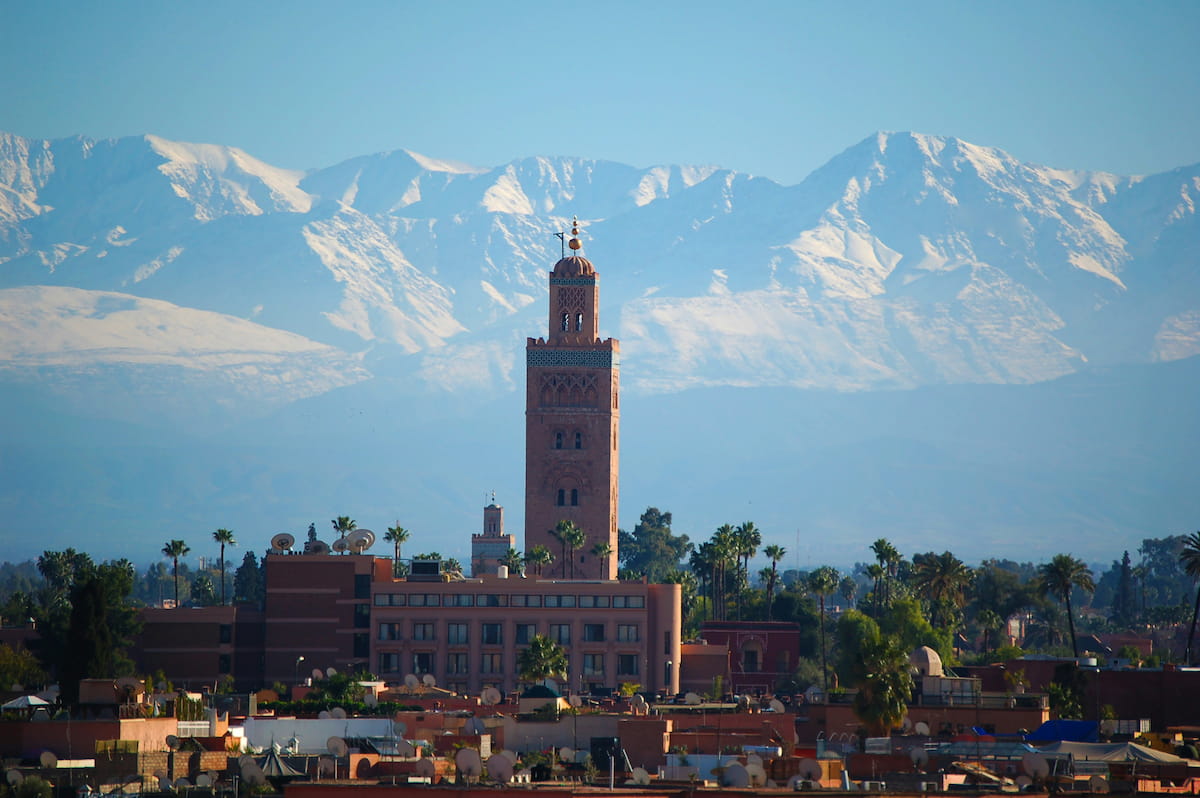
Non-Muslims cannot enter the mosque itself, but the gardens surrounding this 12th-century landmark are open to all and genuinely beautiful — orange trees, roses, and the city’s most iconic skyline backdrop. The mosque’s 70-meter minaret has guided travelers into Marrakech for nearly a millennium. The gardens are particularly lovely in the early morning and at the golden hour before sunset, when the minaret glows in warm light against a blue sky.
💡 The call to prayer from the Koutoubia carries across the entire medina and sounds otherworldly in person. Plan to be somewhere you can pause and listen — it happens five times daily, with the predawn and sunset calls being the most atmospheric.
Built in the 12th century and expanded by the Saadians, the Menara is a vast olive grove and reflecting pool on the edge of the city with the Atlas Mountains as a backdrop. It’s not Instagram-fancy, but it’s one of the most peaceful places in Marrakech — a real contrast to the intensity of the medina — and the view of the snowy Atlas peaks reflected in the pool on clear winter days is legitimately extraordinary. A good spot to slow down mid-trip.
💡 Rent a bike from the medina and ride out here — it’s about 2km from Jemaa el-Fnaa and the bike rental will cost around $5 for a half day. Best visited on a clear day when the mountains are visible.
Adjacent to the Bahia Palace, the Mellah is Marrakech’s former Jewish quarter — a network of narrow streets, shuttered synagogues, and carved wooden balconies that tell a layered story of the city’s multicultural past. It’s less touristy than the main medina, more residential, and genuinely fascinating. The Lazama Synagogue inside is one of the oldest in Morocco and can be visited with a small tip to the caretaker. The wrought-iron balconies are a distinctive architectural feature you won’t find elsewhere in the medina.
💡 Combine this with Bahia Palace — they share the same neighborhood and are a short walk apart, making them a natural half-day pairing.
The most beautiful building in Morocco — and quite possibly in the world at this price point. Built between 1564 and 1565, this Quranic school housed 900 students and is covered in the most intricate zellige tilework, carved cedar wood, and stucco calligraphy you’ve likely ever seen. The central courtyard with its marble pool and three-story galleries is stunning. It’s consistently the most photographed and marveled-at site in Marrakech, and admission is 50 MAD ($5). Five dollars. Let that sink in.
💡 Go first thing when it opens (9am) to see the light fall beautifully across the courtyard before the crowds arrive. By 11am it can get very busy — particularly with photography enthusiasts framing the same shots in the central pool reflection.
A sprawling 19th-century palace built by the grand vizier Si Moussa and expanded by his son Ba Ahmed. The scale is remarkable — 150 rooms, ornate Andalusian gardens, carved ceilings, and an endless series of mosaic-tiled courtyards. It was intended to be the most magnificent palace of its era, and even in its current partially unfurnished state, the craftsmanship is extraordinary. Worth noting: the ticket office accepts cash only, so bring your dirhams. The entry fee for foreign visitors is 100 MAD (~$10).
💡 The best photos happen in the late afternoon when softer light comes through the courtyard openings. Morning light hits the main rooms better. Visit either first thing or after 3pm to avoid the midday flat light.
Hidden and forgotten for more than three centuries — the Saadian sultans who succeeded this dynasty sealed the tombs to erase their predecessors from history — these 16th-century royal mausoleums weren’t rediscovered until 1917. Today they’re one of Marrakech’s most evocative sites: 66 tombs in a remarkably compact space, each decorated with astonishing hand-carved detail. The Hall of Twelve Columns is particularly impressive. Entry is 100 MAD (~$10) and the site can feel intense on a busy day, so time your visit to avoid peak midday hours.
💡 Opening hours are 9am–5pm daily. This is one of the most popular tourist sites in Morocco, so arrive at opening or in the last hour of the day. Combine it with Bahia Palace for an efficient historic sites morning.
The garden Yves Saint Laurent loved enough to save from developers in 1980 and eventually call home. French painter Jacques Majorelle spent 40 years creating this cobalt-blue oasis of exotic plants, cactuses, bamboo groves, and reflecting pools — and the color he patented (Majorelle Blue) is still the garden’s defining visual. The YSL Museum next door can be added for a combined ticket of ~$23. It’s outside the medina (about 20 minutes on foot from Jemaa el-Fnaa) and markedly more curated than anything else in Marrakech — worth the slight premium.
💡 The garden opens at 8:30am daily and the first 30 minutes are noticeably calmer. By 10am it can get congested. Book tickets online in advance during spring and fall — it does sell out, and the walk is not worth a turned-away trip.
A traditional Moroccan hammam is a bath ritual: steam room, black soap scrub, exfoliation mitt, and a rinse that leaves your skin feeling genuinely different. It’s been a cornerstone of Moroccan daily life for centuries. The local hammams (frequented by residents, not tourists) are cheaper and more authentic; the riad-arranged hammams are more comfortable for first-timers and come with a translator of sorts — staff who explain each step. Either way, budget an hour and expect to feel remarkably relaxed afterward.
💡 Book through your riad for your first visit — they’ll send you somewhere reputable and price-controlled. Avoid unsolicited “free hammam tour” offers on the street, which often lead to pressure sales on products or inflated entry fees.
Most include a morning souk walk to source ingredients, then two to three hours hands-on with a local cook learning to make tagine, couscous, harira soup, and pastilla. You eat what you make — which is part of what makes it genuinely worth the price. Marrakech’s cooking schools are widely considered among the best in North Africa, and the combination of souk experience plus cooking instruction plus lunch is an excellent day. Classes fill fast in spring and fall; book a few days ahead.
💡 Look for classes limited to 6–8 participants for actual hands-on time rather than watching a chef demonstrate. Your riad can recommend vetted local schools — many have partnerships with quality small operators.
The Palmeraie — a palm grove on Marrakech’s northern edge — was once described by Ibn Battuta in the 14th century. Camel rides through the grove are a tourist activity, fully acknowledged, and genuinely enjoyable if you go in with the right expectations. A one-hour circuit takes you through the palms with views back toward the city and the Atlas Mountains. The experience is better suited to those wanting a gentle novelty than those seeking an authentic desert encounter — for that, you need the Sahara day trip.
💡 Book through your riad or a reputable operator rather than flagging down someone in the street. Pre-agreed prices avoid the negotiation theater that can mar the experience. Mornings are cooler and the light is better for photos.
The High Atlas is less than an hour from the medina and the contrast is staggering: you drive out of the urban heat and dust into dramatic mountain scenery, Berber villages, terraced orchards, and valleys where life hasn’t changed much in centuries. The Ourika Valley is the most popular day trip target (about 60km from Marrakech) — waterfalls, village walks, and a local lunch with Atlas views. The Toubkal summit circuit (North Africa’s highest peak at 13,671 ft) requires two days but is fully guided and manageable for fit hikers.
💡 A shared minibus day tour from the medina runs $45–$60 per person. Private car and driver (booked through your riad) is $70–$100 for the vehicle and gives you full flexibility on pacing and stops.
A sunrise balloon flight over the Palmeraie and medina is one of those experiences that actually lives up to the hype. You launch before dawn and float over the city as the light builds — the old walls, the minarets, the patchwork of rooftops and gardens — with the Atlas Mountains as a backdrop. Most operators include a Berber tea ceremony after landing and ground transfer back to your riad. Flights run roughly 60–90 minutes and operate year-round, with spring and fall offering the clearest skies.
💡 Book directly with a licensed Moroccan operator — Ciel d’Afrique and Marrakech by Air are established names. Book 1–2 days in advance; flights are weather-dependent and occasionally rescheduled, so leave buffer days in your itinerary.
Morocco’s most impressive waterfalls, three hours north of Marrakech in the Middle Atlas foothills. The falls drop 360 feet through a series of terraced cascades surrounded by wild olive trees, and the resident Barbary macaques that live in the cliffs add something genuinely wild to the scene. A shared tour runs $35–$50 per person including transport and a local guide. It’s a long day (leave by 7am, return by 7pm) but the scenery is completely different from anything else in a Marrakech trip — worth it if you have five nights or more.
💡 Swim in the pools at the base of the falls — they’re cool, clear, and one of the most refreshing things you can do on a warm Moroccan day. Bring a towel and a dry bag for your phone.
Worth It / Skip It
Don’t Make These Mistakes
Not agreeing on a price before you commit to anything. In the medina, prices for everything — taxis, souvenirs, food, guided tours — are negotiable, and the first price quoted to a tourist is almost never the real one. Ask before you buy, agree on a number before you sit down, and confirm with your taxi driver before you get in. This isn’t rude — it’s expected. Skipping this step leads to arguments and inflated bills that ruin the experience.
Trusting “helpful” strangers who volunteer to guide you. A very common Marrakech experience: a friendly local tells you the street you’re looking for is closed, then guides you somewhere else — usually a shop where they earn a commission. If someone approaches you unsolicited and offers to help you find anything, politely decline and consult your map. Your riad staff are an excellent alternative for getting directions and local recommendations.
Visiting in July or August without knowing what you’re signing up for. Temperatures regularly exceed 105°F in the medina during summer, and many riads have limited air conditioning. The souks become genuinely uncomfortable by 10am, and outdoor activities like the Atlas Mountains day trip become inadvisable. If you must travel in summer, book a riad with a confirmed pool and plan all outdoor activity for before 9am and after 5pm.
Booking a riad based on photos alone, without checking recent reviews. Marrakech has hundreds of riads and the photo-to-reality gap can be significant — some properties use heavily edited images or outdated photos. Always read reviews from the past 3–6 months, specifically looking for comments on cleanliness, staff responsiveness, and accurate location descriptions (some “medina” riads are a 25-minute walk from anything interesting). Your riad recommendation here has been vetted, but do the same homework for any alternative you consider.
VacayValue Scorecard — Marrakech
Packing List — Marrakech
The Best Finds, Before Everyone Else
New destination guides, price updates, and value-travel discoveries we can’t stop talking about — weekly, free.
Marrakech Is the World’s Best Argument for International Travel on a Budget
There is nowhere else on earth where $35/night gets you a hand-tiled courtyard, rooftop breakfast, and staff who treat you like a guest in their home rather than a number. There is nowhere else where $5 buys entry to one of the most architecturally extraordinary buildings in human history. Marrakech is where budget travelers realize that the best experiences on the planet are not always behind expensive doors.
The flights are the honest cost here — $650–$1,050 per person from the US is real money, and there’s no shortcut around it. But once you land, the value proposition flips completely. Food is extraordinary at $5–$15 per meal. The attractions are priced for local incomes, not tourist ones. The medina itself — the souks, the squares, the hidden alleyways — costs nothing and delivers everything. A well-planned 5-night trip for two can realistically land at $1,800–$2,600 all-in, including flights. That’s less than many domestic beach weekends.
One practical note: go in March, April, May, or October. The summer heat is a genuine barrier to enjoyment, not just a mild inconvenience. Time your visit right and you’ll leave Marrakech with the particular kind of travel satisfaction that comes from a place that cost less than you expected and delivered more than you imagined.