
Paris 2026: The Most Expensive Cheap Trip in Europe
Paris has the reputation of being ruinously expensive. The reputation is wrong. A croissant costs $1.50. The metro is $10 a day. The Louvre is free the first Sunday of every month. You just have to know which Paris you’re visiting.
It’s 7:30am and you’re at the boulangerie two doors from your hotel. The croissant is $1.50. The espresso is $2. You eat standing at the zinc bar like every Parisian around you, and then you walk to the Seine — five minutes away — and you stand on a bridge and look at Notre-Dame and the Île de la Cité and the whole absurd beauty of the city in the morning light, and it costs absolutely nothing. This is Paris on a budget. It’s better than you’ve been told.
The expensive version of Paris — palace hotels, Michelin dinners, shopping on the Rue du Faubourg Saint-Honoré — is real and genuinely costs a fortune. But there is another Paris that runs on $1.50 croissants, $10 metro day passes, free world-class museums, and bistro prix fixe lunches for $22. That Paris is 25–30% cheaper than London for an equivalent experience and produces memories that cost almost nothing. This guide is about that Paris.
What’s In This Guide
Best Time to Visit Paris
Sweet spot: April–May and September–October. The terraces are open, the lines at the Eiffel Tower are manageable, and hotels run 25–35% below July–August prices. September is particularly excellent — warm evenings, post-summer energy, and a city that feels like itself again after the tourist peak.
Where to Stay in Paris — The Arrondissement Decision
Paris’s 20 arrondissements spiral outward from the center, and price follows that spiral almost exactly. The 1st and 6th are beautiful and wildly expensive. The 10th, 11th, and 18th are well-connected, genuinely Parisian, and 30–40% cheaper for equivalent hotels. The non-negotiable rule: stay within 5 minutes’ walk of a metro station. All rates verified March 2026.
One of the best-located budget properties in Paris — private rooms with en-suite bathrooms in a well-designed building near the Canal Saint-Martin, one of the most photogenic and genuinely local neighborhoods in the city. The 10th puts you 15 minutes by metro from Notre-Dame, the Louvre, and the Eiffel Tower area, while keeping hotel rates 40% below the tourist core. The rooftop bar is excellent — the view over the Paris rooftops from up here costs nothing if you’re staying.
A 19th-century textile factory converted into one of the most thoughtfully designed mid-range hotels in Paris. The 11th arrondissement is where Parisians actually go out — the best natural wine bars, bistros, and independent restaurants in the city are within walking distance. The hotel itself is genuinely beautiful: exposed brick, original timber beams, and an indoor pool in the old factory basement. At $130–$190 in shoulder season, it’s significantly better value than anything comparable in the tourist core.
The most iconic address in Paris — the red geranium façade on Avenue Montaigne, the Eiffel Tower visible from the Michelin-starred restaurant, the suites that have hosted every name in fashion and film for over a century. At $900–$1,500+, it belongs on this list solely as the benchmark against which the rest of Paris accommodation looks like exceptional value. If a once-in-a-lifetime budget allows it, this is the right choice. If it doesn’t, Hôtel Fabric is a genuinely wonderful hotel at one-seventh the price.
Get the Budget Travel Cheat Sheet
Booking shortcuts, packing hacks, and money-saving moves our readers use on every trip — free when you subscribe.
15 Best Paris Experiences
Paris has one of the best free tiers of any city on earth. The neighborhoods, the parks, the Seine, the markets, the boulangeries — the experience of being in Paris costs almost nothing if you walk it correctly. The paid tier adds the monuments and the museums. The signature tier is for the experiences you’ll describe for the next decade.
Montmartre sits on the highest hill in Paris — a village absorbed into the city that never fully became it. The narrow cobblestone streets, the vineyard, the artists’ studios, the view from the steps of Sacré-Cœur across the entire city below: this is Paris at its most visually extreme and it costs nothing to walk. Sacré-Cœur itself is free to enter. The Musée de Montmartre (Renoir, Utrillo, Toulouse-Lautrec all worked in these buildings) is the one paid option on the hill. The Place du Tertre artist square is tourist-heavy but authentic in its own way. Allow half a day and get there before 10am to see it without crowds.
💡 Come on a weekday morning when the streets are quiet and the light is at its best. The backstreets east of Place du Tertre toward Rue Lepic are where you find the real Montmartre — small cafés, no English menus, locals buying groceries.
The Seine riverbanks from the Pont de l’Alma to Notre-Dame and the Île de la Cité are the defining walk in Paris — Notre-Dame’s towers, the Pont Neuf, the Shakespeare & Company bookshop, the Tuileries garden at one end and the Marais at the other, all connected by a 2-kilometer riverside path. Paris Plages (July–August) transforms the Left Bank into a temporary beach. The bouquinistes — the green metal bookseller boxes that have lined the Seine since the 16th century — are an experience in themselves. In the evenings, Parisians set up picnics along the lower quays with bottles of wine from the nearest cave à vins. Join them.
💡 The Passerelle des Arts (Pont des Arts) is the footbridge between the Louvre and the Institut de France — the best mid-Seine view in Paris. The lower quays are accessible by stairs from the main road and are far more pleasant than walking at street level.
Paris has two great formal gardens and both are free. The Jardin du Luxembourg in the 6th is the more beautiful — the Luxembourg Palace as backdrop, the octagonal fountain, the iron chairs that Parisians drag into circles for conversations that last all afternoon. The Jardin des Tuileries stretches from the Louvre to the Place de la Concorde and is the most central green space in the city. Both are full of Parisians doing normal Parisian things: reading, arguing, playing pétanque, feeding pigeons with aggressive confidence. These gardens are free, open every day, and essential to understanding how this city actually lives.
💡 The Luxembourg on a sunny weekday afternoon is one of the great low-cost Paris experiences — position a green chair in the sun and do nothing for two hours. This is exactly what Parisians do and exactly what visitors rush past.
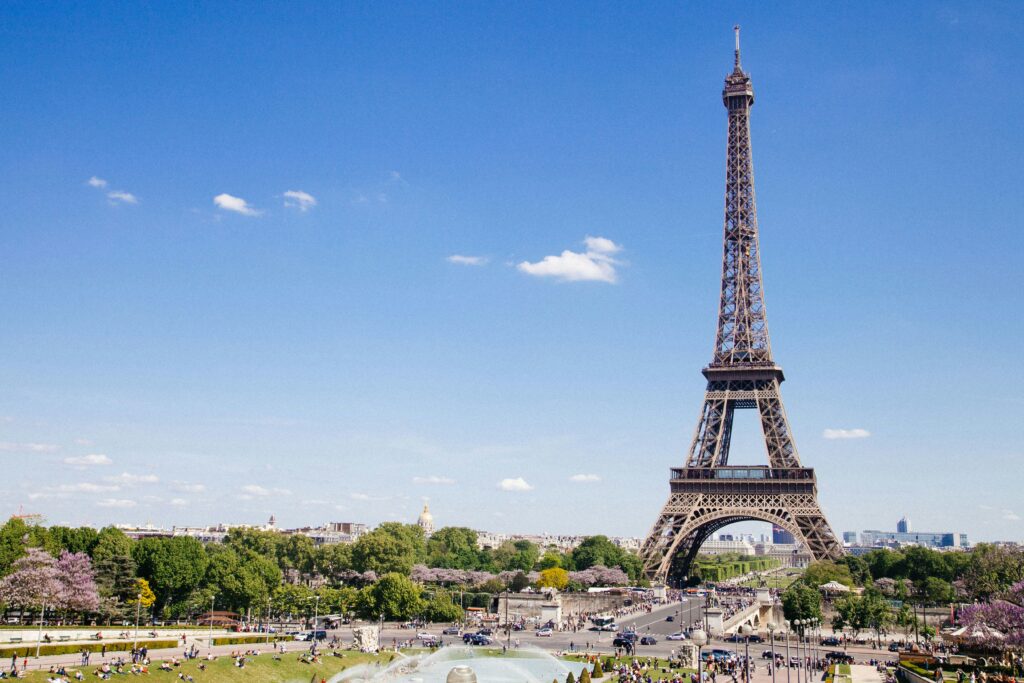
The most visited paid monument on earth and one of the most legitimately extraordinary things you can do in any city. The range covers the two meaningful choices: stairs to the 2nd floor ($16 — recommended, great physical experience, shortest queue) or summit by lift ($40 — the 276-meter view is genuinely different). The nightly light show from the Champ-de-Mars lawn below is free and happens every hour on the hour after dark — one of the best free spectacles in Europe. Both the visit and the light show are worth doing and together cost $16–$40 plus whatever you spend on the picnic blanket and the wine from the nearby market.
💡 Book online 60 days in advance — summit tickets for sunset sell out within hours during summer. For the light show from below: arrive at the Champ-de-Mars at 9:45pm, find a spot on the lawn, and watch the tower spark to life at 10pm. It costs nothing and looks exactly as good as from inside.
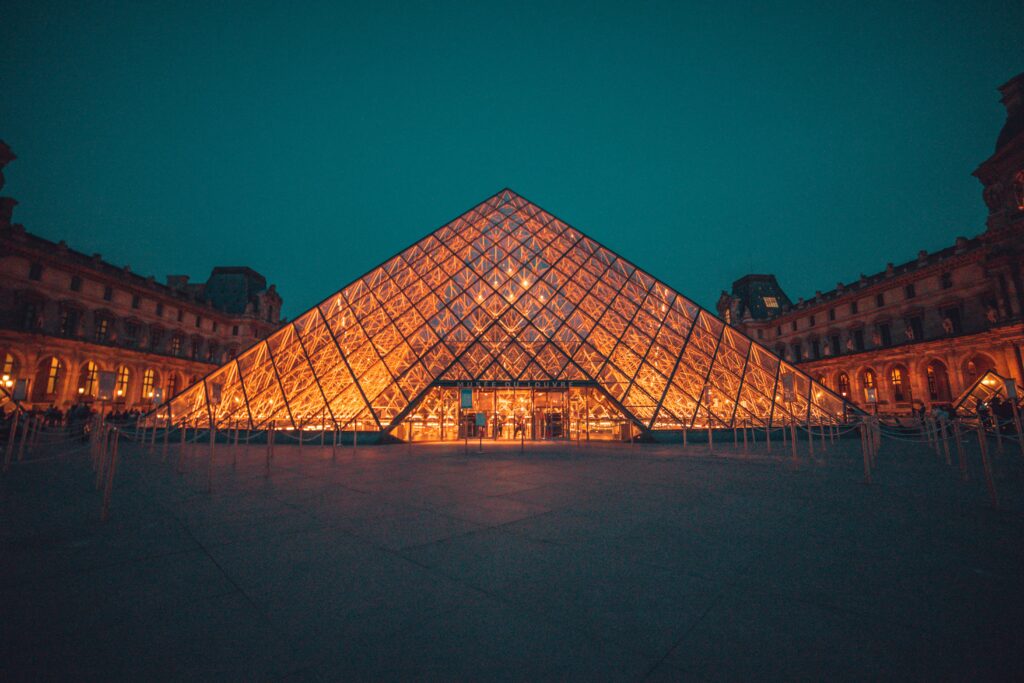
The largest museum on earth and home to the Mona Lisa, Venus de Milo, Winged Victory of Samothrace, and roughly 35,000 other works that would be the centerpiece of any other museum on the planet. A full visit requires 3–4 hours minimum and a willingness to accept that you will not see everything. The $35 admission for non-EU visitors is fair for what it delivers. The first Sunday of every month, entry is free — book your timed entry slot well in advance as free Sundays fill up weeks ahead. The Richelieu wing (French and Northern European painting and sculpture) is consistently less crowded than the Denon wing where the Mona Lisa lives.
💡 Enter via the Porte des Lions entrance (rue du Carrousel) rather than the main Pyramid — the queue is shorter. Start in the Richelieu wing and work toward the Italian galleries — you’ll arrive at the Mona Lisa with context rather than confusion. Friday evenings (until 9:45pm) are the least crowded weekday option.
The world’s best collection of Impressionist and Post-Impressionist art — Monet, Renoir, Degas, Van Gogh, Cézanne, Seurat — housed in a converted 1900 railway station whose architecture is itself worth the ticket price. The Orsay is more manageable than the Louvre: 2–3 hours covers the essential collection, the crowds are lighter, and the context of the building makes every gallery feel intentional rather than encyclopedic. The upper floor, with the Impressionists and the giant clock windows, is one of the great museum experiences in the world. At $18, it’s the best value single admission in Paris.
💡 Thursday evenings (until 9:45pm) are the Orsay’s quietest times. Book timed entry online — the walk-up queue can be 45 minutes on weekend mornings. The museum café on the upper floor serves lunch with a view of the Seine for $15–$22.
The most beautiful interior in Paris — a 13th-century royal chapel on the Île de la Cité with 1,113 stained glass panels covering 6,500 square feet of wall space, depicting scenes from the Bible in colors that look backlit even on a gray day. Built in 1248 by Louis IX to house relics from the Passion of Christ and completed in under 33 months, it remains one of the supreme achievements of Gothic architecture. At $13 and a 45-minute visit, it is the most efficient spend in Paris per unit of extraordinary. Go before the Louvre, not after — this should reset your expectations of what a medieval building can look like.
💡 The chapel is next to the Conciergerie on the Île de la Cité — combine both in a morning for $22 total using a combined ticket. Go early — the chapel fills up and the upper chapel has limited space. Sunny mornings produce the most extraordinary light through the windows.
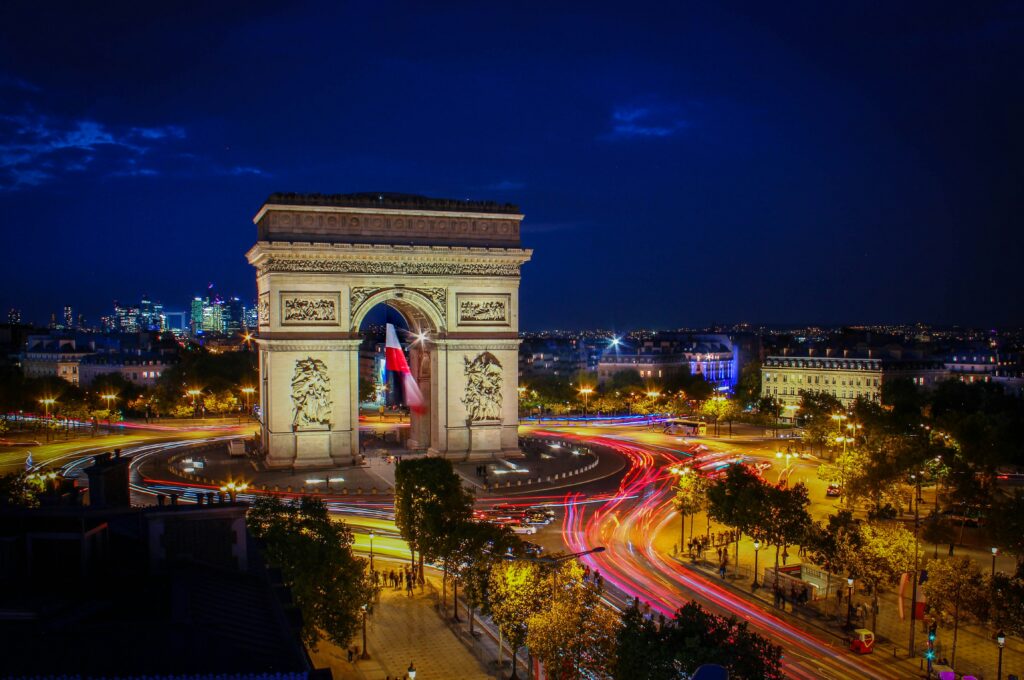
The Arc de Triomphe commands the top of the Champs-Élysées — 12 roads radiating outward like spokes from the center of Haussmann’s Paris. The rooftop observation deck is reached by 284 steps and gives you the view of the Haussmann plan that no other viewpoint replicates: the straight lines of the boulevards, the Second Empire rooflines, the Eiffel Tower in the distance. At $15, it is the cheapest paid viewpoint in central Paris and arguably the most architecturally informative. Included in the Paris Museum Pass.
💡 Go at dusk — the Champs-Élysées lights up at sunset and the view of the traffic circle 50 meters below is genuinely hypnotic. The tunnel underpass (accessed from the Champs-Élysées metro station) is the only safe way to reach the Arc — do not try to cross the road.
The best breakfast in Europe costs under $5 and is available on virtually every street in Paris. A croissant ($1.50), a pain au chocolat ($1.80), and an espresso ($2.00) eaten standing at a zinc bar next to commuters is the authentic Paris morning — the one that the $35 hotel breakfast exists to simulate at ten times the price. The standard at any neighborhood boulangerie in Paris is genuinely high: French law tightly regulates the definition of an artisan boulangerie and the bread must be made on the premises. There are around 35,000 of them in France. You will not have a bad croissant.
💡 Avoid hotel breakfasts unless specifically included in the rate — paying $20–$35 for a hotel breakfast in Paris when the boulangerie around the corner costs $4 is the single most consistent budget mistake visitors make.
The prix fixe lunch — two or three courses at a fixed price — is how Parisians eat well without thinking about it, and it is the best food value in Western Europe. For $18–$28 you get a starter, a main, sometimes a dessert, and often a glass of wine or a coffee. The cooking is serious French bistro food — duck confit, steak tartare, sole meunière, crème brûlée — not a tourist approximation. The trick is the same as everywhere: walk two blocks from any major landmark before you sit down. The bistros surrounding the Louvre or Notre-Dame charge $40–$55 for a prix fixe that costs $22 four blocks away.
💡 Look for the handwritten chalk board menu with two or three options per course. If the menu has photos or is available in five languages, walk on. The best bistro lunch in Paris involves the waiter explaining the daily specials in French while you nod and point — it always works out.
A 70-minute cruise on the Seine from the Pont de l’Alma past Notre-Dame, the Musée d’Orsay, the Louvre, and the Île de la Cité. The glass-roofed boats give you an unobstructed look at Paris from the water — the Eiffel Tower from beneath, the cathedral from the river, the Pont Neuf from mid-channel. It is tourist infrastructure, unambiguously, but it is also genuinely beautiful and provides spatial context for the city that walking cannot replicate. At $18–$22, it belongs in the itinerary of any first Paris visit. The evening cruise, as the city lights up, is the better option.
💡 The evening departures (7pm–10pm) are significantly better than daytime — the Eiffel Tower light show is visible from the water at 10pm, the city is illuminated, and the temperature is comfortable. Book online to skip the dock queue.
The Palace of Versailles — Louis XIV’s 700-room monument to absolute monarchy — is 35 minutes from Paris by RER C train and costs $7 round trip. Palace entry is $22. The Hall of Mirrors alone justifies the trip: 73 meters of golden arches, crystal chandeliers, and ceiling paintings commissioned by the Sun King to narrate his own greatness. The gardens — 800 hectares of formal French landscape designed by André Le Nôtre — are free with palace entry. Budget a full day: the palace, the gardens, the Grand Trianon, the Petit Trianon with its fake peasant village built for Marie Antoinette. It is the most excessive thing humans have ever built and it is fascinating.
💡 Take the RER C from Paris Austerlitz, Gare de Lyon, Saint-Michel, or Musée d’Orsay stations — all terminate at Versailles Château Rive Gauche, a 10-minute walk from the main gate. Arrive before 9:30am; the Hall of Mirrors is manageable before 11am and overwhelming after noon.
Chef Bertrand Grébaut’s Septime in the 11th arrondissement is the restaurant that defined the Parisian neo-bistro movement — seasonal, market-driven, technically precise, and anti-pretentious in a way that manages to be more impressive than the grandeur it rejects. The tasting menu runs $90–$130 with a wine pairing that is among the most intelligent in the city. It has held a Michelin star while explicitly not caring about Michelin stars, which is its own kind of achievement. At this price point in Paris, you are getting something that would cost $200+ in London or New York. Book two to three weeks ahead; it fills immediately.
💡 Reservations open on Mondays at noon for the following week — set a reminder. The lunch service is slightly shorter and $20–$30 less per person. Septime La Cave (the wine bar across the street) serves excellent small plates for $40–$60/person without a reservation.
The Moulin Rouge has been running in Montmartre since 1889 — the same building, the same red windmill, the French cancan that Toulouse-Lautrec immortalized in paint. The show is a genuine spectacle: 60 Doriss Girls, original costumes, live orchestra, and the particular Parisian combination of glamour and absurdity that makes it both kitsch and extraordinary. The $130–$200 price covers the show plus a half-bottle of champagne at your table. It is expensive, unambiguously. It is also the most theatrically extravagant 90 minutes you will spend in Paris, and you will almost certainly describe it to someone in the next month.
💡 Book directly through the Moulin Rouge website at least 3–4 weeks ahead — the best seats go early. The 9pm show is slightly shorter than the 11pm show; both are identical in quality. Dress smartly — the venue takes it seriously and so should you.
Learning to make croissants, coq au vin, or a proper soufflé from a French chef in a Paris kitchen is one of the most enduring things you can do in the city — you bring the technique home and you cook it for your friends and it still tastes like Paris. The Le Cordon Bleu day workshops start at $100 and cover the fundamentals of French technique in a half-day session. Independent cooking schools in the Marais and Saint-Germain run $120–$180 for market-to-table experiences: you shop at the morning market with the chef, then cook and eat what you bought. The skill travels. The memory travels.
💡 La Cuisine Paris (4th arrondissement, steps from the Seine) runs well-reviewed croissant and French pastry workshops for $100–$130 that include all ingredients and eating what you make. Book 2–3 weeks ahead; small-group classes fill quickly.
Worth It / Skip It
Don’t Make These Mistakes
Not booking the Eiffel Tower and Louvre in advance. Both require timed entry tickets booked online. Walk-up tickets for the Eiffel Tower summit are essentially unavailable in summer — they sell out days or weeks ahead. The Louvre’s timed entry system means that even if tickets are technically available on the day, the entry windows you want will be gone. Book both as soon as you know your dates, 30–60 days ahead. The experience of turning up and finding no tickets is genuinely avoidable and genuinely ruins a day.
Eating every meal near the major monuments. Paris has two food economies: the tourist circuit around the Louvre, Notre-Dame, the Eiffel Tower, and the Champs-Élysées, where a mediocre lunch costs $40–$55; and everything else, where the same budget buys significantly better food at a proper bistro. The Champs-Élysées is one of the worst value streets for food in Europe. The bistros around Oberkampf in the 11th, the trescas of the 18th — all excellent, all priced for people who live in the city.
Renting a car or taking taxis everywhere. Paris traffic is genuinely severe, parking costs $30–$60/day in central arrondissements, and taxis from CDG run $55–$70. The RER B train from CDG to central Paris takes 35 minutes and costs $12. The metro connects every major sight in the city for $10/day. Uber and Bolt exist for rainy days and late nights. A car in Paris is an expensive inconvenience for tourists — the metro is faster to virtually every destination you need.
Skipping the first-Sunday-free museum opportunity. On the first Sunday of every month, all French national museums — including the Louvre ($35), Musée d’Orsay ($18), Centre Pompidou ($18), Musée de Cluny ($12), and others — are free. If your Paris dates happen to include a first Sunday, plan your museum day around it and save $60–$100 per person. Book a timed entry slot online in advance; free Sundays fill up weeks ahead.
VacayValue Scorecard — Paris
Packing List — Paris
Every Sunday: One Destination. One Honest Take.
Join travelers who plan smarter. One email per week — real costs, specific advice, no filler.
Paris Is Not As Expensive As Its Reputation — But Only If You Know Which Paris You’re Visiting.
The expensive Paris — palace hotels, grand restaurants, shopping on the golden triangle — is real and genuinely costs a fortune. But that’s not the only Paris available. The Paris of $1.50 croissants and $10 metro day passes and free Impressionist museums and $22 prix fixe lunches is also real, also extraordinary, and available to anyone willing to walk two blocks from a landmark before sitting down to eat.
The Louvre is one of the greatest collections of art on earth and it costs $35 — or nothing on the first Sunday of the month. Sainte-Chapelle is one of the most beautiful buildings in human history and it costs $13. Walking the Seine from Notre-Dame to the Eiffel Tower and back costs nothing. The croissant at the boulangerie two doors from your hotel costs $1.50 and is better than anything you will eat today at home.
Go in May or September. Stay in the 10th or 11th. Eat at the boulangerie every morning. Book your Eiffel Tower tickets 60 days out. Watch the light show from the lawn. Do all of this and Paris will cost you less than you expected and give you more than you’ve been told.