⚖️ Comparison · Cultural Travel · Europe
Athens vs. Florence: Europe’s Two Greatest Cultural Value Cities, Compared
Athens vs Florence is the most interesting tie in travel. Both score 8.2 on VacayValue. Every single category row is identical. The cities are not.
⏱ 12 min read
✅ Updated April 2026
💰 Prices verified April 2026
Cultural Travel
Mediterranean
Value Showdown
VV Score 8.2 Athens
VV Score 8.2 Florence

Athens, Greece

Florence, Italy
The numbers are identical. Five category rows, five tied scores, one shared VacayValue rating of 8.2. Which makes this the most genuinely difficult comparison we’ve run — because the tie is real, and so is the difference.
Athens and Florence both earn their 8.2 scores, but they earn them from completely different directions. Athens delivers its value through affordability — cheaper hotels, cheaper food, and landmark admission that costs a fraction of what comparable European sites charge. Florence delivers its value through concentration — more Renaissance masterpieces per city block than anywhere on earth, in a city compact enough to walk end to end in an hour. Same score. Completely different trip. Here’s how to figure out which one belongs on your itinerary first.
Athens, Greece
8.2
VacayValue Score
Cheaper Daily
Ancient World
Florence, Italy
8.2
VacayValue Score
Art Density
Renaissance
Flights — Getting There
Both are transatlantic routes with connections — neither city has meaningful nonstop service from most US cities. But the routing experience differs enough to factor into your planning.
✈ Round-Trip Flights from Major US Hubs
Athens (ATH)
$480–$720 per person RT
Athens is a major European hub — more airlines serve ATH than FLR, giving you better fare competition. Turkish Airlines via Istanbul, Lufthansa via Frankfurt, and Air France via Paris are reliable options from most US cities. Total travel time typically 12–16 hours depending on departure city and connection.
Carriers: Turkish Airlines · Lufthansa · Air France · SAS · TAP
Travel time: 12–16 hrs with connection
Florence (FLR / PSA / BLQ)
$520–$800 per person RT
Florence’s Peretola airport (FLR) is small with limited US connections — most travelers fly into Rome (FCO) or Pisa (PSA) and transfer. Pisa is 70 minutes by train; Rome is 90 minutes on the fast train. Build this into your logistics. Some fly directly to Bologna (BLQ) which adds a short train leg. Slightly pricier fares overall due to the indirect routing.
Carriers: Lufthansa · ITA Airways · SWISS · British Airways
Travel time: 11–15 hrs + transfer to Florence
🤝
Category Verdict — Flights
Draw — Both Score 3.5
Athens wins on fare competition; Florence wins on nothing — the airport routing adds real friction. Both score identically.
💡 Booking Tip
If connecting through Rome for Florence, consider building in a night there — it breaks up the journey and Rome to Florence on the high-speed train takes 90 minutes. For Athens, search Turkish Airlines specifically: their Istanbul hub often produces the sharpest transatlantic fares to ATH.
Where to Stay — Dollar for Dollar
Both cities score 4.0 on Accommodation Value — but Athens reaches that score by being cheaper, while Florence reaches it by delivering more per dollar at the mid-to-high tiers. Rates verified April 2026. Both cities use the Euro.
🏨 Accommodation — Nightly Rate Per Room
Athens · Budget
$50–$85/night
Excellent guesthouses and boutique hostels around Monastiraki and Psiri — often with rooftop Acropolis views at prices that feel unreasonable for what you get. The City Circus and The Stanley are the benchmark properties at this tier.
Florence · Budget
$80–$120/night
Budget options exist but compete with massive tourist demand — especially April through October. Hotel Ferretti and YellowSquare deliver clean, well-located rooms. Expect smaller spaces than Athens at the same price point.
Athens · Mid-Range
$90–$150/night
Genuinely beautiful boutique hotels, many in historic Plaka with Acropolis views. Electra Palace Athens and New Hotel are the tier benchmarks — quality that would cost 40% more in Florence.
Florence · Mid-Range
$130–$210/night
Florence’s mid-range genuinely delivers — boutique hotels in converted Renaissance palazzos with frescoed ceilings and Arno views. Hotel Lungarno and Soprarno Suites operate at this tier and are worth every euro.
Athens · Luxury
$250–$500+/night
Hotel Grande Bretagne is Athens’ grand dame — Parliament views, impeccable service, and a rooftop pool with the Acropolis as backdrop. Grand Hyatt Athens is the newer competitor at a slightly lower rate.
Florence · Luxury
$400–$1,000+/night
The Four Seasons Firenze is one of Italy’s great hotels — a 15th-century convent with private gardens, a heated pool, and rooms that feel more like private apartments. Villa Cora and Hotel Savoy complete the top tier.
⚖️
Split Verdict — Accommodation Value
Athens on Price · Florence on Character
Athens runs 30–40% cheaper at every tier. Florence delivers Renaissance palazzo stays that Athens simply cannot match. Both score 4.0.
Food & Drink — Two Tables Worth Traveling For
Both cities score 4.5 on Food Affordability — high but not perfect, and for the same structural reason: good value overall, with some aspirational dining that costs real money. Where they differ is in what the food culture feels like at ground level.
🍽 Food & Drink — Typical Meal Costs
Athens
Souvlaki / street food
$2.50–$5
Taverna dinner
$12–$22 per person
Daily food budget
$20–$40 per person
Athens’ food culture is outdoor, communal, and deeply affordable. The Monastiraki souvlaki strip is one of the great cheap-eat institutions in Europe. A mezze spread of grilled octopus, tzatziki, saganaki, and fresh bread for two people can land under $35 with wine. The food punches well above its price.
Florence
Panino / market lunch
$5–$9
Trattoria dinner
$18–$35 per person
Daily food budget
$30–$60 per person
Florence’s food ceiling is higher — a bistecca alla Fiorentina for two is an event, not just a meal. The Mercato Centrale lets you eat brilliantly and cheaply at lunch. Evening trattorias near Santo Spirito still feel local and fair. The trap is the tourist corridor around the Duomo, where €20 will buy you a disappointing pizza and regret.
⚖️
Split Verdict — Food Affordability
Athens on Cost · Florence on Ceiling
Athens feeds you better for less. Florence’s best meals are among Europe’s finest — but you pay accordingly. Both score 4.5.
Getting Around — The Gap You Don’t Expect
Both cities are walkable at their cores and well-served by transit. But Florence’s historic center is dramatically more compact — you can walk from the Uffizi to the Accademia to Ponte Vecchio to Santa Croce without needing transit at all. Athens requires more intentional navigation.
🚇 Transit — Daily Cost Per Person
Athens
$5–$12 /person/day
The Athens Metro (Lines 1, 2, 3) is clean, fast, and covers all major tourist zones. A single ticket is €1.50; 24-hour pass is €4.50. Monastiraki station puts you within a 10-minute walk of the Acropolis, Ancient Agora, and flea market. Taxis via Beat (Athens’ Uber equivalent) fill the gaps affordably.
💡 The Athens Metro runs to the airport — skip the taxi and save €35 each way.
Florence
$3–$8 /person/day
Florence’s historic center is so compact that most visitors barely use transit. The Uffizi, Accademia, Duomo, and Ponte Vecchio are all within a 20-minute walk of each other. Buses and the new T1 tram cover wider areas. You’ll spend less on transport here than almost any major European city.
💡 The T1 tram connects the airport to Santa Maria Novella station in 20 minutes — €1.70, far cheaper than a taxi.
🏆
Edge — Getting Around
Florence
Florence’s walkability is genuinely exceptional — most visitors spend almost nothing on transport. Athens’ metro is excellent but you’ll use it more.
Best Time to Visit — Does Your Window Match?
Both cities share similar Mediterranean rhythms — spring and fall are the sweet spots, summer is peak crowds and heat, winter is quiet but manageable. The nuances within that pattern matter for planning.
📅 Seasonal Timing — When to Go
Apr – Jun & Sep – Oct
Warm but not brutal (70–85°F), low humidity, manageable crowds. May is arguably Athens’ finest month — wildflowers on the Acropolis slopes and long evenings for outdoor dining. October is similarly excellent and cheaper.
Apr – Jun & Sep – Oct
Virtually identical window. April through early June is glorious — warm enough to eat outdoors, manageable museum lines. September and October see summer crowds thin while the light turns golden over the Arno. Book the Uffizi well ahead regardless of season.
Nov – Mar
Cool and quiet (50–65°F), with Acropolis admission dropping to €15 (low season rate). Rain is possible but infrequent. The city functions normally — museums, restaurants, nightlife all running. Fewer tourist scams, shorter queues, better rates.
Nov – Mar
Chilly (40–55°F) and occasionally rainy, but Florence in winter has a quieter, more local feel that many prefer. The Uffizi is practically yours. Some smaller restaurants close for a week or two, but the essential city is fully operational.
Jul – Aug
Extreme heat (90–100°F+), maximum crowds, and a cap on Acropolis visitors that can leave same-day ticket buyers stranded. The city still works but demands early starts and midday retreats. Book Acropolis tickets weeks ahead if you must travel in summer.
Jul – Aug
Hot (88–95°F), intensely crowded, and peak hotel prices. The Uffizi, Accademia, and Duomo climb are all significantly more congested. Many Florentines themselves leave in August. If this is your only window, book everything months in advance and start every day before 9am.
💡 The Timing Decision
April through early June is the clearest overlap — both cities are simultaneously at or near their best. If your window is July or August, Florence suffers more from heat and crowds than Athens does, simply because Florence’s compact center concentrates tourists more intensely. If winter is your only option, both cities handle it well — Athens edges it for warmth, Florence for quiet.
Experiences & Activities — What Your Days Look Like
This is the category that most clearly reveals the character difference between these two cities. Athens gives you the ancient world — open-air, often free, requiring physical stamina. Florence gives you the Renaissance — indoors, requiring advance booking, and dense enough that you can see the world’s greatest paintings before lunch.
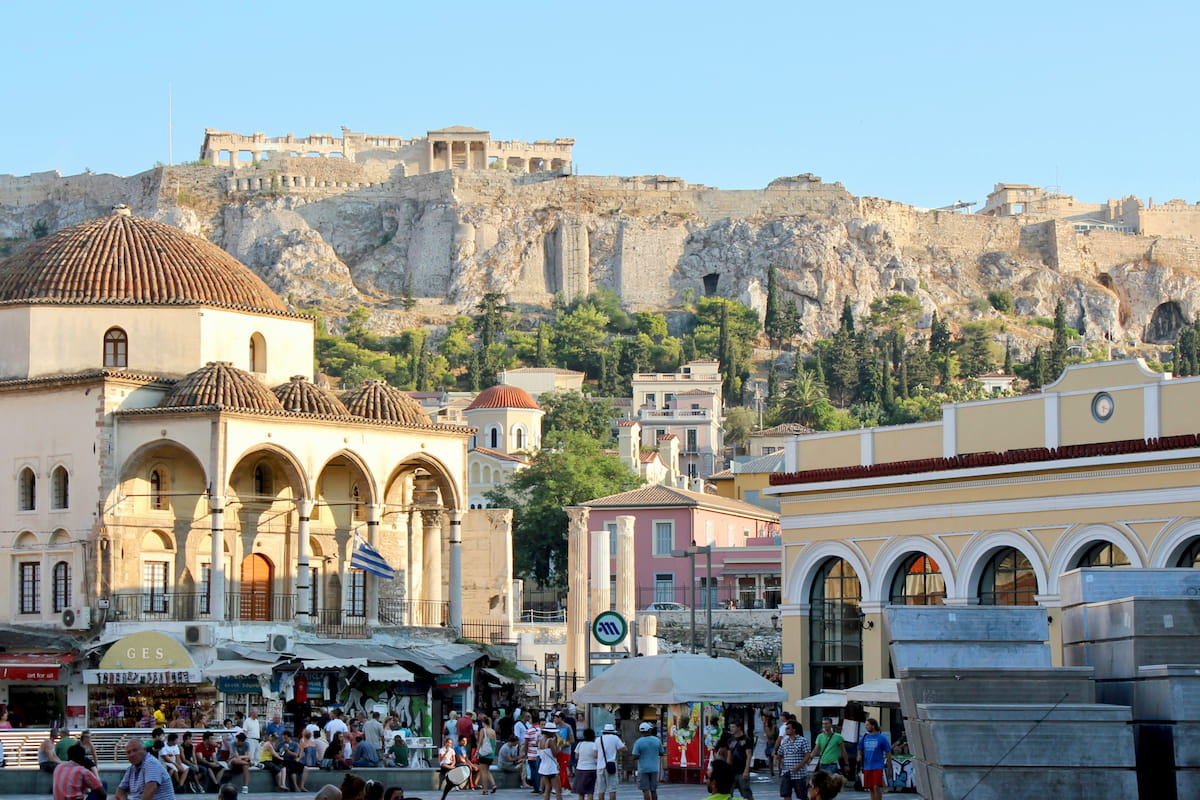
Athens, Greece

Florence, Italy
🎯 Experiences — What You’ll Actually Do
Athens · Activity Cost: 3.5
Athens’ big-ticket experiences are outdoors and ancient. The major challenge: as of April 2025, individual site tickets are required for each location (the combination pass was discontinued). The Acropolis alone now costs €30 ($33) at peak season. That’s real money — but it’s still less than the Uffizi, and the site is vastly larger.
Acropolis (peak season)$33 (€30)
Acropolis Museum$17 (€15)
Ancient Agora$11 (€10)
Cape Sounion day trip$30–$45
Plaka / Monastiraki wanderFree
Florence · Activity Cost: 3.5
Florence’s top experiences are almost all indoors and require advance booking — especially in spring and summer. The Uffizi and Accademia are the essential two, and together they’ll run $60+ per person before the mandatory booking fees. But what they contain is inarguably extraordinary: the Botticellis, the David, the Caravaggios.
Uffizi Gallery$28 (€25) + booking fee
Accademia (Michelangelo’s David)~$24 (€22) + booking fee
Duomo dome climb$30 (€27)
Palazzo Pitti$22 (€19)
Piazzale Michelangelo viewsFree
⚖️
Split Verdict — Experiences
Athens: Ancient Outdoors · Florence: Renaissance Indoors
Different eras, different formats, different planning demands. Both score 3.5 — and both earn it.
What Your Trip Will Cost — 2 Adults, 5 Nights
All costs in USD. Includes round-trip flights from a major US hub, accommodation, food, local transport, and a realistic mix of paid experiences. April 2026 verified pricing.
🧮 5-Night Trip Total — 2 Adults
Athens, Greece
flights, hotel, food, transit, sites
Florence, Italy
flights, hotel, food, transit, museums
Athens Savings
~$400–$500
~$500–$700
~$1,500–$6,000
VacayValue Head-to-Head Scorecard
Overall VacayValue Score
Every row is identical. The decision isn’t about the scores — it’s about which version of Europe you want.
Before You Go — Practical Essentials
VisaUS passport: 90 days visa-free (Schengen). No application needed.
CurrencyEuro (€). Cards accepted widely in tourist areas. Carry some cash for street food and market stalls — many vendors are cash-only.
Best TimeApril–June and September–October. See timing section above.
Watch ForThe “closed today” scam near the Acropolis — strangers claiming the site is shut and offering to take you to a family shop instead. It’s never closed during listed hours. Book Acropolis tickets online in advance at peak season.
VisaUS passport: 90 days visa-free (Schengen). Same zone as Greece — combined days count toward the 90-day limit.
CurrencyEuro (€). Cards accepted nearly everywhere. Florence’s tourist infrastructure is sophisticated — you’ll rarely need cash, though small cafes and market vendors appreciate it.
Best TimeApril–June and September–October. See timing section above.
Watch ForThe restaurant corridor immediately around the Duomo — overpriced and tourist-oriented. Walk 10 minutes toward Santo Spirito or Santa Croce for restaurants where locals actually eat. Book the Uffizi and Accademia well in advance — same-day tickets are often unavailable April through September.
Pick Your City — The Deciding Factors
The scorecard ties. The choice doesn’t. Here are the specific conditions that tip each city.
Choose This City If…
Athens
VV 8.2 · ATH
→Ancient history is the primary draw. Nothing else on earth offers the Acropolis, Ancient Agora, and Temple of Hephaestus within an hour’s walk.
→Budget is a real constraint. Athens runs $400–$700 cheaper per person for a 5-night trip at the budget tier.
→You want a rawer, less polished city. Athens rewards travelers who embrace spontaneity — it’s less organized than Florence, and more alive for it.
→Greece’s islands are on the itinerary. Athens is the gateway — fly in, see the city for 3–4 days, then ferry to Santorini, Mykonos, or Crete.
→You prefer outdoor experiences. Athens’ major sites are open-air — the Acropolis, the Agora, the Panathenaic Stadium. Rain-day plans matter more here than in Florence.
Full Athens Guide →
Choose This City If…
Florence
VV 8.2 · FLR
→Renaissance art is the reason you travel. The Uffizi, Accademia, and Palazzo Pitti together form the greatest concentration of Renaissance masterpieces on earth.
→Walkability and compactness matter to you. Florence’s historic center is small enough to cover on foot — no transit decisions needed for most of your day.
→You’re combining with other Italy destinations. Rome is 90 minutes by fast train; Siena, Pisa, and the Cinque Terre are all easy day trips or overnights.
→Food quality at the top end is a priority. A proper bistecca alla Fiorentina or a tasting menu at a Michelin-starred trattoria is genuinely in another tier from anything Athens offers.
→You prefer a more polished, organized experience. Florence is deeply tourist-ready — excellent signage, English everywhere, and a city that has figured out how to handle visitors at scale.
Full Florence Guide →
Athens vs Florence — Common Questions
Is Athens or Florence better for first-time visitors to Europe?
Both are outstanding first-Europe trips. Athens is better if ancient history is the draw and you want a more raw, affordable Mediterranean experience. Florence is better if Renaissance art is the priority — nowhere on earth concentrates more masterpieces per city block. The deciding factor is almost always which era of history excites you more: ancient Greece or the Italian Renaissance.
Is Athens cheaper than Florence?
Yes, meaningfully so on accommodation. Budget hotels in Athens average $50–$85/night versus $80–$120 in Florence for comparable quality. A taverna dinner in Athens runs $12–$22 per person; a trattoria in Florence runs $18–$35. Flights from the US are similar for both. Over a 5-night budget trip, Athens runs roughly $400–$600 per person cheaper — which adds up to a real difference in what you can do with the remaining budget.
Is it worth visiting both Athens and Florence on the same trip?
Yes — and the routing is straightforward. Athens and Florence are roughly 2 hours apart by direct flight, making a combined Greece-and-Italy itinerary very manageable. The cities are so different in character (ancient vs. Renaissance, raw vs. polished) that visiting both feels like two distinct trips, not repetition. Allow at least 4–5 nights in each city to do either justice — 3 nights in Florence is survivable but tight for the Uffizi, Accademia, and Duomo.
Do US citizens need a visa for Greece or Italy?
No visa required for either. Both Greece and Italy are Schengen Area members, and US passport holders receive 90 days visa-free across the entire Schengen Zone. Important note: the 90 days covers your combined total across all Schengen countries, not separately for each. Both countries use the Euro — no currency switch if you visit both on the same trip.
Is Athens or Florence safer for tourists?
Both are safe by European standards. Athens has a reputation for petty theft in the Monastiraki and Omonia areas — keep bags close on crowded metro platforms and in the flea market. The “closed today” scam near major sites is common but harmless if you know to ignore it. Florence is very safe, with pickpockets concentrated around the Duomo and Ponte Vecchio in summer. Neither city presents serious safety concerns for attentive travelers, including solo women.
Still Deciding? Get the Full Breakdown.
Every week we cover one destination in depth — real costs, honest context, and the one thing most guides get wrong. No filler.
VacayValue Verdict
The Score Is a Perfect Tie. The Right City Is Yours Alone.
Athens and Florence are two of the most extraordinary cities in the world, and VacayValue’s methodology returns the same number for both because it should. They deliver equivalent value — just from entirely different directions. Athens is the cheaper trip, the rawer trip, the trip where you stand on a 2,500-year-old hill and feel the weight of the civilization below you. Florence is the more polished trip, the art-saturated trip, the trip where you walk into a room and find yourself standing in front of Botticelli’s Birth of Venus thinking about how long you’ve wanted to see it.
If your budget is the constraint, Athens wins clearly — you get more days, more experiences, and more meals for the same money. If you’re traveling specifically for art and the Italian Renaissance is what draws you, no budget argument overrides what Florence contains. And if the answer is genuinely “either would be incredible” — it is, and you’re allowed to just pick the one that sounds better right now.
“Every row in the scorecard is tied. The decision has nothing to do with value — both cities earn their 8.2 honestly. It has everything to do with which version of Europe you’ve always wanted to see first.”
Book either city. Come back for the other one. Both trips will stay with you.
Athens
8.2
VacayValue Score
Florence
8.2
VacayValue Score