
Florence 2026: The Renaissance Is Free. The Museums Are Not
The Uffizi is $27. Michelangelo’s David is $22. The dome climb is $32. A trattoria dinner with wine is $25. Florence is more affordable than people think — if you know the real numbers.
You turn a corner in the Oltrarno and the dome appears without warning — eight-sided, terracotta-red, impossible, filling the gap between two buildings like it was placed there on purpose. Brunelleschi finished it in 1436, the largest dome in the world, and for six hundred years nobody has built anything larger out of brick. Florence does this constantly. It ambushes you with the greatest things humans have ever made.
Florence is dense in a way that only a few cities on earth manage — dense with art, history, and some of the best eating in Italy. The Uffizi holds Botticelli’s Primavera and Birth of Venus. The Accademia holds Michelangelo’s David. The Duomo complex holds the greatest dome in the world. All of this is within a twenty-minute walk of each other in a city of 370,000 people. The honest budget reality: the big three attractions cost around $80 per person combined, but the streets, markets, churches, piazzas, and trattorias that give Florence its character are largely free or $5. Budget those museum tickets correctly and the rest of the trip is surprisingly affordable.
What’s In This Guide
📅 Best Time to Visit Florence
Best months: May and September–October. May delivers Florence at its most vivid — spring light, outdoor dining, pre-peak pricing. September rivals it: harvest season, returning locals, golden evening light on the stone buildings. Biggest pitfall: August. Many of the neighborhood trattorias Florentines actually eat at close for 2–3 weeks around Ferragosto (August 15). You end up in a city of tourists eating at tourist-facing restaurants. If August is unavoidable, book everything — including restaurants — months in advance.
Where to Stay in Florence
Florence’s historic center is compact enough that neighborhood choice matters less than in larger cities — you’re rarely more than 15 minutes’ walk from anything important. The main zones: the Duomo area (most central, most expensive, most tourist-facing), Oltrarno (south of the Arno — the most characterful and local-feeling neighborhood, slight walk to main museums), and Santa Croce (east of center, slightly calmer, good local restaurant scene). Italian tourist tax ($3.85–$9.30 per person/night depending on hotel star rating) is charged at checkout and is not included in advertised room rates. All prices verified March 2026.
Consistently one of the best-reviewed budget stays in Florence, and for good reason — a hostel with a rooftop pool is a rare find in any Italian city, let alone one five minutes from the Duomo. Private rooms are available alongside dormitory options, keeping the social atmosphere without sacrificing privacy for couples or solo travelers who want a door that locks. The location near Santa Maria Novella train station makes arriving and departing straightforward, and the walk to the Uffizi, Accademia, and Piazza della Signoria is under fifteen minutes. At $50–$90 for a private room, this genuinely overdelivers for the price point.
Occupying a historic building steps from Piazza della Signoria — Florence’s outdoor sculpture museum and civic heart — Hotel Davanzati is managed by the Davanzati family and has the attentive service quality that distinguishes family-run Italian hotels from chain properties. The Uffizi is a two-minute walk; the Ponte Vecchio is five. Rooms are well-appointed in a warm Tuscan style without being over-designed. The hotel’s free aperitivo hour is a genuine budget win — complimentary drinks and snacks between 6 and 7pm that substitute nicely for a pre-dinner bar stop. At $100–$180, it sits in the best value corridor for central Florence.
Part of the Lungarno Collection — the Ferragamo family’s hospitality group — Portrait Firenze occupies a 14th-century palazzo directly on the Arno riverbank, with Ponte Vecchio visible from the upper rooms. The design balances historic Florentine architecture with contemporary restraint in a way that feels genuinely Florentine rather than generic luxury-hotel. The rooftop terrace bar at sunset, with the Ponte Vecchio and Vasari Corridor below, is one of the most civilized views in Italy. At $200–$450 per night, it competes directly with equivalent Paris or London properties at meaningfully lower prices.
Get Our Free Florence Trip Planner
Uffizi booking strategy, Oltrarno restaurant picks, day-trip guides to Siena and Cinque Terre. Free to your inbox.
15 Best Florence Experiences
Florence has one of the most striking splits between what’s free and what costs money of any city in the world. The piazzas, bridges, churches, markets, and streets — the lived environment of the Renaissance — are free. The museums that hold the Renaissance’s greatest output are paid, and the three main ones (Uffizi, Accademia, Brunelleschi Dome) cost around $80 per adult combined. That’s not a criticism — these are three of the most significant collections of Western art in existence. The key is budgeting correctly for the paid tier so the rest of the trip (which is mostly free and mostly excellent) doesn’t feel like an afterthought.
The civic heart of Florence for seven hundred years — the L-shaped piazza where the Medici wielded power, where Savonarola was burned at the stake in 1498, and where copies of Michelangelo’s David and Donatello’s Judith now stand under open sky. The Loggia dei Lanzi on the south side is an open-air sculpture gallery holding Cellini’s Perseus with the Head of Medusa (original, not a copy) and Giambologna’s Rape of the Sabine Women — two of the greatest sculptures of the 16th century, free to stand next to for as long as you like. The square itself is alive from morning until after midnight with locals and visitors, street performers, and the general orchestrated chaos of Italian public life.
💡 Sit at the base of the Neptune Fountain in the late afternoon when the crowds thin and the light turns golden. The Palazzo Vecchio’s crenellated tower catches the last light beautifully. This is the square where Florentines actually congregate — watch how differently locals use it versus tourists.
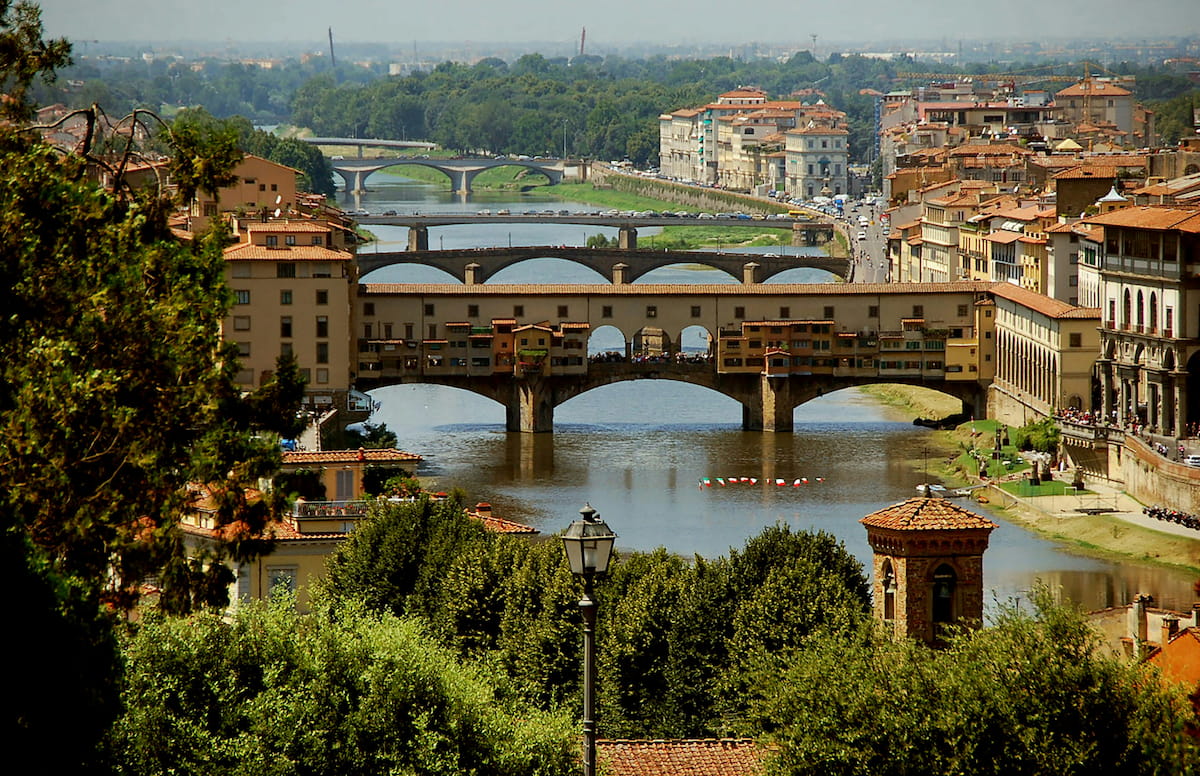
The oldest bridge in Florence, lined with goldsmiths’ shops since 1593 when Duke Ferdinand I expelled the butchers and fishmongers who had occupied it. The Vasari Corridor — the elevated private passageway Cosimo I built in 1565 so the Medici could cross the Arno without mixing with common citizens — runs directly above the shops. Cross at golden hour, then walk the Lungarno (riverside walkway) in either direction: Lungarno degli Archibusieri toward the Uffizi, or Lungarno Serristori toward the Oltrarno neighborhood. The light on the Arno at dusk is one of Florence’s defining images, entirely free to experience.
💡 The jewelry sold on Ponte Vecchio ranges from genuinely handmade artisan pieces to mass-produced tourist goods — they look similar and the price difference is enormous. If buying, ask the vendor whether the piece is made in-house. The shops that have been on the bridge for generations (many display their founding date above the door) are the ones worth your time.
A large terrace on the hill south of the Arno, a 20-minute walk or short bus ride from the center, holding a bronze copy of Michelangelo’s David and a panoramic view of the entire Florence basin: the Duomo and Bell Tower in the foreground, the Arno curving through the city, the hills of Fiesole behind, the Tuscan countryside beyond. Every evening, locals and visitors crowd the terrace wall to watch the sun set over the city. There are no words for it that aren’t inadequate. Come 45 minutes before sunset and claim a wall position. A bar at the terrace sells expensive drinks — bring your own wine from a nearby enoteca for the authentic local version of this experience.
💡 Walk up via the scenic staircase path (Viale Michelangelo, past the rose garden) rather than taking Bus 13 up — the views on the climb are excellent and the walk takes about 20 minutes from the Ponte Vecchio. Take the bus down afterward if your legs object.
Five minutes above Piazzale Michelangelo, up a cypress-lined path, stands one of Italy’s most beautiful Romanesque churches — San Miniato al Monte, built between 1013 and 1207, with a geometric marble facade in white, green, and gold that has barely changed in eight centuries. The interior holds extraordinary medieval inlaid marble floors, a Renaissance tabernacle, and a 13th-century apse mosaic. The monks who live here still sing Gregorian vespers at 5:30pm daily in the crypt — one of the more quietly extraordinary experiences available in Florence, free and unhurried. The cemetery adjacent to the church contains the graves of notable Florentines, including Carlo Lorenzini (author of Pinocchio) and Swiss sculptor Arnold Böcklin.
💡 Time your visit to arrive at the church by 5:15pm and descend to the crypt for 5:30pm vespers. The monks sing in the low stone space for about 30 minutes. Photography is not permitted during the service. Afterward, the terrace in front of the church offers the same panoramic view as Piazzale Michelangelo but with almost no one on it.
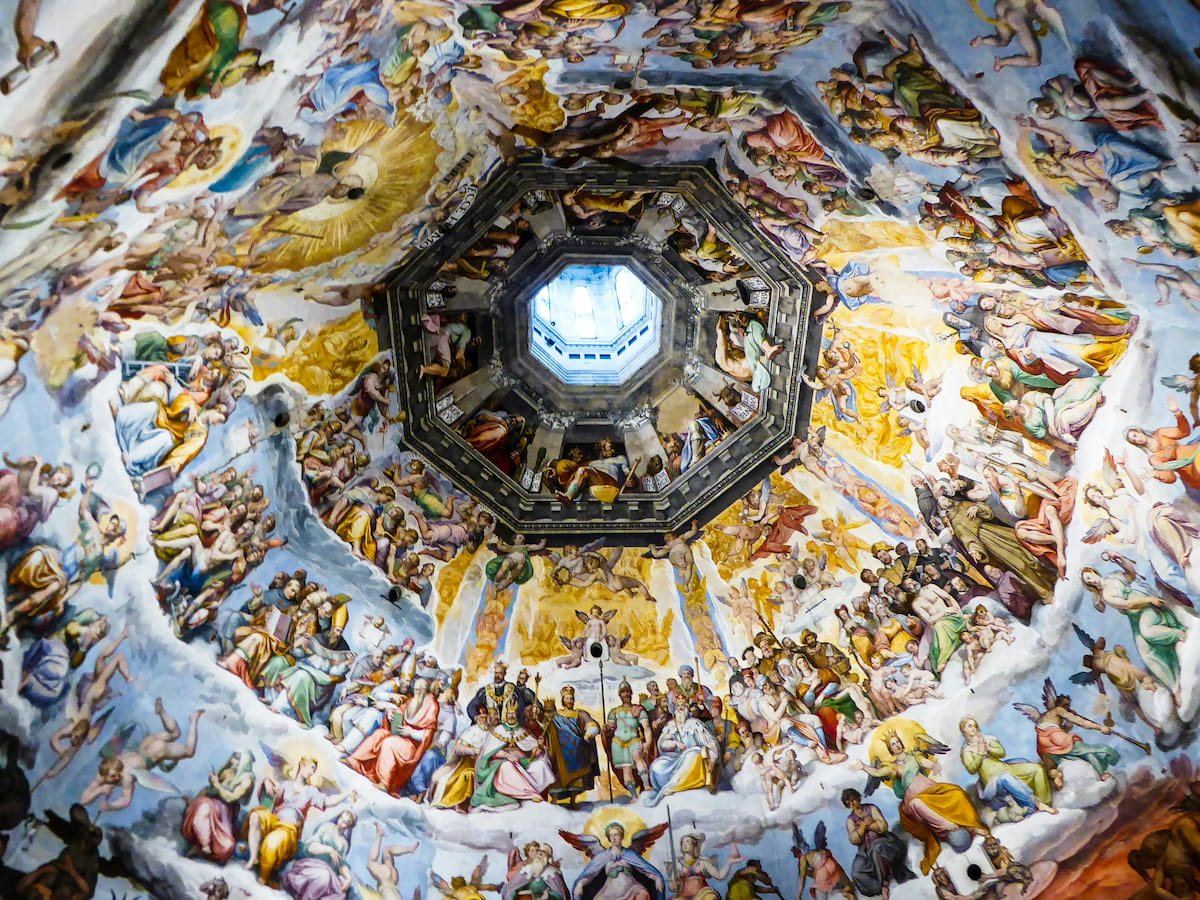
The cathedral interior itself — the vast Gothic nave, the frescoed interior of the dome (viewable from the floor, 90 meters below), the 15th-century stained glass, the clock above the entrance door that runs counterclockwise — is free to enter without any pass or ticket. The catch is the line: entry requires going through the main entrance, which can mean a 20–40 minute wait during peak hours. The dome climb, Bell Tower, Baptistery, and Museum require a Duomo complex pass (see paid section). But the cathedral interior alone, standing on the medieval marble floor and looking up at Vasari’s Last Judgment covering the inner dome, is worth every minute of the queue.
💡 The line for free cathedral entry is separate from the ticketed entrance for pass holders. Come at 8am when it opens or after 4pm when it’s quieter. Check the dress code before entering — shoulders and knees must be covered; scarves are available to borrow at the entrance if needed.
The non-negotiable. Commissioned by Cosimo I de’ Medici in 1560 to house the Florentine state offices (uffizi means “offices”), the building was converted into a public art gallery in 1769 — making it one of the world’s oldest museums. The collection spans from Byzantine gold-background paintings through the full arc of the Italian Renaissance: Giotto, Simone Martini, Botticelli’s Primavera and Birth of Venus (which you will see reproduced everywhere but still nothing prepares you for the original), Leonardo da Vinci’s Annunciation, Michelangelo’s Doni Tondo, Raphael, Titian, Caravaggio. Allow three to four hours minimum. Advance booking is essential — tickets sell out weeks ahead in peak season. The combined Uffizi + Pitti + Boboli Gardens 5-day pass ($44) is the best value if you plan to visit all three.
💡 Book via the official Uffizi ticket site (tickets.uffizi.it) not third-party resellers who add significant markups. The first-entry morning slot (before 9am at $29 with early booking) is the least crowded and is worth the slightly earlier alarm. The museum closes Mondays — plan accordingly.
The David requires some preparation of expectations: the copy in Piazza della Signoria is outdoors and surrounded by tourists. The original is in a purpose-built rotunda designed by architect Emilio de Fabris in 1873 specifically to display it under natural light from above. It is 17 feet tall, carved from a single block of Carrara marble between 1501 and 1504 by a 26-year-old Michelangelo, and it is — without question — one of the greatest things a human being has ever made. The Hall of Prisoners leading to the David room holds Michelangelo’s four unfinished Slaves, which are arguably more emotionally powerful than the finished statue because you can see the figures still struggling to free themselves from the marble. Standard entry $17; add $4.35 reservation fee if booking online.
💡 Book the first entry slot (8:15am when the museum opens) — the David rotunda is quieter for the first 30 minutes of the day than at any other time. Book at least 4–6 weeks ahead for peak season. The Accademia is closed Mondays, same as the Uffizi — do not plan both on consecutive days without checking the calendar.
The Brunelleschi Pass ($32) covers the Dome climb plus the Bell Tower, Baptistery, Opera del Duomo Museum, and Santa Reparata crypt — valid for 3 consecutive days with one entry per monument. The dome climb itself is 463 steps with no elevator, through the narrow space between the inner and outer dome shells where you can see Brunelleschi’s engineering system up close — the herringbone brick pattern, the chains, the ribs. From the lantern at the top: Florence laid out below in every direction, terracotta and stone. The Bell Tower (Giotto Pass at $22 or included in Brunelleschi Pass) offers a different and equally extraordinary view at 414 steps. The Baptistery’s gilded Byzantine mosaics are some of the most beautiful medieval art in Italy — note that dome mosaic restoration is currently ongoing.
💡 The dome climb timed slot books out days to weeks ahead — buy the Brunelleschi Pass before you land in Florence. The official site (duomo.firenze.it) has the lowest price; third-party vendors charge significantly more. Wear comfortable shoes with grip — the narrow internal stairs are steep and uneven. No bags larger than a small backpack.
The Pitti Palace — originally built for banker Luca Pitti as a statement of wealth intended to outshine the Medici, then purchased by the Medici when Luca went bankrupt — houses multiple museums across its enormous rooms. Behind it, the Boboli Gardens cover the hillside in formal Italian garden design: terraced levels, fountains, grottos, antique statuary, and views across the Arno valley. The combined Uffizi + Pitti + Boboli 5-day pass ($44) covers all three with priority entry — significantly better value than buying separately. If you’ve already bought the Uffizi standalone, the Boboli alone is $11. Pitti’s Palatine Gallery holds an extraordinary collection of Raphael and Titian portraits, often overshadowed by the Uffizi’s fame.
💡 Visit the Boboli Gardens in the late afternoon when direct sun leaves the formal terraces — the garden is beautiful at any time but the afternoon light on the statuary and the view across to Piazzale Michelangelo is particularly good in the hour before closing. The gardens are a legitimate escape from the summer heat, too — significantly cooler than the stone streets below.
The ground floor of Mercato Centrale (near San Lorenzo) is Florence’s main produce market — butchers, fishmongers, cheesemakers, pasta makers, and the specific Florentine offal tradition made legible through the vendors who’ve been here for generations. The upper floor food hall has stalls serving everything from lampredotto (tripe sandwiches, the definitive Florentine street food, around $5.50) to fresh pasta and artisan pizza. Sant’Ambrogio Market in the Santa Croce neighborhood is smaller, more local-feeling, and equally excellent — the surrounding area has some of the city’s best neighborhood restaurants. Both markets operate mornings only (roughly 7am to 2pm) and are free to browse.
💡 Try lampredotto at Nerbone inside Mercato Centrale — the tripe sandwich has been served here since 1872 and is Florence’s most legitimate street food. If the thought of tripe doesn’t appeal, the bollito (boiled beef) panino is equally excellent and considerably less challenging. Budget $5.50–$8.20 for a proper market lunch.
The Oltrarno neighborhood (south of the Arno) is where the working, making Florence has survived the longest — leather workshops, furniture restorers, bookbinders, goldsmiths, perfumers, and printmakers still operate from the same narrow streets they’ve occupied for centuries. Via Maggio, Borgo San Jacopo, and the streets around Piazza della Passera have the highest concentration of genuine artisan businesses. Walking here costs nothing; visiting workshops, watching craftspeople work, and buying directly from makers is one of the most satisfying and authentic experiences in Florence. Many workshops welcome browsers and some offer demonstrations. Leather goods bought directly from Oltrarno workshops are a fraction of the price of the same quality item bought in a tourist-facing shop near the Duomo.
💡 Look for the Artigianato sign in workshop windows — it designates certified Florentine artisan businesses. The Scuola del Cuoio (Leather School) inside the Santa Croce church complex offers leather-working demonstrations and sells handmade bags, wallets, and belts made on-site. Workshop visits are free; expect to pay $55–$220 for quality handmade leather goods.
An hour and fifteen minutes from Florence by SITA bus ($7.65 each way), Siena is Gothic Italy where Florence is Renaissance — darker stone, steeper streets, the extraordinary shell-shaped Piazza del Campo where the Palio horse race takes place twice a year. The Duomo di Siena rivals Florence’s in ambition and surpasses it in decorative extravagance — the striped black-and-white marble interior and the extraordinary Piccolomini Library with its Pinturicchio frescoes are extraordinary. The city walls are walkable for free. The Pinacoteca Nazionale holds works by Duccio and Simone Martini at prices far below Uffizi levels. Siena is the most compelling day trip from Florence and the most visited — go on a weekday for significantly fewer crowds.
💡 Buses from Florence’s Santa Maria Novella bus station run frequently and are the easiest option — faster and cheaper than the train for Siena. Buy tickets at the station or online. The Piazza del Campo’s shell-shaped pavement is best appreciated from above — climb the Torre del Mangia (the civic tower, $9.85) for the view across both Siena and the surrounding Sienese hills.
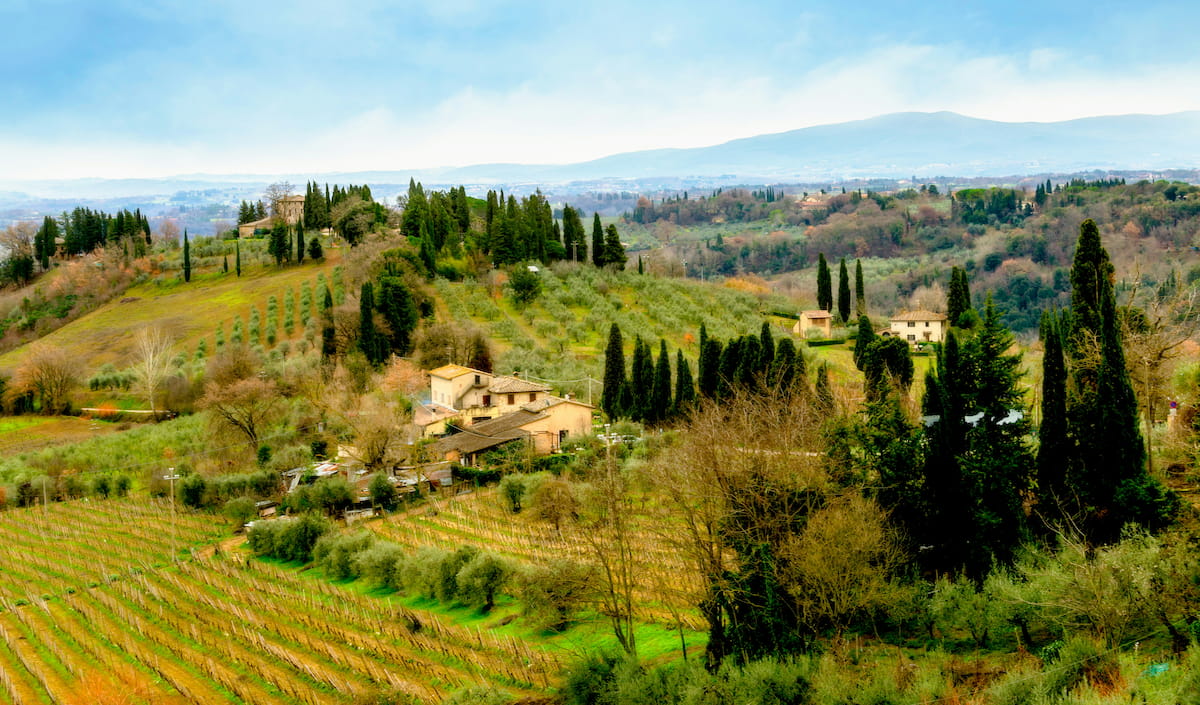
The Chianti Classico zone — the band of wine country between Florence and Siena producing some of Italy’s greatest Sangiovese-based wines — is 45 minutes from Florence by car. A guided half-day or full-day tour visits two or three estates, typically including a winery walk, wine cellar visit, and a seated tasting of four to six wines with local cheeses and cured meats. The landscape — rolling hills covered in vines, olive trees, and cypress rows — is as remarkable as the wine. In October, visiting during harvest adds the extraordinary spectacle of grapes being picked and crushed. A well-organized small-group tour from a specialist operator (not a large bus tour) is fundamentally different from a tourist-bus wine experience.
💡 Look for tours with maximum 8–10 participants that visit estate-level producers rather than large commercial wineries. October harvest tours are the most memorable but book months ahead. If self-driving, the SS222 Chiantigiana road through the Chianti Classico zone is one of the most beautiful drives in Italy — but designate a non-drinking driver before you start.
Florence is the origin point of Tuscan cuisine — bistecca alla Fiorentina, ribollita, pappa al pomodoro, pici pasta, schiacciata bread, cantucci biscuits. A hands-on cooking class typically covers two or three courses, teaching techniques specific to Tuscan cooking (the rough-cut pasta style, the bread-soup traditions, the olive oil sourcing), followed by eating what you’ve made with Tuscan wine. The best classes are limited to 8–10 participants and are taught in functioning home kitchens or working restaurant back-of-houses rather than purpose-built tourist cooking studios. The experience is both a meal and a skill — you leave with recipes you can actually reproduce.
💡 Classes set in the Chianti or Mugello countryside (transported from Florence by the operator) are more expensive but significantly more atmospheric than city-center studio classes. Look for operators who source ingredients from their own gardens or local markets the morning of the class — this signals the same commitment to provenance that characterizes good Tuscan cooking.
The Vasari Corridor is the elevated private passageway Cosimo I de’ Medici built in 1565, running from the Palazzo Vecchio across the Ponte Vecchio and through the Oltrarno to the Pitti Palace — a secret route for the ruling family that allowed them to move across Florence without descending to street level. After extensive restoration, the Corridor has reopened to small-group guided tours, passing through rooms holding the Uffizi’s collection of self-portraits (Raphael, Rubens, Velázquez, Rembrandt, Bernini, and hundreds more) while walking above the city in spaces unchanged since the Medici used them. The tour runs approximately 75 minutes and is limited to 15 people per group. This is one of the genuinely rare Florence experiences — a route and a collection that most visitors never access.
💡 Book through the official Uffizi ticketing system (tickets.uffizi.it) as soon as dates for your travel period become available — Vasari Corridor tours sell out weeks to months ahead for peak season dates. The tour includes a portion of Uffizi corridor time, so don’t schedule a separate Uffizi visit on the same day.
Worth It / Skip It
Don’t Make These Mistakes
Arriving in Florence without the Uffizi and Accademia pre-booked. During peak season (April through October), both museums sell out of preferred time slots days to weeks in advance. Showing up without a reservation means either joining a standby queue in summer heat with no guarantee of entry, or buying from a third-party vendor who charges $10–$20 above the official price for the same ticket. Book at the official Uffizi site (tickets.uffizi.it) and the Accademia’s official booking system as soon as your dates are confirmed.
Planning your trip around August without knowing about Ferragosto. August 15 is Ferragosto — Italy’s main national holiday — and the two weeks surrounding it are when Italians collectively go on vacation. Many family-run trattorias, artisan workshops, and local businesses in Florence close for up to three weeks. The city fills with tourists being served by a skeleton crew of tourist-facing operations. If August is your only option, book every restaurant and experience before you arrive; your favorite neighborhood trattoria may simply be shut.
Confusing the Brunelleschi Pass price on third-party sites with the official price. The Brunelleschi Pass costs $32 on the official duomo.firenze.it website. Third-party booking platforms, aggregators, and reseller sites routinely charge $44–$55 for the same pass. The official site requires registration and books out faster, but the savings are meaningful — especially for families or groups. The dome climb timed slot should be locked in before you leave home; it books out during peak season.
Forgetting to budget for the Italian tourist tax (tassa di soggiorno). Florence charges a mandatory city tax of $3.85–$9.30 per person per night, depending on the hotel’s star rating. This is charged separately at checkout and is not included in room rates shown on booking platforms. For two people in a 4-star hotel for 5 nights, this adds roughly $65–$93 to your accommodation bill that many travelers don’t anticipate. Budget for it in advance so it doesn’t come as a surprise at checkout.
VacayValue Scorecard — Florence
Packing List — Florence
Budget Travel Finds, Weekly
New destination guides, price updates, and the underrated spots we can’t stop recommending — free to your inbox.
Florence Is Among the Greatest Cities on Earth — and the Budget Works If You Plan the Museums Right
Florence scores an 8.2 because almost every metric holds up under scrutiny. Flights are comparable to other Southern European destinations. Hotels are cheaper than Rome or Paris for equivalent quality. Food is extraordinary and honest — bar breakfast for $3.85, pizza by the slice for $3.30, trattoria dinner for $22–$33 per person with wine. The streets, squares, bridges, markets, and churches are free and are themselves among the most beautiful made environments in the world. The Tuscan countryside is 45 minutes away.
The honest constraint is the museum budget. The Uffizi ($27), Accademia ($22), and Brunelleschi Dome ($32) cost around $81 per person for all three — more if you add Pitti Palace, Boboli Gardens, and the Vasari Corridor. This is not unreasonable for what you’re accessing; these are three of the most significant art collections and architectural achievements in Western civilization. But it means a couple visiting Florence properly spends roughly $162 on museum admissions before any other costs, which surprises people who come expecting Italian affordability to extend to the museums. Plan for it, and everything else is genuinely good value.
Five nights is the right amount of time. Long enough to cover the main museums without rushing, to find your neighborhood trattoria, to take the day trip to Siena, and to spend a lazy afternoon in the Oltrarno watching craftspeople work. Florence is a city that gets better every day you’re in it — give it the time it deserves.