
Siem Reap 2026: The Largest Religious Monument on Earth
The world’s greatest ancient city costs $37 to enter. Hotels from $15. Street food from $1.50. Siem Reap is one of the most extraordinary destinations on the planet — and one of the cheapest.
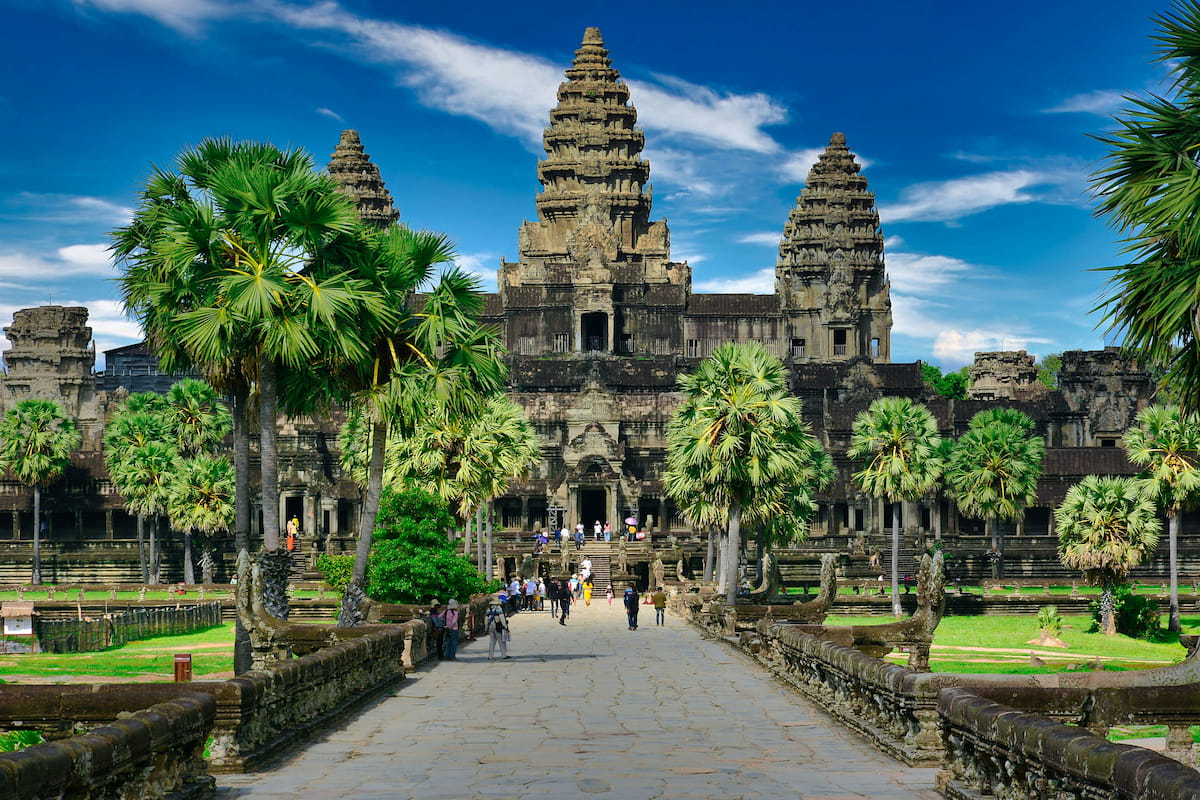
You wake up at 4:30am, pay $37 for your Angkor Pass, ride a tuk-tuk through the dark for fifteen minutes, and walk to the edge of the reflecting pool just as the sky behind Angkor Wat turns from black to purple to gold. The world’s largest religious monument — built in the 12th century, lost to jungle, rediscovered — lit by the rising sun. This is why people fly 22 hours to Cambodia.
There are destinations that are genuinely affordable, and then there is Siem Reap — a category of its own. Once you absorb the transatlantic flight cost, everything on the ground is among the cheapest in the world: hotels with pools for $25, Khmer curries for $3, tuk-tuks to ancient temple complexes for a couple of dollars. The Angkor Archaeological Park — a UNESCO World Heritage Site covering 400 square kilometers of temples, causeways, and royal cities — charges $37 for a full day’s access. The value proposition here is, simply, unmatched.
Siem Reap’s new airport (SAI) opened in late 2023, replacing the old REP airport. The new Siem Reap–Angkor International Airport is located about 40km from the city center (~45-minute drive). Make sure your flight itinerary shows SAI — not the old REP. Also required before entry: a $30 Cambodia e-visa (apply at evisa.gov.kh) and a completed e-Arrival Card (mandatory since September 2024). Don’t skip either — airport immigration lines for unprepared travelers can be long.
What’s In This Guide
📅 Best Time to Visit Siem Reap
Best months: November–February for ideal weather. May and October–November for best value. The dry season (November–April) is the classic travel window — comfortable temperatures and no rain. May is the VacayValue sweet spot: rains haven’t fully arrived, prices drop sharply, and you’ll have temples nearly to yourself in the mornings. Avoid mid-December through early January unless booked months ahead — Angkor at Christmas is a different experience from the rest of the year.
Where to Stay in Siem Reap
Stay in town — within the old city around Pub Street, the Old Market (Phsar Chas), or the quieter Wat Bo neighborhood. All are 20–30 minutes by tuk-tuk from the Angkor temples. The new SAI airport is about 45 minutes from the city center — confirm your hotel’s shuttle situation or use Grab. Siem Reap hotels offer some of the most extraordinary value in Southeast Asia: pools, breakfast, genuine service, and beautiful design at prices that don’t exist anywhere in Europe or North America. All rates verified March 2026.
Private rooms from $18 and dorm beds from $7 — with a rooftop pool and bar that make this one of the most consistently recommended budget stops in all of Southeast Asia. The social atmosphere is excellent for solo travelers and the events calendar (temple tours, cooking classes, pub crawls) gives you a ready-made itinerary and group to explore with. The organization also runs community social programs, so your stay supports local initiatives. A short walk to Pub Street and the Night Market.
The mid-range tier in Siem Reap delivers something remarkable: boutique hotels with pools, included breakfast, air conditioning, and genuinely beautiful design — for $30–$65 per night. This is where the city’s value proposition really crystallizes. Properties like Angkor Rise typically include complimentary tuk-tuk rides to the temples, helpful staff who’ll arrange sunrise visits and cooking classes, and rooms that in any European capital would cost three to four times as much. The Old Market area location puts you in walking distance of restaurants, night markets, and the Siem Reap River.
Consistently rated as one of the finest hotels in Cambodia — and at $120–$250/night, a category of value that simply doesn’t exist at this quality level anywhere else in Asia’s premium hospitality market. The hotel runs a hospitality training school for underprivileged Cambodian youth, meaning your stay directly funds vocational education; the graduates provide genuinely exceptional service as a result. The infinity pool, spa, and Kroya restaurant are standouts. Design is sophisticated, staff are extraordinary, and the property sits within easy reach of Angkor. At these prices, it’s genuinely one of the great luxury values on earth.
Get Our Free Siem Reap Trip Planner
Angkor temple strategy, day-by-day itineraries, and the local tips that travel guides skip. Straight to your inbox — free.
15 Best Siem Reap Experiences
Siem Reap’s experience split is unusual: the free tier is genuinely extraordinary (Cambodian temples not covered by the Angkor Pass, night markets, riverside walks), while the paid tier delivers some of the world’s great ancient wonders for $37–$62 total. That means your Angkor Pass covers Angkor Wat, Bayon, Ta Prohm, Angkor Thom, Preah Khan, and dozens of other temples — all on a single multi-day pass. The splurge tier is where bucket-list ambition meets the Cambodian countryside: sunrise balloons, Phnom Kulen mountain, remote temple expeditions.
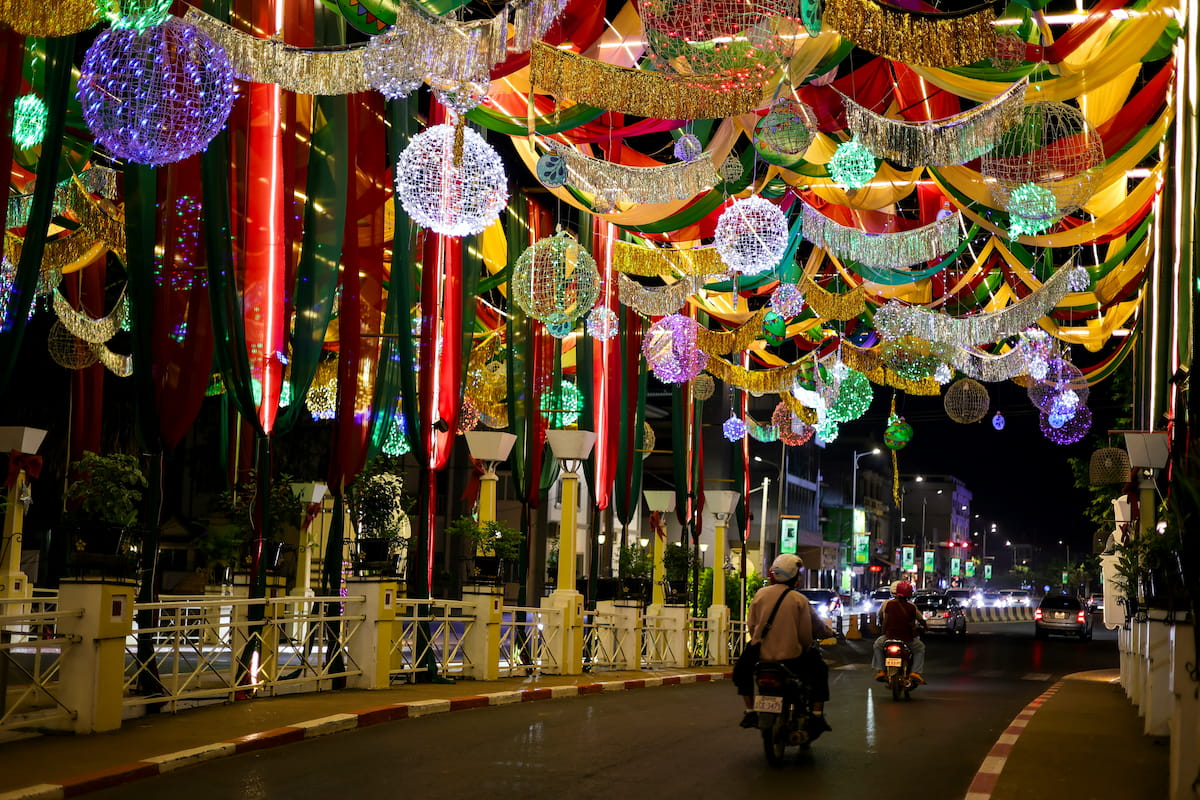
The social heart of Siem Reap. Pub Street is a pedestrian lane lined with Khmer restaurants, bars, massage shops, and the chaotic buzz of a Southeast Asian tourist strip done well — without the seediness that defines equivalent areas in Bangkok or Phuket. The adjacent Angkor Night Market is a well-organized covered market with local crafts, silks, artwork, and street food stalls. Free to wander; the only cost is what you eat and buy. Worth a full evening even if you’re not drinking — the energy peaks around 8–10pm and it’s genuinely fun people-watching.
💡 Avoid the $1 cocktail buckets if you value the next morning’s 4:30am temple alarm. The night markets close around 11pm; arrive by 7pm for the full selection before stalls sell out of popular items.
An active Buddhist temple in the city center whose grounds are open to respectful visitors. The monks’ saffron robes, the incense, the chanting at dawn and dusk, the gold-leaf pagodas — it’s an immediate reminder that Cambodia is a deeply living Buddhist culture, not just an archaeological site. The Siem Reap River runs alongside the old city and the riverside promenade connects several temples and markets in a pleasant 30-minute walk. Best at sunrise when monks do their morning rounds and the light is soft on the water.
💡 Always remove shoes before entering temple buildings and dress modestly (shoulders and knees covered). A small donation in the offering box is customary and appreciated.
A covered market in the heart of the old city where local food vendors, fresh produce stalls, souvenir sellers, and fabric merchants coexist in slightly organized chaos. Early morning is when it’s most authentically local — vegetable sellers, fish mongers, food cooks — before the tourist wave arrives around 9am. Good for picking up silk scarves, Cambodian spices, handmade jewelry, and small gifts at prices notably lower than the Night Market. Worth a full morning browse even if you’re not buying anything.
💡 The prepared food section inside the market (northeast corner) serves excellent bai sach chrouk (pork and rice) and num banh chok (Khmer noodles with fish gravy) from about $1.50 — one of the best breakfast deals in Cambodia.
Cambodian Living Arts hosts free traditional Apsara dance performances in Siem Reap as part of their mission to revive Khmer performing arts nearly destroyed by the Khmer Rouge. Apsara dance — the temple wall carvings of Angkor Wat brought to life — is extraordinary to watch: the hand positions, the slow deliberate movements, the elaborate costumes. The organization supports Cambodian artists directly; a donation to their work is appropriate and meaningful. Check their current schedule at cambodianlivingarts.org.
💡 Arrive early for a seat — these performances are genuinely popular and the connection between the living dance and the stone Apsara carvings you’ll see at Angkor Wat the next morning is striking. Visit the carvings with the dance still fresh in your memory.
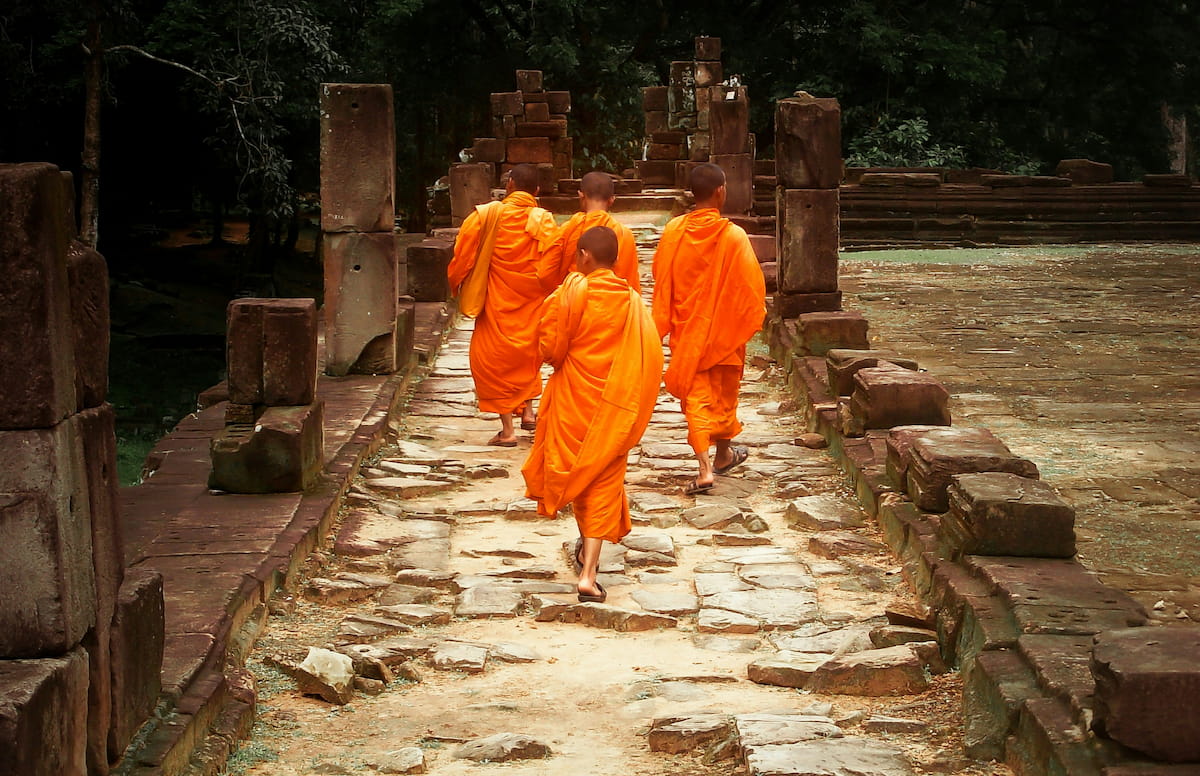
Every morning before dawn, monks from Siem Reap’s temples walk the streets in saffron robes to receive offerings of food from local residents — a practice unchanged for centuries. Watching the procession as the city stirs awake, the robes glowing in the early light and the air still cool, is one of the most genuinely moving things you can witness in Cambodia. The streets around Wat Bo and Wat Preah Prom Rath see particularly consistent processions. It costs nothing, lasts about 30 minutes, and sets a tone for the whole trip that no guidebook can replicate.
💡 Observe quietly from a respectful distance — do not photograph monks without permission and do not obstruct the procession. This is not a performance; it is a living daily ritual. If a local offers to sell you food to donate to the monks, you may participate, but it is not expected.
The world’s largest religious monument — a 12th-century Khmer temple complex covering 402 acres, built by Suryavarman II to represent Mount Meru, home of the Hindu gods. At sunrise, with the temple reflecting in the lotus pools and the sky shifting through every shade of orange and pink above the five towers, it is one of the singular visual experiences in all of travel. The Angkor Pass covers entry: $37 for one day, $62 for three days (10-day window), $72 for seven days (30-day window). Children under 12 enter free with passport. Buy your pass the evening before to skip the morning ticket line.
💡 Position at the left-side pool (not center) for the best reflection photography with fewer people in frame. Arrive at the reflecting pool by 5:15am — the light builds fastest between 5:45 and 6:15am. After sunrise, walk the full outer gallery (bas-reliefs depicting 1,200 years of history) before the tour groups arrive around 8am.
The state temple of Jayavarman VII, built in the late 12th century at the center of Angkor Thom — the great walled city within the park. Bayon is covered in 216 massive stone faces gazing in all four cardinal directions, each one serene and slightly smiling, each one believed to be a portrait of Jayavarman VII himself. The effect of walking among them — the faces emerging from stone at every angle, some weathered to near-abstraction, some impossibly crisp — is completely unlike any architectural experience elsewhere. Arguably more affecting than Angkor Wat itself for many visitors.
💡 Visit Bayon in the afternoon when the tour buses have moved on to other sites — the faces catch the golden late-afternoon light beautifully, and the temple is quieter. The upper terrace for an eye-level encounter with the faces is not to be missed.
Left intentionally in a partially unreconstructed state, Ta Prohm is the temple where the jungle has fought back: enormous Strangler Fig and Silk Cotton trees have grown directly through the stone walls and towers over centuries, their root systems engulfing doorways and splitting galleries. Built in 1186, it was one of the wealthiest monasteries in the Angkor empire — housing 12,640 people including 615 dancers. The combination of ancient stone and living trees makes it one of the most photographed temples in Southeast Asia, and deservedly so.
💡 Visit early morning or late afternoon to avoid the peak tour bus crush. The famous giant tree roots at the eastern entrance gallery are the most photographed spot — go directly there first, before groups arrive, then explore the less-visited western sections in relative solitude.
Rent a bicycle in town and ride out into the surrounding rice paddies, fishing villages, and rural Cambodia that exists just beyond the tourist zone. The flat terrain around Siem Reap is ideal for cycling — village paths wind through farms, past wooden stilt houses, and alongside lotus ponds. You’ll pass children riding to school, farmers working flooded paddies, and roadside sugarcane juice vendors charging about $0.50 a glass. Renting a quality bike for a full day runs $5–$8 from shops near Pub Street and the Old Market.
💡 Head north of town toward the villages between Siem Reap and Angkor Wat for the best countryside ride. Go early — by 9am the heat builds fast. Bring plenty of water and a small amount of cash for roadside coconuts. The Grab app works in Siem Reap as a backup if the return ride defeats you.
Southeast Asia’s largest freshwater lake sits 15km south of Siem Reap and hosts floating villages where communities live year-round on stilted homes and houseboats — schools, clinics, and markets all afloat. The lake swells dramatically during wet season (September–October is the peak, when it quadruples in size) and contracts in dry season. A boat tour through the floating village of Kampong Phluk or Mechrey takes about two hours and is a genuinely fascinating window into Cambodian life that has nothing to do with temples. Best at sunset when the light on the water turns gold.
💡 October and November offer the best water levels for the most impressive floating village experience. Avoid overcrowded Chong Kneas (closest to Siem Reap, most touristy) — choose Kampong Phluk or Mechrey for a more authentic and less commercially staged visit.
Cambodian cuisine deserves far more international recognition than it gets. Amok (fish curry steamed in banana leaves), lok lak (stir-fried beef with lime and pepper), bai sach chrouk (pork over rice), and the extraordinary Khmer kroeung paste built from fresh lemongrass, galangal, kaffir lime, and turmeric — these are genuinely sophisticated flavors. A cooking class typically starts with a market visit to source ingredients, then hands-on preparation of three to four dishes you eat together at the end. An excellent half-day activity that creates an enduring connection to the country’s food culture.
💡 Book through your hotel or a locally run school rather than a tour aggregator — the price is lower and the instruction more personal. Class sizes of 6–8 give you real hands-on time versus watching a demonstration.
Founded by Aki Ra, a former child soldier and Khmer Rouge combatant who spent decades manually de-mining the Cambodian countryside, this museum documents the landmine crisis that still kills and maims Cambodians annually and provides education for landmine-affected children. The exhibits are sobering and important — Cambodia has one of the highest rates of landmine victims per capita in the world, and this context deepens everything you see in the countryside. The $5 admission funds the museum’s ongoing work and the children’s education program.
💡 Visit this museum before your temple days, not after. Understanding the modern history of Cambodia — the Khmer Rouge, the civil war, the de-mining — gives the country’s survival and the restoration of Angkor a weight that purely archaeological tourism misses.
A tethered balloon operates at the edge of the Angkor park, rising about 200 meters to give aerial views of the temples and surrounding jungle at dusk or sunrise. At $25–$35 per person it’s the most affordable aerial perspective on Angkor available — a free-flight balloon over the complex runs $180–$220 but is a different experience entirely, drifting over the temple rooftops at dawn. Both are genuinely spectacular. The tethered balloon is a genuine bargain for what it delivers. Book directly at the launch site or through your hotel.
💡 The free-flight balloon (Angkor Balloon Company) operates at sunrise only and must be booked in advance. It’s a bucket-list item — drifting over Angkor Wat’s five towers as the sun clears the horizon is one of the great travel moments in Southeast Asia.
The sacred mountain where Jayavarman II declared independence and founded the Khmer Empire in 802 AD. The park contains the River of a Thousand Lingas — the Kbal Spean riverbed carved with thousands of Hindu fertility symbols that bless the waters flowing down to Angkor — a massive reclining Buddha carved into a cliff face, and natural swimming holes fed by mountain waterfalls. It’s a full day out of Siem Reap (60km, roughly 2 hours) and a genuinely different experience from the main temple circuit: jungle, water, altitude, and sacred sites in combination.
💡 Arrange a private driver ($40–$60 for the full day) rather than joining a crowded minibus tour — the extra cost buys flexibility to spend more time at the waterfall and swimming holes. Arrive before 10am; the crowds and heat build significantly by midday.
Banteay Srei (“Citadel of Women”) is 37km northeast of Siem Reap — a detour from the main Angkor circuit, but often cited by archaeologists as the finest example of classical Khmer art in existence. Built in 967 AD from pink sandstone, the carvings are so detailed and so precisely executed that early European explorers refused to believe they were pre-industrial. The combination of the pink stone, the intricate devatas, and the complex mythological narratives carved in relief is extraordinary. Included in the Angkor Pass — you just need transport to get there.
💡 Combine Banteay Srei with Beng Mealea (the jungle-covered temple 68km from Siem Reap, either included with your Angkor Pass or $10 standalone) for a full remote temples day. Hire a private driver for the whole circuit — tuk-tuks aren’t ideal for the longer distances.
Worth It / Skip It
Don’t Make These Mistakes
Visiting the temples between 10am and 3pm during dry season. Temperatures regularly hit 95–100°F by midday and the temples offer almost no shade. Tour groups flood the main sites from 8:30am onward. The optimal temple strategy: arrive at Angkor Wat at 5:15am for sunrise, explore the main complex until 9am, return to your hotel for a pool and rest break from 10am to 3pm, then head back out for the late afternoon light at Bayon or Pre Rup. This schedule is how you see the temples at their best and survive the heat.
Booking only 2 nights in Siem Reap. Two nights gives you one full temple day — enough for Angkor Wat but not enough to see Bayon, Ta Prohm, the outer circuit, or anything beyond. Most travelers who visit Siem Reap for 2 nights leave feeling they didn’t have enough time. Five nights is the sweet spot: three temple days with rest breaks and two days for the city itself, the floating village, cooking classes, and day trips.
Using only USD and ignoring the Cambodian Riel. Cambodia’s economy runs almost entirely on US dollars, which is genuinely unusual — your ATM will dispense dollars. However, small purchases (food stalls, tuk-tuks, market items) often involve Riel for change. The current exchange rate is approximately 4,100 Riel per dollar — knowing this prevents you from being shortchanged. Keep some small dollar bills ($1s and $5s) for tuk-tuks and tips; drivers often struggle to make change.
Forgetting the Cambodia e-visa and e-Arrival Card before traveling. The e-visa costs $30 and is processed at evisa.gov.kh — allow 3 business days for processing, though it’s often faster. The e-Arrival Card (mandatory since September 2024) must be completed online before landing — travelers who skip it face long waits at airport tablets upon arrival. Both take 15 minutes to complete online. Skipping them is completely avoidable inconvenience.
VacayValue Scorecard — Siem Reap
Packing List — Siem Reap
The Best Finds, Before Everyone Else
New destination guides, honest price updates, and the value-travel finds we can’t stop talking about — weekly, free.
The World’s Greatest Ancient City Costs $37 to Enter. Plan Accordingly.
Siem Reap scores a 9.0 — our highest score to date — for a reason. Once you absorb the transatlantic flight, everything on the ground is so affordable that daily decisions simply stop being financial decisions. Hotel with a pool for $30. Khmer lunch for $3. A private tuk-tuk to Angkor and back for $15. The Angkor Archaeological Park — more than 400 square kilometers of 12th-century temples, royal cities, and sacred monuments — for $62 over three days. There is nowhere else in the world where a UNESCO World Heritage Site of this magnitude is this accessible to a budget traveler.
The honest part of the score: flights from the US cost real money. You’re looking at $800–$1,200 economy with connections, and the transit time is 22+ hours each way. Siem Reap is genuinely long-haul. This isn’t a weekend trip. But it’s a trip that changes how you think about ancient civilizations, about human ambition, about what people were capable of building with stone and water and sheer collective will 900 years ago.
Give it five nights minimum. Buy the 3-day Angkor Pass. Visit the temples at sunrise and sunset, not midday. Eat at local Khmer restaurants. Go to the Tonle Sap. Take a cooking class. And do not — under any circumstances — schedule a single temple hour between 10am and 3pm during dry season. Siem Reap will give you your money’s worth many times over. You just have to show up prepared to receive it.