
Athens 2026: The Birthplace of Western Civilization
The Parthenon is real. The souvlaki is $4. Budget hotels steps from the Acropolis from $35. Athens is one of Europe’s great underrated value cities — but the site fees have changed significantly.
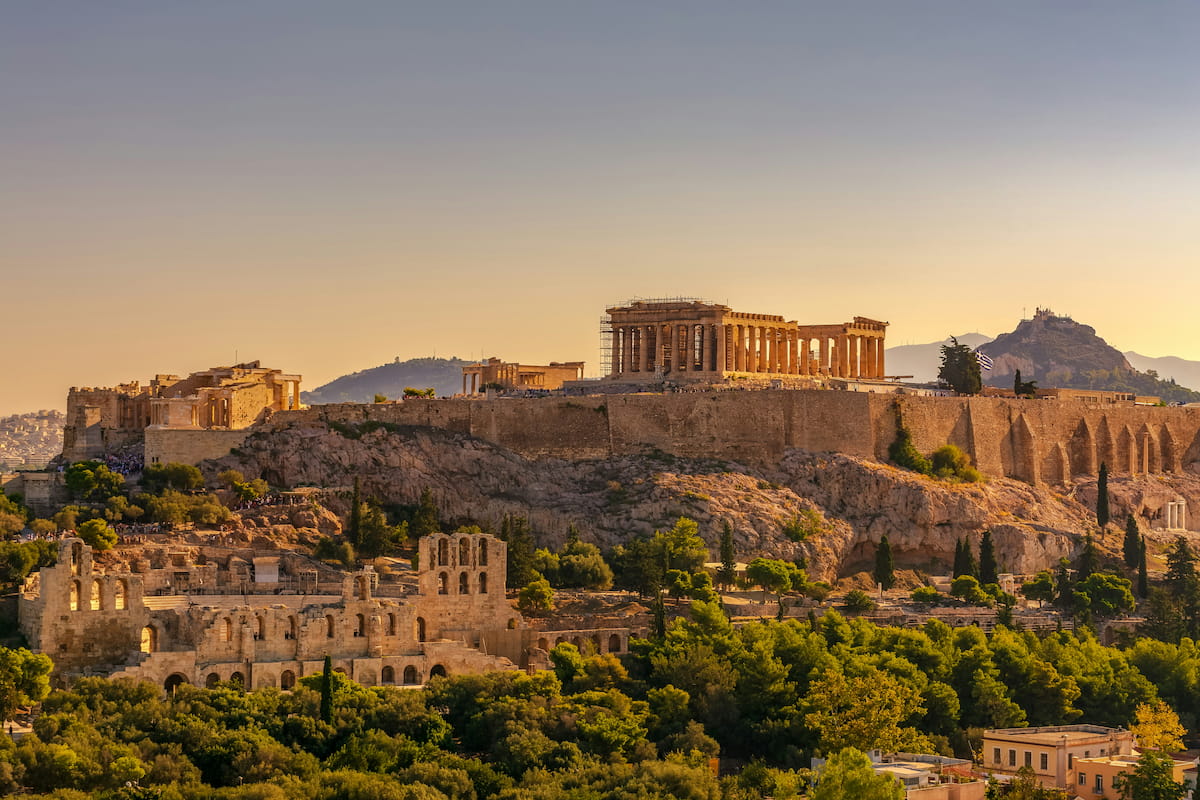
You climb the steps of the Propylaea and the Parthenon comes into full view — 2,500 years old, knocked down by a powder magazine explosion in 1687, partially reconstructed over the last two centuries, and still somehow the most perfect building ever built. Athens doesn’t ask you to imagine the ancient world. It shows it to you.
Athens has spent years being underestimated — the city you pass through on the way to Santorini. That’s changing fast, and for good reason. The neighborhood revival around Monastiraki, Psirri, and Koukaki has made Athens one of the most compelling city destinations in Europe. Flights from the US are short by international standards (9–10 hours direct). Hotels are cheaper than Rome, Paris, or Barcelona. And the food — souvlaki for $4.50, fresh-caught seafood, rooftop tavernas with Acropolis views — is genuinely extraordinary. The honest caveat: Greece raised Acropolis admission to $33 per person in 2025 and eliminated the popular combo ticket, so the ancient sites budget needs recalculating. We’ve done it for you.
What’s In This Guide
📅 Best Time to Visit Athens
Best months: May and September–October. May is the VacayValue top pick — excellent weather, pre-peak pricing, and lively street life without the summer crush. October rivals it for atmosphere. One strategic note: visiting November through March gets you the Acropolis at $16 instead of $33 — a significant saving for couples or families. The Acropolis in winter, with few visitors and clear winter light on the Parthenon, is legitimately one of the better ways to experience it.
Where to Stay in Athens
Stay in the historic triangle: Monastiraki, Plaka, or Koukaki — all within walking distance of the Acropolis, the Ancient Agora, and Syntagma Square. Monastiraki is the most bustling (flea market, metro, excellent souvlaki at every corner); Plaka is the most charming (neoclassical lanes, quieter at night); Koukaki is the most local and increasingly fashionable, south of the Acropolis with excellent restaurants and calmer streets. Greek hotel tax (typically $0.55–$4.50/room/night depending on star rating) is usually included in advertised rates. All prices verified March 2026.
Consistently one of Athens’ best-rated budget stays, and for obvious reasons: a rooftop terrace with Acropolis views, Monastiraki metro literally outside the door, and private rooms from $30 that put you walking distance from the Acropolis, the Ancient Agora, and some of the city’s best souvlaki. The hostel format means social common areas and a lively atmosphere, but private room options give you the location without sacrificing privacy. For solo travelers and couples on a serious budget, the value-to-location ratio is unmatched in Athens.
Plaka Hotel’s main draw is the rooftop breakfast terrace — you eat your morning meal with the Parthenon close enough to feel you could walk there in five minutes (you can, in about fifteen). The location in the pedestrianized Plaka lanes puts you directly among the neighborhood’s neoclassical architecture and tavernas, yet within easy walking distance of Syntagma Square and the major ancient sites. Rooms are clean and well-appointed; the pool is a welcome bonus for summer visits. Genuinely excellent value for a European capital of this historical weight.
A sleek five-star hotel on Mitropoleos Street, steps from Syntagma Square and the beginning of the Plaka lanes. The rooftop pool and restaurant deliver one of Athens’ most celebrated views — the Acropolis lit at night above the city, framed by the pool deck — and the interior design is genuinely exceptional for a city that hasn’t always been associated with design-forward hospitality. At $150–$320 per night, it competes directly with equivalent Parisian or Roman properties at significantly lower prices. The location couldn’t be more central without sleeping in the Parthenon itself.
Get Our Free Athens Trip Planner
Acropolis timed-entry strategy, day-by-day itineraries, and the food neighborhood guide. Straight to your inbox — free.
15 Best Athens Experiences
Athens has a fascinating split between what’s free and what costs money. The city’s ancient archaeological sites now charge individually — the combo ticket was eliminated in April 2025, so visiting the Acropolis, the Ancient Agora, and the Acropolis Museum means three separate admissions totaling roughly $60–$65 per adult. But the neighborhoods, the flea market, the street food, the seafront, and the hill walks are completely free — and some of the most memorable parts of the trip. The signature tier is where Athens genuinely shines for once-in-a-lifetime moments: sunset at Sounion, Athens Festival performances at the Odeon, private Acropolis sunrise access.
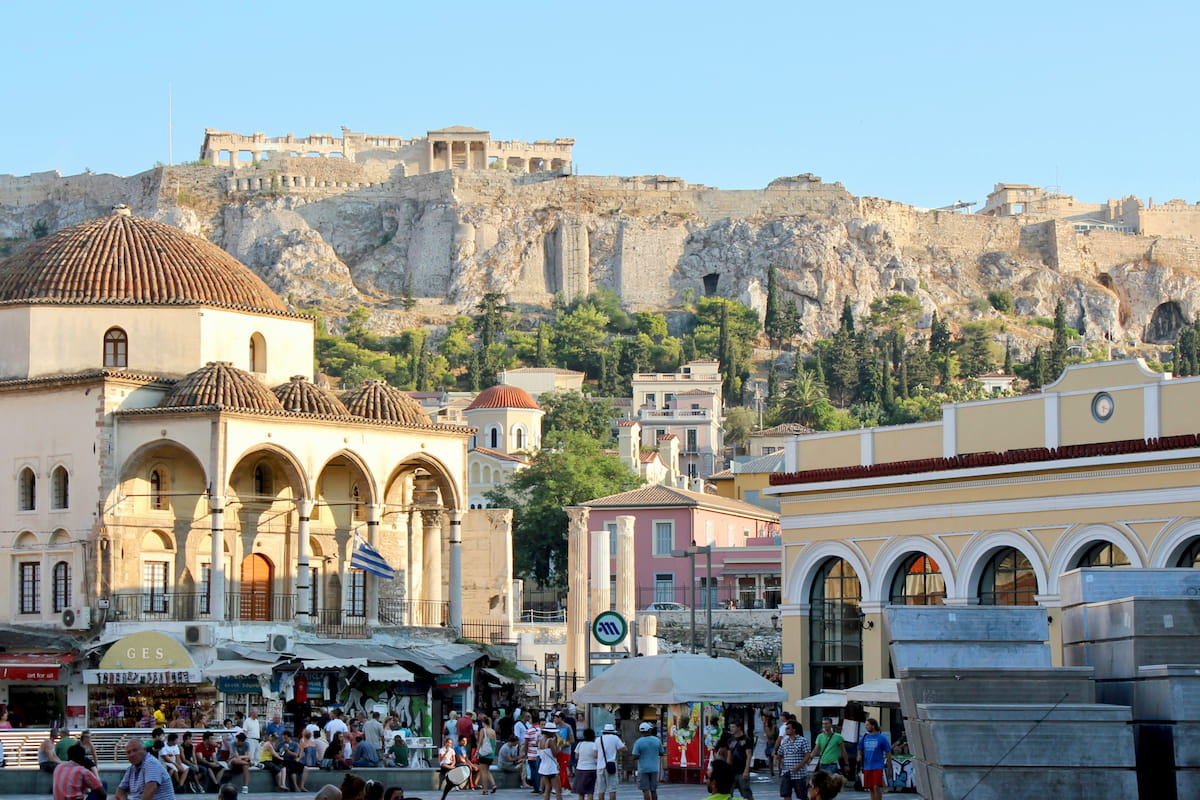
Every Sunday morning, the streets around Monastiraki Square overflow into a full-blown flea market — vintage clothing, old coins, antique cameras, Soviet-era medals, handmade jewelry, and the kind of beautiful junk that only accumulates in cities this old. The permanent market stalls in Avyssinias Square operate daily; the Sunday expansion takes over the surrounding streets from early morning until early afternoon. You can spend three hours here and leave empty-handed and fully satisfied. The Acropolis rising directly above it makes for a surreal backdrop.
💡 Come Sunday before 11am for the best selection and fewer crowds. Cash is preferred for market vendors. Negotiating politely is expected and usually rewarded — especially for anything that isn’t mass-produced.
A rocky outcrop immediately northwest of the Acropolis entrance — the ancient council hill where the Apostle Paul preached to the Athenians in 51 AD and where Athens’ highest court once met. The climb takes about five minutes and rewards you with one of the best views of the Acropolis available from any free vantage point in the city. Locals come here to watch the sunset on the Parthenon, which glows amber before fading to white. No ticket, no timed entry, no queue. Just a rock and 2,500 years of history beneath your feet.
💡 Arrive 30–45 minutes before sunset and claim a spot on the flat rock face. The Acropolis faces west, so the late-afternoon light hits the Parthenon columns at an angle that photographers chase for years. Wear shoes with grip — the marble surface is genuinely slippery.
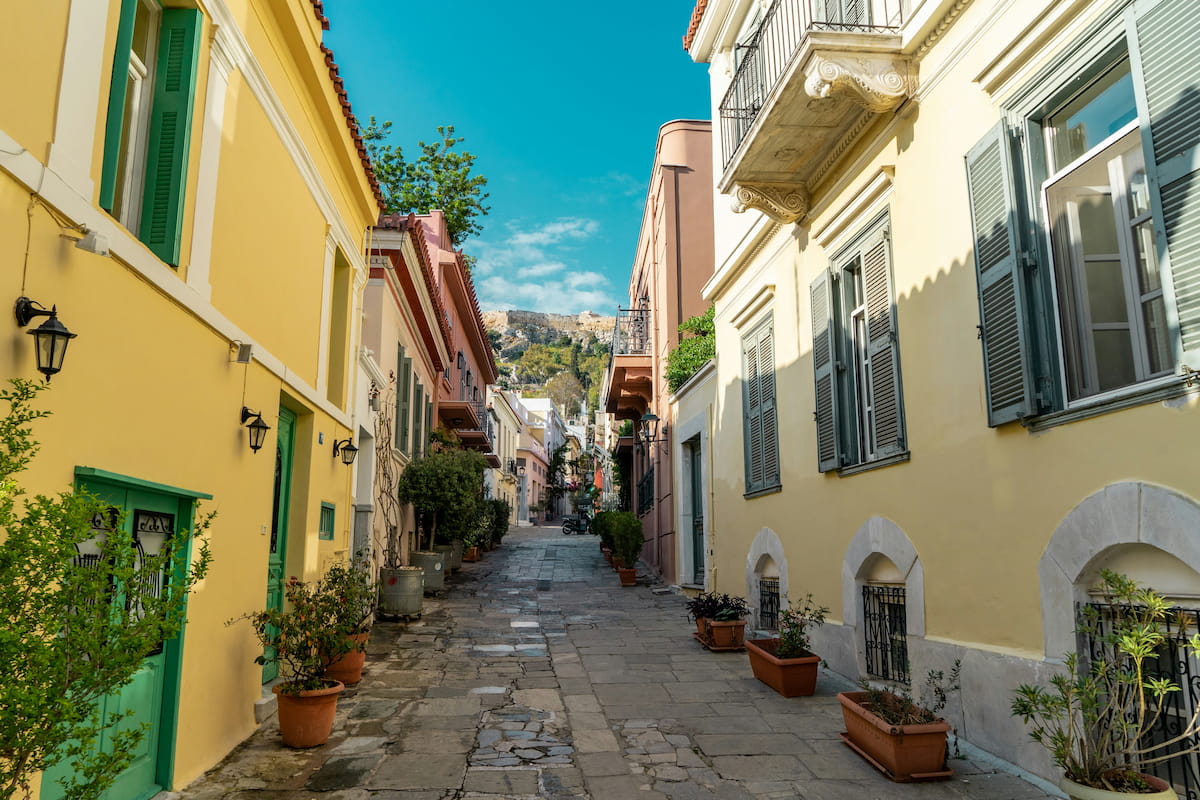
Plaka is Athens’ oldest continuously inhabited neighborhood — its narrow lanes have been home to residents since antiquity. Walk up through the whitewashed alleys of Anafiotika, built by Cycladic island masons in the 19th century who missed home and replicated their island architecture on the north slope of the Acropolis. Bougainvillea drapes over doorways, cats sleep on steps, and the city disappears into something that looks like a dreamlike village. It costs nothing and delivers some of the most photogenic and peaceful moments in Athens.
💡 Enter Anafiotika via Stratonos Street on the north slope of the Acropolis. Follow the narrow path upward and let it deposit you at the Acropolis entrance area. The whole walk takes 20 minutes and requires no planning. Best in morning light.
The highest point in Athens — a pine-covered limestone hill rising 277 meters above sea level, crowned by the white Chapel of St. George. The view from the top takes in the entire Athens basin: the Acropolis in the foreground, Piraeus and the Aegean Sea behind it, the ring of mountains beyond. You can walk up (about 25 minutes via the path from Kolonaki) or take the funicular from Plutarchou Street ($9 round trip). The walk is genuinely pleasant through pine forest and feels a world away from the city noise below. At sunset, the panorama is extraordinary.
💡 Walk up and take the funicular down if you’re tired — the climb is uphill-only challenging, not exhausting. The café at the summit charges predictably inflated prices but the terrace view is exceptional. Bring your own drinks if you’re budget-conscious.
A walk from Monastiraki Square through the Psirri neighborhood and back is one of the best ways to understand contemporary Athens — souvlaki joints, rooftop bars, street art, neighborhood kafeneions where old men play backgammon, and one of the finest concentrations of casual eating in any European capital. The circuit takes 30 minutes to walk briskly or three hours if you stop for everything worth stopping for. Souvlaki at Kostas on Adrianou (consistently cited as the best in central Athens, $2.75), then sesame koulouri from a street cart ($0.55), then freddo espresso at any sidewalk café ($3.25).
💡 Psirri on a Friday or Saturday evening is where Athenians actually go out — packed, loud, excellent. The neighborhood around Karaiskaki Square has the highest concentration of good bars and is much more local-feeling than the Monastiraki tourist strip.
The non-negotiable. Built between 447 and 432 BC under Pericles, the Parthenon is the defining monument of Western civilization — the building that established the proportional systems, architectural refinements, and aesthetic philosophy that everything from the US Capitol to every neoclassical courthouse in America descends from. The Acropolis complex includes the Propylaea gateway, the Erechtheion with its Porch of the Caryatids, and the Temple of Athena Nike. Timed entry is mandatory since 2024 — book your slot online in advance, especially April through October. The standard adult ticket is $33; the winter rate (November–March) is $16.
💡 Book the first entry slot (8:00am) for the least crowded experience and the best light on the columns. Arrive 15–20 minutes early. By 10am, tour groups arrive in waves. Wear grippy shoes — the marble steps are polished smooth. Bring water and a hat; there is almost no shade on the rock.
One of the finest museum buildings in the world, designed by Bernard Tschumi and opened in 2009 directly at the foot of the Acropolis. The top floor — a glass room housing the Parthenon frieze fragments, positioned to align exactly with the temple visible through the glass above — is genuinely moving. The original sculptures from the Acropolis that couldn’t survive outdoor exposure are here; the Elgin Marbles controversy is contextualized by the empty brackets where London’s half of the frieze belongs. Allow two hours. The ticket is separate from the Acropolis site entry.
💡 Visit the museum the morning before your Acropolis site visit, not after. Understanding what the carvings depicted — the Panathenaic procession, the battle of Lapiths and Centaurs, the birth of Athena — transforms what you see on the rock from beautiful marble ruins into a narrative you can read.
The civic center of ancient Athens — where Socrates argued philosophy, where Athenian democracy was practiced, and where the best-preserved ancient Greek temple in existence still stands: the Temple of Hephaestus, completed in 415 BC and so well-preserved it was used as a Christian church for centuries. The Stoa of Attalos (a reconstructed ancient shopping arcade) houses an excellent museum of everyday objects from ancient Athenian life — pottery, coins, tools, votive offerings. A completely different experience from the Acropolis: closer to the ground, more intimate, and less crowded.
💡 Enter from the Thissio side (Adrianou Street entrance) rather than the Monastiraki side for a less crowded arrival. The Temple of Hephaestus in the late afternoon light is among the most beautiful sights in Athens and receives a fraction of the Parthenon’s attention.
The largest archaeological museum in Greece and one of the great museums of the world — 11,000 objects spanning 5,000 years of Greek prehistory through late antiquity. The highlights alone could fill a full day: the Mask of Agamemnon (Mycenaean gold death mask, c. 1500 BC), the Antikythera Youth bronze (first century BC), the frescoes of Akrotiri, the Artemision Bronze (Zeus or Poseidon, throwing something that no longer exists). Not on the Acropolis tourist circuit — that’s exactly why it’s less crowded and more rewarding for serious visitors. About 2km north of Monastiraki; take the metro to Omonia.
💡 Allocate three hours minimum. The museum is enormous and consistently underestimated. Pick up the map at the entrance and prioritize the rooms labeled on the self-guided route — the prehistoric collection on the ground floor alone is worth the admission.
Athens’ food scene has transformed over the past decade from an afterthought to a genuine destination. A guided food tour through the Central Market (Varvakeios), the Monastiraki food stalls, Psirri, and the Koukaki neighborhood covers not just what to eat but why: the regional variations in Greek cuisine, the difference between a tourist-facing gyro and what Athenians actually eat, and the tavernas, mezedopoleia, and ouzeri that don’t appear on TripAdvisor. Most food tours run 3–4 hours and include enough food to constitute lunch. Well worth the investment for context that makes every subsequent meal more meaningful.
💡 Book a morning tour (usually starting at 9 or 10am) to catch the Central Market at full activity — fish, meat, and spice vendors at peak energy. Evening tours focus more on mezedes and wine, which is equally good but a different experience.
Built entirely of white Pentelic marble — the same stone as the Parthenon — the Panathenaic Stadium hosted the first modern Olympic Games in 1896 and still hosts the Athens Classic Marathon finish line today. Running down to the track and standing at the finish is a strange and genuine thrill. The stadium seats 50,000 and has been used for athletic events since 329 BC in some form. A small museum in the tunnels underneath tells the story of the modern Olympics revival. Worth the ticket for the combination of ancient site, living sporting venue, and the view back toward the Acropolis from the top tiers.
💡 Visit early or late in the day — the marble seating has no shade and the sun is brutal midday. The track is open for visitors to walk/run. Climbing to the top tier of seating for the full panoramic view of Athens is mandatory.
Athens’ port city, 15 minutes by metro from Monastiraki, has a working harbor energy that’s completely different from the tourist-facing central city. The waterfront at Mikrolimano — the smallest of Piraeus’ three harbors, lined with fishing boats and seafood restaurants — is where Athenians go for a proper Sunday lunch: grilled whole fish, fried calamari, ouzo, and the Mediterranean at your feet. Prices at Mikrolimano restaurants are higher than neighborhood tavernas but still reasonable compared to any European coastal equivalent. A worthwhile half-day escape from the ancient sites circuit.
💡 At Mikrolimano, ask to see the fish before ordering and confirm the price per kilo — whole fish is charged by weight, not portion, and the price can vary significantly by species. Dorade (sea bream) and lavraki (sea bass) are the local benchmarks; both are excellent grilled simply with olive oil and lemon.
A 2nd-century Roman odeon built into the south slope of the Acropolis, seating 5,000 under the open sky — the Parthenon directly above, the Athens basin spreading out below, and a stage that has hosted everything from the Greek National Opera to the Bolshoi Ballet to major international orchestras. The Athens Epidaurus Festival runs from June through September. Watching a performance here — any performance, at any price level — with the illuminated Acropolis overhead is one of the definitive cultural experiences in all of Europe. Tickets from $22 for upper sections to $131 for orchestra seats.
💡 Book as soon as the summer program is announced (usually March). Upper section tickets at $22–$38 have perfectly adequate sightlines and the Acropolis view is identical from anywhere in the house. Bring a light jacket — evening temperatures drop surprisingly quickly at the open-air venue.
Seventy kilometers south of Athens, where the Attic peninsula ends in a dramatic cliff above the Aegean, stands the Temple of Poseidon — built in 444 BC, the same decade as the Parthenon, and among the best-preserved Doric temples in Greece. The setting is extraordinary: 60-meter limestone cliffs dropping to the deep blue sea, with a temple whose sixteen remaining columns frame the horizon. Lord Byron carved his name on one of the columns during his 1810 visit. A KTEL bus from Pedion Areos departs several times daily and costs about $6.50 each way; the temple admission is $11/adult.
💡 Time your visit to arrive at the temple about 90 minutes before sunset and stay for the full golden-hour light on the columns and sea. The bus back runs until late evening in summer. Bring food and water — the café at the site is expensive and limited.
The Greek Ministry of Culture offers small-group pre-opening Acropolis access (07:00–09:00 before public entry) as a premium experience — a maximum of five groups, with professional guides, allowing you to see the Parthenon in the first light of day with almost no one else present. The cost is high but the experience is categorically different from a standard morning visit: the silence, the particular quality of early light on 2,500-year-old marble, the sensation of standing where very few people have stood undistracted by crowds. The kind of memory that stays for decades. Book well in advance through the official Ministry of Culture channels.
💡 This service has limited availability and books out months ahead for peak season dates. Check the official Hellenic Heritage e-ticketing site (hhticket.gr) for current scheduling. The private access includes a dedicated guide — brief them on specific interests before arriving to maximize the experience.
Worth It / Skip It
Don’t Make These Mistakes
Arriving at the Acropolis without a timed-entry ticket booked in advance. Since April 2024, timed entry is mandatory — and during peak season (May through October), preferred morning slots sell out several days ahead. Showing up at 8am without a pre-booked slot means either joining a standby queue with no guarantee of entry at your preferred time, or buying from the on-site office and potentially getting a time slot that defeats the purpose of an early visit. Book at hhticket.gr as soon as your Athens dates are confirmed.
Budgeting for Athens archaeological sites using pre-2025 prices or expecting the combo ticket. The old $33 combination ticket covering the Acropolis and six other sites was eliminated in April 2025. The Acropolis now costs $33/adult alone ($16 winter). Add the Acropolis Museum ($16), Ancient Agora ($13), and Panathenaic Stadium ($11) and you’re at $73/adult for four attractions — significantly more than many visitors expect. This doesn’t make Athens expensive; it means accurate budgeting requires knowing the current numbers.
Visiting the Acropolis between 11am and 3pm in summer. The rock is fully exposed, marble reflects heat, there is almost no shade, and temperatures on the Acropolis plateau regularly exceed 105°F in July and August. Combine this with peak tourist crowds at midday and you have a genuinely unpleasant experience. The Greek Ministry of Culture has partially closed the Acropolis on extreme heat days — this is not a hypothetical risk. Go at 8am or after 4pm in summer. Period.
Taking a taxi from ATH airport without confirming the fixed fare. The official fixed rate from Athens International Airport to the city center is $44 daytime ($59 midnight–5am). Some drivers attempt to use the meter instead, which can run higher depending on traffic. Confirm the $44 fixed rate before getting in, and use the official taxi rank — not drivers who approach you inside the terminal. Alternatively, Metro Line 3 runs directly from the airport to Monastiraki in about 40 minutes for $11.50.
VacayValue Scorecard — Athens
Packing List — Athens
The Best Finds, Before Everyone Else
New destination guides, honest price updates, and the value-travel finds we can’t stop talking about — weekly, free.
Athens Is Europe’s Best Underrated City — Now With Honest Site Prices
Athens scores an 8.2 because it genuinely delivers on multiple fronts: short flight from the US East Coast, hotels meaningfully cheaper than Rome or Barcelona, food that’s both extraordinary and affordable, and a neighborhood energy in Monastiraki, Psirri, and Koukaki that rewards visitors who look beyond the Acropolis. The Greek souvlaki lunch is a genuinely great meal for $4.50–$8. The rooftop taverna dinner with Acropolis views can be done well for $27–$38 per person. The infrastructure is solid, the metro is clean, and Greeks are hospitable in a direct and warm way that Western Europeans sometimes aren’t.
The honest constraint is the attraction fees. At $33 for the Acropolis, $16 for the museum, $13 for the Ancient Agora, and $11 for the Panathenaic Stadium, a couple covering the main ancient sites spends roughly $145–$160 before lunch on day two. That’s not unreasonable for what you’re seeing — these are some of the most significant monuments in the history of human civilization — but it does mean Athens is no longer the “cheap European destination” it was marketed as for years. Build in the site budget, and the rest of the trip surprises you with its value.
Athens is a city that improves with each day you spend in it. The first day is overwhelming — the history, the heat, the scale. By day three you’ve found your neighborhood café, you know which street leads to the best view, and you understand why people come back. Plan five nights minimum. The Parthenon will be there every morning when you wake up.