
Zion 2026: Utah’s Most Dramatic National Park (And How to Do It Right)
Three-thousand-foot sandstone walls. A river that carved a slot canyon you walk through knee-deep. A chain-assisted trail to a summit that makes your legs shake and your jaw drop. Zion delivers more drama per trail mile than almost anywhere in North America — for $35 park entry.
You’re standing waist-deep in the Virgin River inside a slot canyon where the walls rise 2,000 feet on either side, narrowing to a strip of blue sky directly above you. The water is cold and green and perfectly clear. The Navajo sandstone has been worn smooth by ten million years of river and flood into shapes that have no architectural equivalent. There are 30 people within 50 feet of you and it feels like solitude. This is The Narrows, and it is unlike anything else on earth that costs $35 to reach.
Zion National Park sits in southwestern Utah, 2.5 hours from Las Vegas and 4.5 hours from Salt Lake City. The park receives nearly 5 million visitors per year — the third most of any US national park — which means peak season logistics require planning. But the core value proposition is unchanged: $35/vehicle buys seven days of access to scenery that photographers and painters have been trying to capture since the 1870s and still can’t fully do justice to. The key, as at Yosemite, is timing, early starts, and knowing which trails are worth the effort and which ones you can skip.
What’s In This Guide
📅 Best Time to Visit Zion
The sweet spot: March–April and September–October. Spring brings wildflowers and running waterfalls; fall brings gold cottonwoods and emptying crowds. Both shoulder seasons have the best combination of conditions, accessibility, and manageable visitor numbers. Summer is doable with very early starts (on trails by 6am) but the canyon heat is genuinely dangerous and flash flood risk is highest July–August — The Narrows closes frequently in those two months due to flood watch conditions upstream.
Where to Stay at Zion
Springdale — the gateway town directly outside the south entrance — is the best base for most visitors. It’s walkable to the park entrance, has good restaurants and gear rental shops, and the free Springdale shuttle connects to the park’s own canyon shuttle system. In-park camping at Watchman is the strongest budget option if you can secure a reservation. The Zion Lodge inside the canyon is the only in-park hotel and books out far in advance. All rates verified March 2026.
The only operating NPS campground in Zion in 2026 — South Campground is closed for rehabilitation through the year. Watchman sits just inside the south entrance near the Virgin River, steps from the visitor center and the main shuttle stop. Non-electric sites are $35/night; sites with electrical hookups are $45. Being inside the park means the canyon is yours after the day visitors leave — morning light on the sandstone walls, the river sounds at night, deer in the campground at dawn. It’s one of the better campsite locations in the national park system.
One of Springdale’s best-positioned hotels — walk five minutes to the park entrance, catch the free Springdale shuttle outside the door, and have the sandstone walls of the canyon as your backyard view. Studio and suite units with full kitchens allow self-catering, which cuts daily food costs significantly in a town where restaurant prices run high. The outdoor pool is a genuine amenity after a full day on the trails. The views from the pool deck and balcony rooms — East Temple and the Great White Throne rising behind the town — are some of the best in Springdale without being inside the park.
The only hotel inside Zion Canyon — sitting on the valley floor surrounded by Navajo sandstone walls, with the canyon shuttle stop outside the front door and direct trail access to Angels Landing and The Narrows within walking distance. Staying here means being inside the park after the day-trippers leave, watching the walls turn orange and pink in the last light, and being on the trail before 7am without a drive or shuttle commute. The rooms are comfortable though not luxurious at the price. The location is irreplaceable. Books out 6+ months ahead for peak season.
Get the Budget Travel Cheat Sheet
Booking shortcuts, packing hacks, and money-saving moves our readers use on every trip — free when you subscribe.
15 Best Zion Experiences
Zion’s best experiences are almost entirely trail-based and almost entirely free with park entry. The paid tier is where planning pays off — permits for specific routes that require advance effort but deliver bucket-list results. The free tier, led by The Narrows and the Canyon Overlook Trail, competes with anything a national park charges admission for anywhere in the country.
The most iconic hike in Zion and one of the most extraordinary walks in the world — up the Virgin River into a slot canyon where the walls narrow to 20 feet across and rise 1,000–2,000 feet overhead. The bottom-up route starts at the Temple of Sinawava (last shuttle stop) and walks directly up the river for as far as you want to go. No permit required. The first mile is paved and accessible; the river section begins at the Riverside Walk’s end. You wade through water ranging from ankle-deep to chest-deep depending on season and recent rainfall. Gear rental from Springdale shops ($25–$45 for neoprene socks, canyoneering boots, and a walking stick) makes the experience significantly better and is strongly recommended — it transforms a tolerable wade into a comfortable 4–5 hour adventure.
💡 The Narrows closes immediately when flash flood watches are issued — check the park’s alert board at the visitor center and the weather forecast for the entire watershed before going in. A sunny day in Springdale with storms upstream can produce a flash flood with no warning. Always verify conditions before entering.
The best short hike in Zion for the scenery-to-effort ratio. One mile each way, 163 feet of elevation gain, starting from the parking area just past the east side of the Zion-Mt. Carmel Tunnel. The trail traverses sandstone ledges above Pine Creek Canyon and ends at an overlook with a sweeping view down Zion Canyon — the Great White Throne, Angels Landing, and the full valley visible from above. Takes 45–60 minutes round trip. It’s accessible for most fitness levels, requires no permit, has no water crossing, and delivers a view that most visitors on the valley floor never see. One of the most underrated hikes in the park.
💡 The parking area at the east tunnel entrance fills fast on peak days. Arrive before 8am or after 4pm. The evening light from this overlook — the canyon walls going orange as the sun drops — is the best free sunset view in the park.
Private vehicles are prohibited on Zion Canyon Scenic Drive during peak season (March–November) — the free park shuttle is the only access. The 6-mile canyon road passes the most dramatic section of the park with zero traffic noise, no parking stress, and the ability to get off at any of the nine stops whenever something catches your eye. The shuttle runs every 7–10 minutes at peak times. Riding it end-to-end, getting off at Court of the Patriarchs, Zion Lodge, the Grotto, Weeping Rock, and the Temple of Sinawava, is a full introduction to the canyon that costs nothing beyond park entry.
💡 The last shuttle from the Temple of Sinawava runs about 45 minutes before dark — check the posted schedule at the visitor center. Missing the last shuttle means a 6-mile walk back on a paved road with no lighting.
Three interconnected pools at increasing elevation above the canyon floor, accessed from the Zion Lodge shuttle stop. The Lower Pool (0.6 miles) is accessible for all ability levels, ending at a natural alcove with a hanging garden where water seeps through the sandstone above. The Middle and Upper Pools add 1.5 miles and 150 feet of additional elevation for views extending down the full canyon. In spring, the waterfall feeding the Lower Pool runs at full volume and the hanging garden is in bloom. The trail is one of Zion’s highest-traffic routes — go early or late to avoid the midday crush.
💡 The Upper Emerald Pool is genuinely beautiful and sees far fewer visitors than the lower two. Most people turn around at the Middle Pool. The additional 45 minutes to reach the upper pool gives you a hanging water garden and a canyon view that the majority of visitors never see.
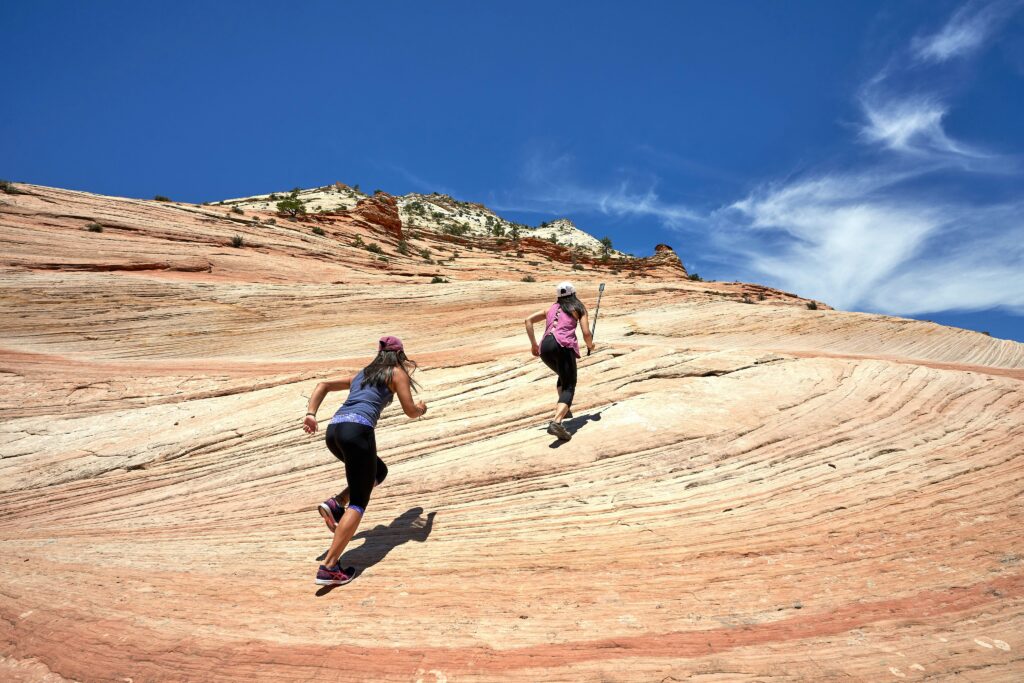
The 12-mile highway connecting the south and east entrances passes through a completely different landscape than Zion Canyon — slickrock domes, checkerboard mesa, fossilized sand dunes, and the mile-long tunnel through the sandstone. Checkerboard Mesa near the east entrance is one of the most photographed geological formations in Utah — a massive dome of Navajo sandstone with a crosshatch pattern caused by ancient wind erosion intersecting with weathering joints. The drive takes 30–40 minutes without stops and offers geological perspectives that the canyon floor doesn’t provide.
💡 Oversized vehicles (RVs, large trucks) require a $15 tunnel escort fee scheduled through recreation.gov. Standard cars drive through free, and the few minutes of darkness punctuated by two natural window openings cut into the sandstone wall are a memorable part of the drive.
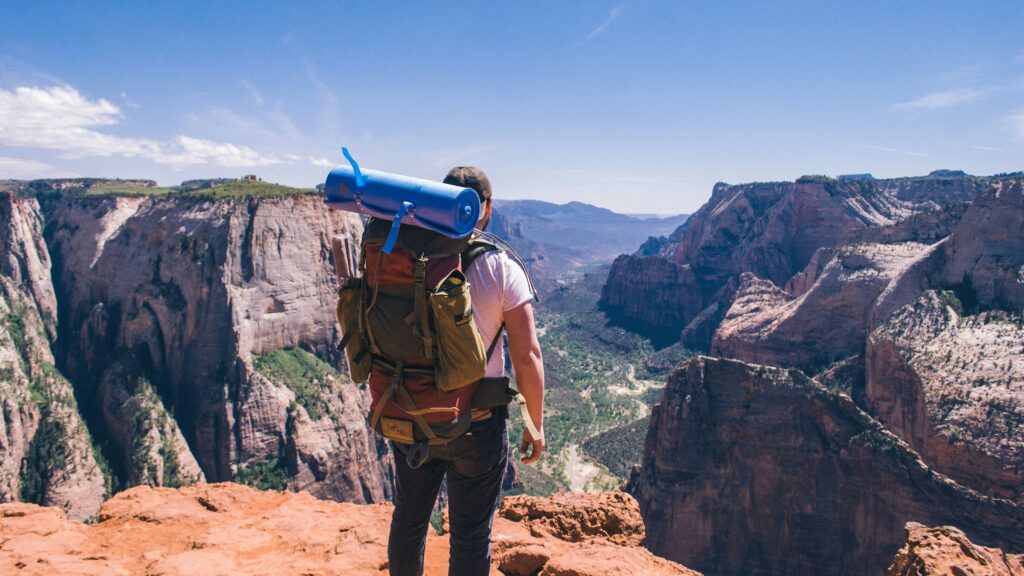
The view from Observation Point (6,507 feet) looks directly down on Angels Landing from above — you can watch permit holders ascending the chains while you sit on a granite ledge 700 feet higher. The traditional route up from the canyon floor (8 miles round trip, 2,148 feet gain) is strenuous. The East Mesa Trail approach from the east entrance road (7.8 miles round trip, 300 feet gain) is far easier and gives you the identical view. The East Mesa Trail passes through pine forest, across open slickrock, and emerges at the Observation Point rim where canyon-approach hikers arrive after a four-hour climb. You arrive moderately warmed up in about two hours.
💡 The East Mesa trailhead requires driving through the east entrance onto a dirt road — a standard car can usually manage in dry conditions. Check current road status at the visitor center. This is the park’s best-kept secret for experienced hikers who want a summit view without the permit lottery and canyon crowds.
One of the canyon’s quietest trails — connecting the Emerald Pools area to the Grotto picnic area along a ledge route above the canyon floor with continuous views of the Great White Throne, Angels Landing, and the Organ. The 2-mile trail has almost no elevation change and is largely unpaved slickrock with cairns. It sees a fraction of the traffic of the Emerald Pools and Angels Landing trails despite running between both. Take the shuttle to Zion Lodge, walk Kayenta to the Grotto, catch the next shuttle back — 90 minutes, no permit, outstanding views the entire way.
💡 The midpoint view of the Great White Throne from the ledge above the canyon floor is one of the best unobstructed photographs in the park. The trail requires some basic route-finding via cairns — not technical, but not a paved path either. Wear proper shoes.
The 2-mile paved round trip from the Temple of Sinawava into the pre-canyon of the Narrows is one of the most beautiful easy walks in the national park system. The trail runs alongside the Virgin River under cottonwood trees with the canyon walls narrowing steadily around you. In spring, the hanging gardens on the walls are in bloom. In fall, the cottonwoods turn gold against the red sandstone. Dusk on the Riverside Walk — after the day visitors have left on the last shuttle — is extraordinarily peaceful. The canyon narrows visible at the trail’s end give the first taste of what The Narrows offers without any wading or gear.
💡 Take the last shuttle of the afternoon to the Temple of Sinawava, walk the Riverside Walk as the canyon empties, and catch a shuttle back after dark. Bring a headlamp for the return walk in low light. The canyon walls in the last light are the most photographed conditions in Zion.
Kolob Canyons is the northwestern section of Zion National Park — accessible from a separate entrance off I-15, 40 miles from the main south entrance. It receives a fraction of the main canyon’s visitors and contains some of the park’s most dramatic scenery: deep red finger canyons, Kolob Arch (one of the world’s longest natural arches at 287 feet), and the 5-mile Taylor Creek Trail through a double-alcove canyon. Most Zion visitors never make the trip. The 5-mile Kolob Canyons Road ends at a viewpoint overlooking a system of finger canyons that are, in some ways, more dramatic than the main canyon — and with almost no one else there.
💡 Kolob Canyons is genuinely uncrowded even in peak summer — the detour from the main canyon takes 45 minutes and the payoff is significant. Combine it with the Taylor Creek Trail for one of Zion’s best half-day outings that almost no one does.
Zion Canyon sits in one of the darkest regions of the American Southwest — minimal light pollution from surrounding communities, canyon walls that block horizon glow on three sides, and elevation that puts you above much of the atmospheric haze. On clear nights from the canyon floor near the Watchman Campground or the Zion Lodge lawn, the Milky Way is visible with the naked eye and the sandstone walls rise in silhouette against a sky dense with stars. The park hosts ranger-led astronomy programs on select evenings (check the schedule at the visitor center). No permit, no fee, no planning required — just stay up past dark and look up.
💡 New moon nights in October and November are the best combination of dark sky and clear conditions. The canyon orientation (roughly north-south) frames the Milky Way as it arcs across the sky between the walls. The Great White Throne in silhouette against a star-filled sky is one of the park’s great unscheduled experiences.
The most famous hike in Utah and arguably the most dramatic day hike in North America. The trail climbs 1,488 feet in 2.4 miles to a narrow fin of sandstone 1,488 feet above the valley floor — the final half-mile involves pulling yourself up exposed chains bolted into rock with significant drop-offs on both sides. The permit system costs $6/person through a lottery on recreation.gov. Seasonal lottery: apply in January for all dates. Daily lottery: apply at 12pm Mountain Time the day before for next-day spots. The view from the summit — the full Zion Canyon spread below, the Virgin River a silver thread, the canyon walls at eye level in every direction — is one of those views that genuinely changes how you think about scale.
💡 Walter’s Wiggles — the 21 sharp switchbacks below the chains section — are the most physically demanding part of the climb. Take them slowly. The chains section requires upper body strength and genuine comfort with exposure. If you’re uncertain about heights, Observation Point via East Mesa (experience 06) gives you a better view with none of the risk.
The full top-down Narrows is a 16-mile overnight slot canyon route — one of the great backcountry adventures in the American Southwest. Beginning at Chamberlain’s Ranch outside the park’s north boundary and ending at the Temple of Sinawava, the route requires wading through the Virgin River for its full length, camping on a designated sandbar in the canyon. Day-use and overnight permits are available through recreation.gov and are significantly harder to obtain than Angels Landing — apply as far ahead as possible. The slot canyon sections in the upper Narrows are narrower, deeper, and more dramatic than the popular lower section.
💡 Zion Outfitter and Zion Adventure Company in Springdale both run guided top-down Narrows trips ($150–$200/person) that include all gear, safety training, and a shuttle to the trailhead. For first-timers on the top-down route, a guided trip removes most logistical complexity and significantly reduces flash flood risk through proper preparation.
Zion’s sandstone contains dozens of technical slot canyons accessible to visitors with a permit and proper gear — narrow passages requiring rappelling, stemming between walls, and swimming through keeper pools. Pine Creek Canyon, The Subway (Left Fork), and Keyhole Canyon are the most popular technical routes. The Subway requires a permit ($15/person) obtained through a lottery — it’s among the most sought-after permits in the national park system. Guided canyoneering trips from Zion Adventure Company and Zion Outfitter ($75–$150/person) provide all gear, instruction, and permit assistance.
💡 Keyhole Canyon is one of the shorter and more accessible slot canyon routes — about 0.7 miles with two short rappels, taking 2–3 hours. A permit is required but it’s less competitive than The Subway. A half-day guided Keyhole trip is the most practical introduction to technical canyoneering for first-timers.
Zion’s backcountry is extraordinarily accessible for an overnight — the West Rim Trail (13.5 miles one-way from the Kolob Terrace Road to the canyon floor) and the top-down Narrows both offer overnight experiences that transform the park from a day destination into a place you genuinely inhabit. The West Rim puts you on the canyon rim at sunrise with views that stretch to Nevada. The Narrows top-down puts you sleeping on a sandbar in a slot canyon. Both require wilderness permits ($15–$30/group) obtained through recreation.gov and both reward the planning effort with the most private and visually extraordinary Zion experiences available at any price point.
💡 West Rim permits are significantly easier to secure than Angels Landing — apply 3 months ahead for peak season dates and your chances are reasonable. The shuttle system enables a one-way trip without a car shuttle, which simplifies logistics considerably compared to most backcountry routes.
Bryce Canyon National Park is 86 miles northeast of Zion — 1.5 hours by car. The two parks are completely different geological experiences: where Zion is vertical sandstone walls and river canyons, Bryce is an amphitheater of eroded limestone hoodoos — thousands of spire formations in orange, red, and white that look like a forest frozen in stone. A day trip from Zion covers the Bryce Amphitheater viewpoints along the rim road and the 2-mile Navajo Loop + Queen’s Garden trail through the hoodoo formations. Between Zion and Bryce, plus an optional Grand Canyon North Rim addition (2.5 hours south), this is one of the great national park circuits in North America.
💡 Bryce Canyon sits at 8,000–9,000 feet elevation — significantly cooler than Zion canyon floor and can have snow at the rim even in May. Bring a warm layer regardless of the season. The winter hoodoo experience — orange spires against white snow — is one of the most visually striking scenes in the American Southwest.
Worth It / Skip It
Don’t Make These Mistakes
Ignoring flash flood warnings and entering The Narrows anyway. Flash floods in the Virgin River slot canyon can arrive as a wall of water and debris moving at 30+ mph with no warning at your location — because the triggering storm is upstream, outside the park, in a watershed you cannot see. The NPS posts a daily flood risk rating at the visitor center and at the Temple of Sinawava trailhead. When the rating is “Flash Flood Watch” or higher, do not enter The Narrows. This is not a suggestion.
Attempting Angels Landing without realistic self-assessment of the exposure. The chains section is not a standard hiking trail — it’s a half-mile of exposed rock ridge with significant drop-offs on both sides, requiring upper body strength to pull yourself up steel chains bolted into the rock. Two questions before attempting it: Are you genuinely comfortable with unguarded exposure at height? Have you hiked 1,300 feet of elevation gain before? If either answer is uncertain, Observation Point via East Mesa Trail (experience 06) gives you a better summit view with none of the exposure risk. That is not a lesser option.
Arriving in peak summer without a heat strategy. The Zion Canyon floor is a heat trap — the walls absorb solar radiation all day and re-radiate it into the canyon, producing temperatures that regularly exceed 104°F in June–August. Shade is limited on many trails. The mitigation is non-negotiable: start hiking before 8am, carry a minimum of 3 liters of water, eat salty snacks, and get off exposed trails by 11am. The park’s most commonly treated medical emergency is entirely preventable with those three habits.
Assuming South Campground is available when planning in-park camping. South Campground — the second major NPS campground in Zion Canyon — is closed for a long-term rehabilitation project through at least 2026 with no confirmed reopening date. Many travel sites and booking platforms still list it as an option. Watchman Campground is the only NPS campsite currently operating in the canyon. If your itinerary includes in-park camping and you find South Campground listed as available on a third-party site, verify current status directly at nps.gov/zion before booking anything.
VacayValue Scorecard — Zion National Park
Packing List — Zion National Park
Every Sunday: One Destination. One Straight Take.
Join travelers who plan smarter. One email per week — verified costs, specific advice, no filler.
Zion Is the Best Dollar-for-Dollar Adventure Experience in North America. The Narrows Alone Justifies the Trip.
The case for Zion as the highest-value adventure destination in the Americas is straightforward: $35 buys seven days of access to The Narrows, Angels Landing, Kolob Canyons, Observation Point, and some of the most concentrated geological drama on earth. The free shuttle eliminates parking logistics. The permit system — $6 for Angels Landing — manages crowds without pricing anyone out. The gateway town of Springdale has good lodging and gear rental within walking distance of the park entrance. Las Vegas is 2.5 hours away. The entire trip is executable from the mainland US for under $500 per person on a budget itinerary.
The honest constraints: summer heat is real and requires serious adaptation, The Narrows flash flood risk demands daily weather awareness, and in-park accommodation books out months ahead. None of these are reasons not to go — they’re reasons to plan properly and visit in March–April or September–October when conditions are at their best and crowds are most manageable. Zion rewards preparation in a way few destinations do — the gap between a prepared visit and an unprepared one is larger here than almost anywhere else.
Enter the Angels Landing lottery before anything else. Book Watchman Campground or a Springdale hotel 6–8 weeks ahead. Rent Narrows gear your first morning. Do the Canyon Overlook Trail the afternoon you arrive. Get into The Narrows before 8am your second day. Drive Kolob Canyons on your last afternoon. Extend by one day if you can.