
The Maldives: Overwater Villas, Whale Sharks & What It Actually Costs
Overwater villas, turquoise lagoons, and whale sharks beneath your snorkel — here’s what this iconic destination actually costs, and how to make the most of every dollar you spend.
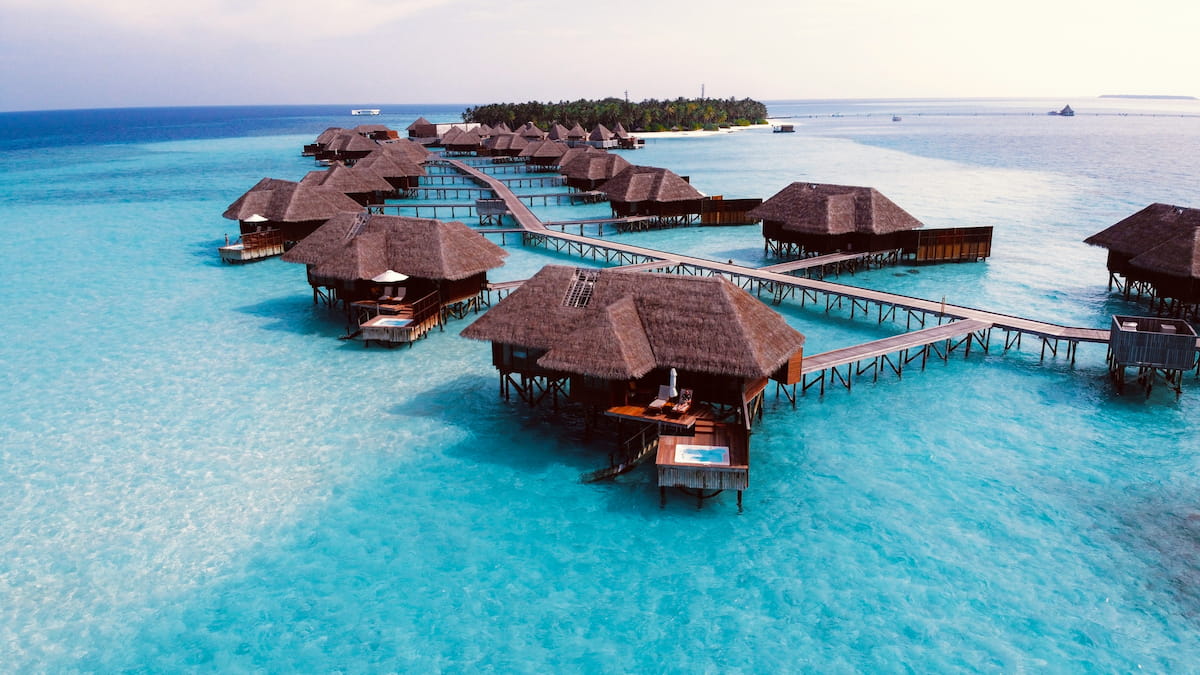
The moment the seaplane banks low over the atoll and the water shifts from navy to that impossible shade of electric teal, you understand why people spend years saving for this. Below you are 1,192 coral islands scattered across the Indian Ocean like confetti, and for the next seven days, one of them is yours.
The Maldives carries a reputation as the most extravagant beach destination on earth — overwater villas starting at $800 a night, seaplane transfers that cost more than a transatlantic flight, restaurant meals priced like Manhattan. That reputation is deserved at the top end. But since 2009, when the government allowed tourists to stay on inhabited local islands, a second Maldives has quietly emerged: guesthouses at $80 a night, shared speedboats for $25 each way, whale shark excursions from $80 a person. This guide lays out both worlds with verified prices, so you can decide which version — or what combination — makes sense for you.
What’s In This Guide
📅 Best Time to Visit the Maldives
January through March delivers the Maldives at its absolute best — calm seas, 80+ feet of underwater visibility, and reliably sunny skies. If budget matters, April and November offer the best trade-off of decent weather and meaningfully lower rates. The monsoon months (May–October) reward scuba divers willing to tolerate some rain — whale sharks peak in South Ari Atoll in August, and manta rays at Hanifaru Bay are most abundant from June through October.
Where to Stay in the Maldives
The most important lodging decision in the Maldives isn’t which hotel — it’s which system. Local island guesthouses sit on inhabited Maldivian communities: no alcohol, modest dress codes on public beaches, but authentic culture and dramatically lower costs. Resort islands are private paradises where one hotel owns the entire island — alcohol flows freely, bikinis are welcome anywhere, and everything is priced accordingly. A growing strategy is the “split stay”: a few nights on a local island, then one or two nights at a resort for the full overwater villa experience. Resort rates below are shown before the 17% TGST and 10% service charge — budget an additional ~27% on all resort bills. All rates verified March 2026.
Maafushi is the most established budget island in the Maldives, and Alaika is a solid representative of what you get at this price point: clean air-conditioned rooms, consistent Wi-Fi, and breakfast included. The island has a designated bikini beach, a handful of dive shops competing on price, and a dozen tour operators running excursions to sandbanks, whale shark sites, and surrounding reefs. It’s a real Maldivian community — you’ll hear the call to prayer, eat at local cafés for $5–$15 a meal, and leave with a very different experience than resort travelers.
Kandima punches above its price class with a large, activity-rich island feel — multiple restaurants, a tennis court, a spa, and a dive center, all without the ultra-luxury price tag of its neighbors. Beachfront studio villas are the entry point; they’re spacious, well-designed, and open directly to a genuinely pristine lagoon. The all-inclusive package (available from around $480/night) makes financial sense here: when resort meals average $40–$80 per person, bundled dining pays off quickly. Transfer is a 25-minute domestic flight plus a short speedboat ride.
Conrad Rangali is one of the Maldives’ most recognizable resorts — home to Ithaa, the world’s first all-glass undersea restaurant — but it earns its price through genuine execution, not just Instagram cache. The overwater villas are private, large, and positioned above a lagoon that shifts between six different shades of blue throughout the day. The 30-minute seaplane arrival is part of the experience, not just logistics. South Ari Atoll placement puts you near excellent whale shark and manta ray sites without traveling far from your villa.
Get the Free Maldives Trip Planner
Which islands, which transfer, which tier — our weekly newsletter breaks down the decisions that actually move the needle on your budget.
15 Best Maldives Experiences
The Maldives splits cleanly into two experience categories: the natural world, which is free or cheap regardless of where you stay, and the curated resort world, which can cost almost anything you’re willing to spend. The five free experiences below are genuinely free — no tour operator required, no resort membership. The six paid experiences range from $25 to $120 per person and represent the Maldives’ best accessible adventures. The four Signature Experiences define why people plan years ahead for this trip.
Every inhabited local island in the Maldives sits above a living coral reef, and on many — particularly Maafushi, Ukulhas, Rasdhoo, and Dhigurah — the house reef is accessible directly from the shoreline with nothing more than a mask and fins. You’ll find blacktip reef sharks, sea turtles, parrotfish, and moray eels within fifty meters of the beach. The underwater world doesn’t know which side of the resort fence you’re on; the reefs near budget guesthouses are frequently identical to those accessed by $1,500/night villas. Gear rental from local dive shops runs $12–$25/day if you don’t bring your own.
💡 The clearest water and most active reef life is typically at sunrise — reef sharks are most visible in early morning, and the light through the water creates extraordinary conditions before tourist boat traffic stirs up the sediment.
Most visitors treat Malé as a layover city, but the capital rewards an afternoon of wandering. The Grand Friday Mosque (Masjid al-Sultan Muhammad Thakurufaanu Al Auzam) — the largest in the Maldives, with its distinctive white dome and green minaret — is striking and open to respectful visitors outside prayer times. The old Friday Mosque (Hukuru Miskiy), built in 1656 from coral stone, is one of the oldest buildings in the country. The fish market, running along the harbor front, gives you an honest look at the tuna-centered economy that underpins Maldivian life. Sultan Park and the adjacent National Museum round out a genuine half-day.
💡 Dress modestly for the mosques — shoulders and knees covered. The fish market is most active early morning (7–9am) when the day’s catch arrives.
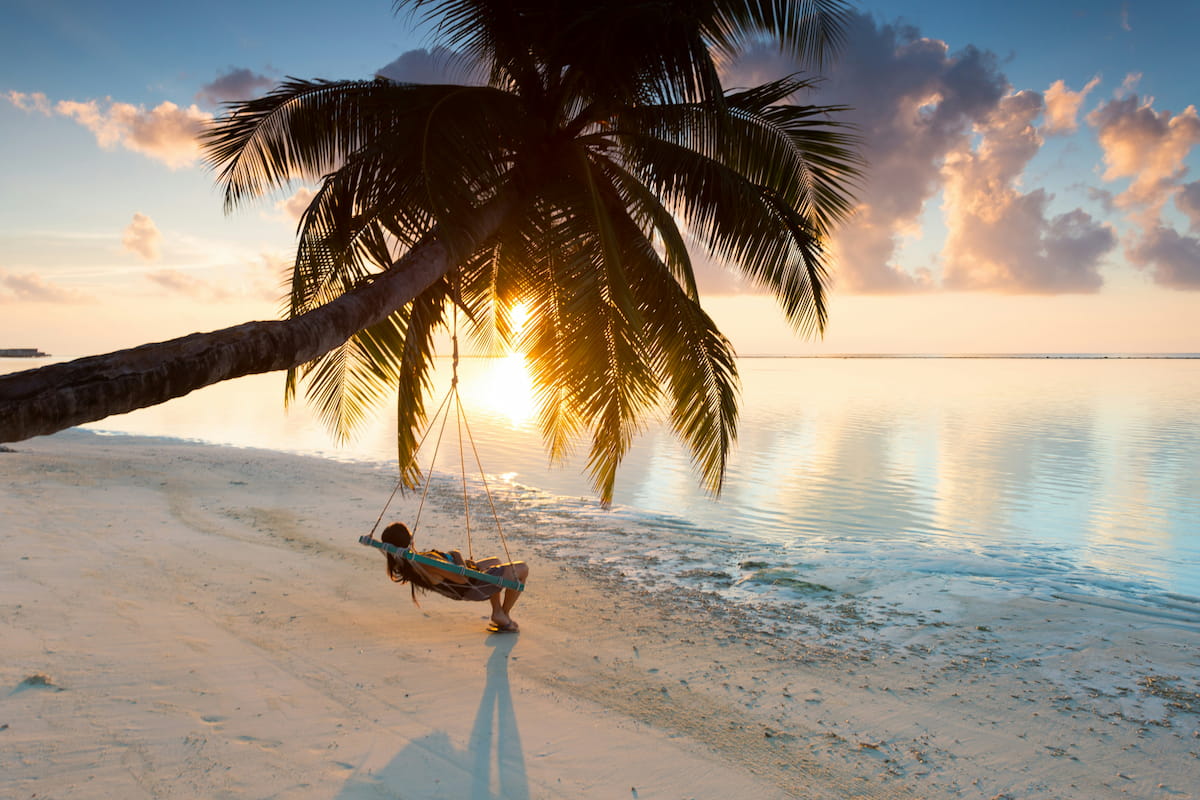
Every local island has a designated bikini beach — a stretch of shoreline where Western beach norms are permitted while the rest of the island follows conservative Maldivian dress codes. These beaches are free, often uncrowded compared to resort beaches, and face the same Indian Ocean waters that cost hundreds of dollars per night to sleep next to. Maafushi’s bikini beach is wide and well-maintained. Dhigurah has a remarkable 2.5-kilometer-long beach on one side of the island — one of the longest in the country. The turquoise you see in photographs is not enhanced.
💡 On local islands, cover up the moment you step off the bikini beach — a light sarong or cover-up is mandatory in the main village areas. Locals are gracious about tourism but appreciate when visitors respect the cultural boundary.
On certain beaches in the Maldives, particularly during warmer months (May through November), phytoplankton called Noctiluca scintillans lights up the surf with vivid blue bioluminescence when disturbed. Walking the shoreline or wading into the shallows causes the water to flash electric blue around your feet — one of the most genuinely surreal natural phenomena on earth. Vaadhoo Island gained international fame for this, but the phenomenon occurs at beaches across the archipelago. No tour operator, no ticket, no schedule required — just a dark beach and some patience after 9pm.
💡 Bioluminescence is strongest on moonless nights during high tide. Ask your guesthouse owner whether they’ve seen it recently on the local beach — sightings are inconsistent and unpredictable, which makes an encounter feel genuinely lucky.
The harbor of any inhabited island tells you more about the Maldives than a resort ever will. Traditional wooden dhoni boats — long, narrow, hand-painted vessels that have carried Maldivians across these atolls for centuries — bob alongside modern speedboats and fishing trawlers. Fishermen sort their tuna catch on the dock in the early morning. Kids dive off the jetty in the late afternoon. Sitting at a local teashop (called a hotaa) with a short coffee and a piece of mas huni — the national breakfast of shredded smoked tuna with coconut and lime — costs about $5 and is worth more than any resort breakfast.
💡 Don’t skip the hotaa experience. Mas huni with roshi (flatbread) is the closest thing the Maldives has to a culinary identity — every local island teashop makes it, and most charge $3–$6 for a full plate.
The standard snorkeling excursion from any local island hits three to four distinct sites — typically a coral garden, a turtle-cleaning station, and a reef channel where current brings in large pelagic fish. These run on small speedboats with 8–16 people, guided by local operators who know exactly where the reef sharks congregate and when the manta rays pass through. The price variance is largely about operator quality: the cheapest will hand you a mask and point at the water; the better ones brief you on marine etiquette, provide quality equipment, and use drones to locate wildlife in real time.
💡 Visit tour agencies the evening before rather than the morning of — operators can tell you about that day’s sightings and whether conditions look favorable. And always ask to see the equipment before you pay.
A Maldivian sandbank is exactly what it sounds like — a temporary strip of white sand rising from the ocean, surrounded on all sides by water the color of a swimming pool, with no shade, no buildings, and no people except whoever got on the boat with you. Most tours include 90 minutes to two hours on the sandbank, snorkeling gear for the surrounding reef, and transportation by traditional dhoni. Some operators add a fresh coconut or a light picnic. The experience is objectively absurd in the best possible way — you’re standing on a tiny island in the Indian Ocean with nothing around you for miles.
💡 Sandbanks shift with tides and storms — what’s a firm strip of sand at low tide may be partially submerged at high tide. Book for low tide if you can, and bring waterproof sandals rather than going barefoot, as the sand gets extremely hot midday.
Spinner dolphins are extraordinarily common in the Maldives — the channels between atolls are prime feeding grounds, and most sunset cruises encounter pods of 20 to 100 animals within 30 minutes of leaving the harbor. The dhoni rocks gently as the sun turns orange and red, dolphins leap and spin alongside the bow, and the day’s best photos happen here rather than underwater. It’s a softer experience than the adrenaline of whale shark snorkeling, and arguably the one most people describe when they get home. Most operators run 2-hour cruises departing around 5pm.
💡 Spinner dolphins are almost guaranteed, but the term “spinner” refers to their spinning jump — not a guarantee of synchronized swimming formations. Come at dawn when they’re most active and playful if that’s specifically what you want to see.
South Ari Atoll is the only place on earth where whale sharks — the world’s largest fish, growing up to 40 feet long and absolutely harmless to humans — are present year-round. From Dhigurah or Maafushi, half-day excursions run directly to the Marine Protected Area where these animals feed in the shallows. You slip in alongside them and drift at the surface while a 30-foot filter-feeder glides past, occasionally so close you can see the individual spots along its back. Hanifaru Bay in Baa Atoll hosts massive manta ray aggregations from May through November — on peak days, 100+ mantas feed simultaneously in the funnel-shaped bay. Sightings are not guaranteed, and most reputable operators offer a partial refund or return trip if conditions are impossible.
💡 Hanifaru Bay is UNESCO-protected and strictly regulated — no diving permitted, snorkeling only, maximum 75 people per session, $17 Marine Protected Area fee per person. Book with operators who follow these rules; the restrictions exist to prevent the kind of overcrowding that has damaged similar sites elsewhere.
Line fishing from a traditional dhoni at sunset is one of the most culturally grounded experiences available in the Maldives — and the version that includes cooking your catch back at the island afterward is a genuine highlight. The technique is hand-lining without rods, the same method Maldivians have used for centuries. Yellowfin tuna, jackfish, and grouper are common catches. Most operators include the boat, equipment, bait, and either a beach BBQ or guesthouse kitchen preparation. Even if you catch nothing, spending an evening on the open ocean in a traditional wooden boat as the atolls go dark around you is worth the price.
💡 The “traditional” designation matters — look for tours using actual dhoni boats with hand lines, not modern motor vessels with rods. The former is an authentic cultural experience; the latter is just regular fishing.
The Maldives consistently ranks among the top five scuba diving destinations on earth. Visibility frequently exceeds 100 feet, currents funnel plankton through channels that attract extraordinary concentrations of large pelagic species, and sites like Fish Head in North Ari Atoll and HP Reef near North Malé Atoll deliver grey reef sharks, eagle rays, hammerheads, and napoleon wrasse on a single dive. Local island dive shops charge $58–$80 per fun dive; resort dive centers charge $85–$120 and offer more comfort and instructor availability. Certified divers: bring your log book. Most local operators in South Ari Atoll will offer an informal whale shark dive from the boat for an additional $20–$30.
💡 Dive packages of 5+ dives typically reduce the per-dive cost by 15–20%. If you’re staying 7 nights and plan to dive daily, a 10-dive package from a local shop often works out to $55–$65 per dive — significantly cheaper than booking day by day.
A seaplane transfer isn’t just transportation — it’s the defining first moment of the Maldives for people who stay at resorts in remote atolls like Baa, Lhaviyani, or South Ari. The Twin Otter banks low over the water, and you see the full geometry of the archipelago from above: rings of coral surrounding lagoons so turquoise they look artificial, tiny islands with their single resort surrounded by nothing but ocean in every direction. Then the plane descends, lands on open water, and taxis to a floating jetty where resort staff are waiting with cold towels and mocktails. Shared seaplane transfers run $290–$700 RT per person depending on resort and atoll.
💡 Window seats are essential — request one when confirming your transfer. The seaplane only operates in daylight (6am–4pm), so if your international flight arrives late, plan for a Malé overnight hotel and add that cost to your budget.
Several resorts and a handful of mid-range operators offer a version of this: a private sandbank — just your group, a table set in the sand, candles, a chef, and the Indian Ocean in every direction — for a meal that runs two to four hours. The logistics are elaborate (the kitchen is back on the island, the food arrives by boat), the setting is preposterous (you are eating dinner on a tiny island in the middle of the ocean), and the occasion-defining quality is absolute. This is the Maldives experience people describe for years afterward. Resort-organized versions include the boat transfer, full menu service, and setup — some include a private sommelier if alcohol is part of the package.
💡 Several local island operators now offer a mid-range version of this at $150–$200 per couple — simpler setup (BBQ and cooler rather than plated service) but the same remarkable setting. Ask your guesthouse if they can arrange a “private sandbank picnic” before assuming you need a luxury resort for the experience.
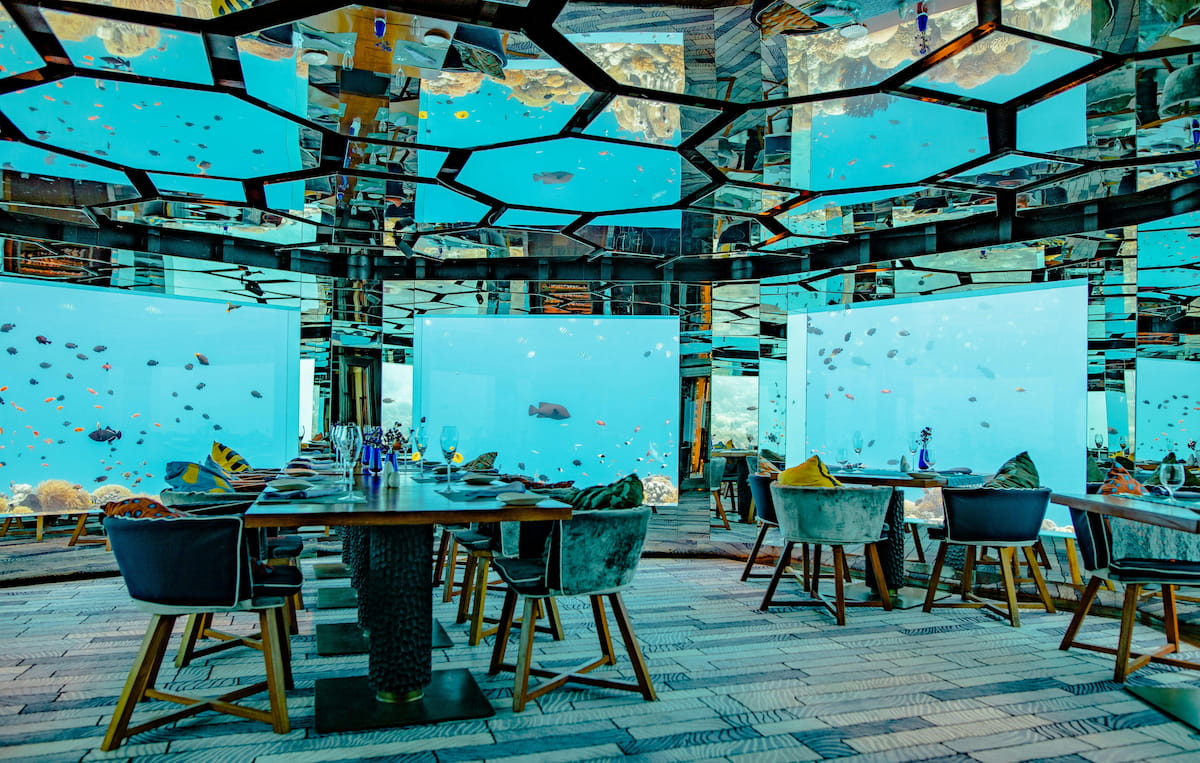
The Maldives is home to several of the world’s only fully submerged restaurants — glass-walled dining rooms built beneath the lagoon where reef fish, rays, and occasional sharks drift past your table while you eat. Conrad Maldives Rangali Island’s Ithaa was the world’s first, and it remains the most celebrated; reservations are made months in advance. Huvafen Fushi offers an undersea spa with treatment rooms 16 feet below the surface. The food quality at these venues is genuinely excellent — the price reflects both kitchen investment and the engineering miracle of eating dry underwater. Non-resort guests can sometimes access undersea restaurants for lunch by booking directly, but dinner reservations are typically prioritized for in-house guests.
💡 Ithaa at Conrad Maldives seats just 14 people and is booked by resort guests first. If staying elsewhere, call the resort directly as day-guest lunch bookings occasionally open up within 2–3 days of your date when cancellations come in.
An overwater villa in the Maldives is genuinely unlike anything else in the world. Your villa sits on stilts above the lagoon — you step off your deck directly into water you can see through to the coral below. The glass floor panel lets you watch fish from your living room. Sunrise from an overwater deck, coffee in hand, with nothing but Indian Ocean visible in every direction, happens in near-perfect silence. Entry-level overwater villas start around $900/night at well-regarded resorts; mid-range properties run $1,200–$1,500; top-tier properties reach $2,500–$4,000+. Even one night represents a meaningful budget outlay, but for many travelers this is the experience they’ve been planning for a decade. The split-stay strategy — combining two nights in an overwater villa with four or five nights in a local guesthouse — makes the bucket-list moment possible without spending a week at resort prices.
💡 The best villa positioning is over the outer lagoon rather than the inner — outer-facing villas typically have clearer water and more marine life directly beneath the deck. Ask specifically about water clarity and marine life under your specific villa before booking.
Worth It / Skip It
Don’t Make These Mistakes
Forgetting to calculate the transfer cost before booking your resort. Seaplane transfers run $290–$700 per person round trip and are not included in room rates. A “bargain” overwater villa at $400/night in a remote atoll may end up costing more than a $600/night resort that’s a 30-minute speedboat ride away. Always check the atoll location and transfer type before comparing resort rates — the total cost picture is what matters.
Arriving late and missing your seaplane window. Seaplanes operate strictly between 6:00 AM and approximately 4:00–4:30 PM due to weather and safety regulations. International flights frequently arrive in Malé in the early hours of the morning or late evening. If your flight lands after 3:00 PM, you almost certainly need an overnight in Malé or Hulhumalé — budget $100–$180 for this, factor it into your trip cost, and don’t discover it on the tarmac.
Booking a local island stay without understanding the cultural norms. Local islands follow Islamic law: no alcohol anywhere on the island (including your guesthouse room), no public displays of affection, no bikinis outside the designated bikini beach, and modest dress throughout the village. These are not suggestions. They’re part of what makes local island stays authentic and affordable, and most travelers find them entirely easy to manage — but they should be understood upfront rather than discovered on arrival.
Ignoring the 17% TGST and 10% service charge on all resort bills. Every resort in the Maldives adds Tourism Goods and Services Tax (17%) plus a mandatory service charge (10%) to essentially every transaction — rooms, meals, excursions, spa, minibar. That’s a 27% addition to every advertised price. A $400/night room costs $508 after charges. A $40 lunch costs $51. Budget this buffer before arrival rather than experiencing sticker shock at checkout.
VacayValue Scorecard — Maldives
Packing List — Maldives
Plan Your Maldives Trip — Free
Weekly guides on getting the most from international beach destinations, including budget strategies and verified price updates.
The Most Expensive Destination on This Site — and Worth Knowing Exactly Why
The Maldives scores a 6.8 out of 10 on the VacayValue scale, and that number tells an honest story: this is the destination where flights are expensive, resorts are genuinely premium, and the per-day cost at a mid-range property would fund a week elsewhere. No amount of travel hacking closes that gap entirely. What the score also captures is a 5.0 in Experience Quality — the maximum — because what you get in exchange for those dollars is genuinely without equal. Whale sharks drifting past your snorkel in open ocean. A lagoon so clear you can read the coral species from forty feet above the surface. An atoll system that looks, from the seaplane window, like the earth forgot to finish filling it in with land.
The local island system changes the value calculation dramatically for budget-minded travelers. A couple staying on Maafushi or Dhigurah, eating at local cafés, and booking excursions directly with island operators can have a full Maldives experience — whale sharks, manta rays, sandbanks, pristine reefs — for under $4,800 including international flights. That’s not a compromise version. The water is identical. The marine life doesn’t check your accommodation tier. The split-stay approach — three or four nights on a local island, two nights in an overwater villa — has become the smart traveler’s answer to the binary choice between budget guesthouse and luxury resort.
The mistakes that destroy Maldives budgets are all calculable in advance: transfer costs not included in room rates, the 27% tax and service charge on every resort transaction, seaplane logistics that require a Malé overnight, alcohol at resort bar prices. Know those numbers before you book, and the Maldives becomes a destination you can plan intelligently rather than one that surprises you at checkout. The experience at the other end of that planning — watching the sun sink into the Indian Ocean from a deck with nothing but water in every direction — lives up to every story you’ve ever heard about it.