
Yellowstone 2026: What a Family Trip to the World’s First National Park Really Costs
Bison crossing the road. A geyser erupting on schedule. Half a rainbow over a waterfall your kids can’t stop staring at. And a park entrance fee that’s $35 for the whole car. Here’s the honest breakdown of what a Yellowstone family trip actually costs in 2026.
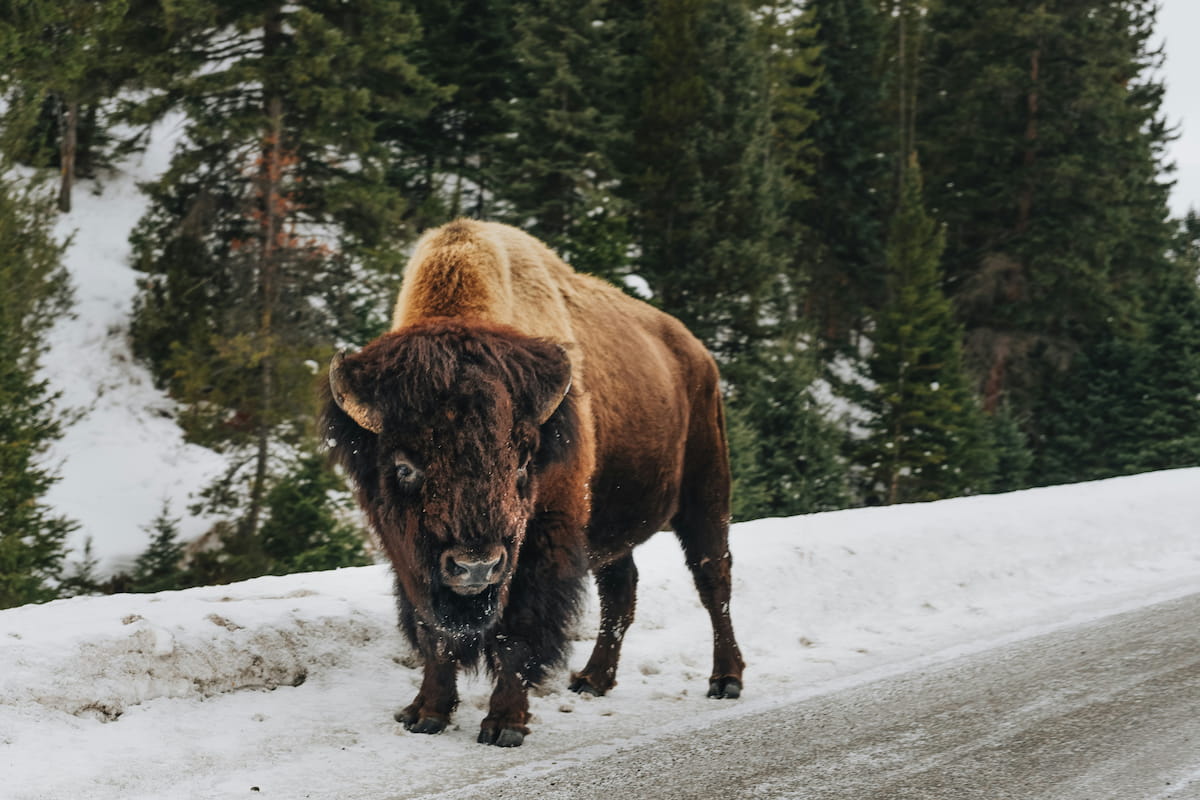
You’ve slowed the car to a full stop because a bison is standing in the middle of the road, twenty feet from your bumper, completely unbothered by your existence. Your kids have stopped arguing about the seat divider. Nobody is looking at a screen. This is the whole point of Yellowstone, and it costs you exactly nothing.
Yellowstone is where the VacayValue model makes the most sense of any destination in this library. The best experiences here — the geysers, the wildlife, the geothermal basins, the waterfalls — are all included in a $35 vehicle entrance fee that covers your entire family for seven consecutive days. No per-person admission. No upsells. Children under 16 always free. The costs that do add up are flights to Bozeman (the main hub), a rental car (non-negotiable), and lodging — and inside the park, those lodges book out 12 or more months in advance. Plan far ahead, and Yellowstone is one of the most remarkable family values in American travel. Ignore that warning, and you’re in a West Yellowstone motel wondering how you missed the reservation window.
What’s In This Guide
📅 Best Time to Visit Yellowstone
Sweet spot for families: May, September, and early October. May gives you wildlife at peak activity, waterfalls at full flow, and manageable crowds before summer hits. September is arguably even better — the elk rut is one of the most dramatic wildlife spectacles in North America, crowds drop dramatically after Labor Day, and prices fall with them. Note: 2026 fee-free days at all national parks include June 14 — your $35 entrance fee is waived on that date.
Where to Stay in Yellowstone
Staying inside the park puts you in the wilderness at dawn and dusk when wildlife is most active. Gateway towns (West Yellowstone, Gardiner, Cody) cost less but add significant drive time each day. In-park lodges book out 12+ months in advance for summer dates — treat this like a concert ticket sale, not a casual reservation. Prices below verified March 2026 for summer season.
Gardiner sits at Yellowstone’s only year-round entrance — the North Entrance through the historic Roosevelt Arch — which means even during winter closures the park is accessible from here. Gateway town hotels in Gardiner run $120–$180/night in summer, significantly less than in-park alternatives, with none of the 12-month booking gauntlet. The drive to Mammoth Hot Springs is under 5 minutes; Lamar Valley for prime wildlife viewing is about 45 minutes. A genuinely strong base for families who prioritize budget over waking up inside the park.
Canyon Village sits at the geographic center of Yellowstone, putting you within 45 minutes of every major attraction. The Grand Canyon of the Yellowstone — where the river drops 308 feet through a canyon of yellow and orange rock — is a short walk from your cabin door. Canyon Lodge offers modern lodge rooms and western-style cabins, making it one of the most comfortable and family-friendly in-park options. Open late May through mid-October; book through yellowstonenationalparklodges.com, available 12 months ahead.
Built in 1903–1904 from local lodgepole pine logs and stone, Old Faithful Inn is the largest log-structure hotel in the world and the most-requested lodging in the entire national park system. The towering lobby with its stone fireplace and handcrafted clock is genuinely extraordinary — this is what arriving at a national park felt like before highways, and it’s worth experiencing once. Rooms with balcony views of Old Faithful are the most coveted in the building. Open May 1 – October 12, 2026. Rooms from around $165 (basic, shared bath) to $700+ (suites). Book at yellowstonenationalparklodges.com — available 12 months ahead, sells out within days for peak summer dates.
Get the Free Yellowstone Family Trip Planner
Lodge booking timeline, wildlife hotspot map, and packing guide — all in one email.
15 Best Yellowstone Experiences
The single most important thing to understand about Yellowstone: the best experiences here cost nothing beyond the $35 park entrance fee. Geysers, hot springs, waterfalls, wildlife — all included. Grouped by cost so you can plan around your budget.
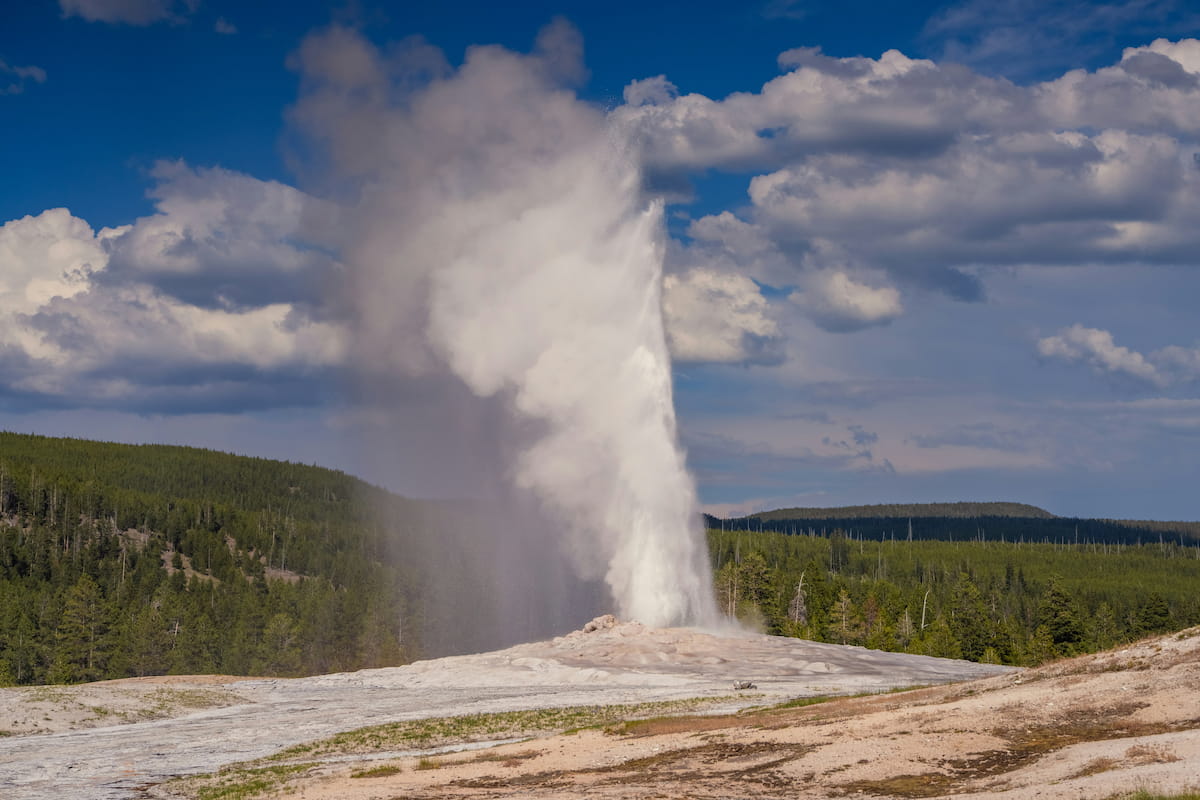
Old Faithful erupts approximately every 90 minutes, reliably enough that the predicted eruption time is posted at the visitor center. The 5-minute eruption sends superheated water up to 185 feet — genuinely spectacular and exactly what everyone came to see. But the surrounding Upper Geyser Basin is the deeper experience: a 3-mile boardwalk trail past Castle Geyser, Riverside Geyser, Morning Glory Pool, and dozens more active geothermal features. Plan 2–4 hours to walk the full basin; plan a full day if the kids want to wait for multiple eruptions.
💡 Check the predicted eruption time at the Old Faithful Visitor Education Center when you arrive — it’s accurate to within ±10 minutes. The viewing area can hold a lot of people, but arriving 20 minutes before the predicted time guarantees a front-row spot. Don’t miss the boardwalk past the inn toward Castle Geyser — that section has almost none of the crowds.
Lamar Valley is known as “America’s Serengeti” — a broad glacially carved valley in Yellowstone’s northeast where bison herds of hundreds, grizzly and black bears, wolves, elk, pronghorn, and coyotes all operate in view of the road. The key is timing: arrive before sunrise and you’ll share the valley with serious wildlife photographers and rangers with spotting scopes. Arrive at 10am and you’ll see bison, possibly bears, but the predator activity will have ended. Lamar Valley is the one place in the lower 48 states where wild wolves are regularly visible from a car window.
💡 Pull over anywhere you see another car already stopped with binoculars or a spotting scope — that cluster is the field signal that something good is being watched. Rangers often station themselves where active wildlife is present and will share their equipment. Never approach wildlife; the minimum legal distance is 100 yards from bears and wolves, 25 yards from bison.
Grand Prismatic Spring is the largest hot spring in the United States and the third largest in the world — 370 feet in diameter, 121 feet deep, with rings of brilliant blue, green, yellow, and orange caused by heat-resistant microorganisms. From the boardwalk at its edge, it’s impressive. From the Fairy Falls trailhead overlook (1.3 miles round trip, very easy), it’s one of the most dramatic and otherworldly views in the park — the aerial perspective shows the full rainbow ring pattern against steam rising from the surface. This overlook hike is one of the most underrated moves in Yellowstone.
💡 The overlook trail leaves from the Fairy Falls trailhead — don’t mistake it for the Midway Geyser Basin boardwalk, which gives a ground-level view from the edge. The overlook takes 30–45 minutes round trip and the view is categorically different. Mid-morning light (9–11am) is ideal for photography.
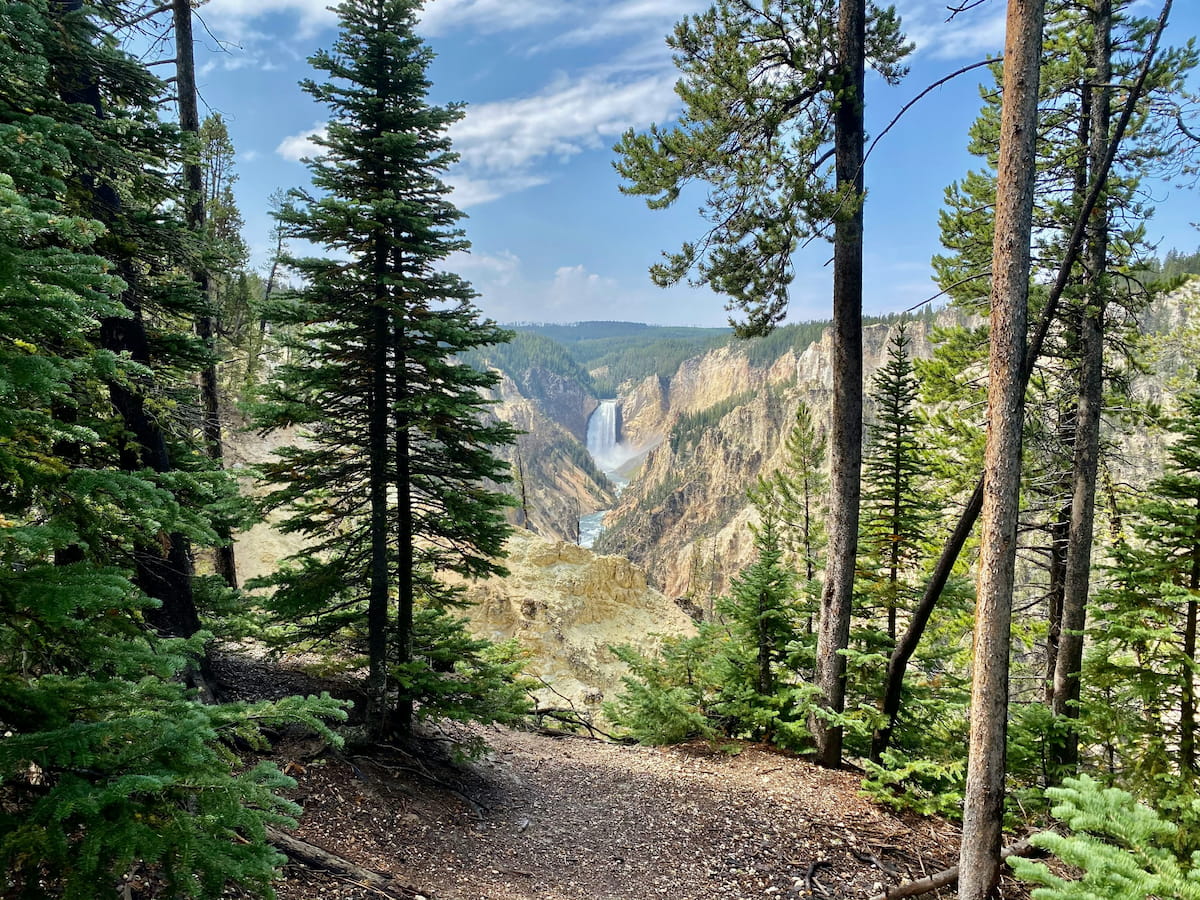
The Yellowstone River drops 308 feet at Lower Yellowstone Falls into a canyon of yellow, orange, and white rhyolite — a canyon 800–1,200 feet deep and 20 miles long. Artist Point on the South Rim gives the most iconic view (and the most reproduced photograph in Yellowstone’s history); Uncle Tom’s Trail descends 328 steps to a platform directly below the Upper Falls. The canyon walls were painted by Thomas Moran in 1871, helping convince Congress to protect Yellowstone — you’re looking at the view that created the national park idea. A full loop of both rims takes 3–4 hours and is accessible to most fitness levels.
💡 Lookout Point on the North Rim has a slightly closer perspective of the Lower Falls than Artist Point and is typically less crowded. Do both. The 30-second walk difference between viewpoints is worth it for the change in angle.
The hottest, most dynamic, and most acidic geothermal area in Yellowstone — and the one that changes most unpredictably. Steamboat Geyser, the world’s tallest active geyser (capable of erupting to 300+ feet), sits here and has been unusually active in recent years. The basin’s two connected boardwalk loops cover about 2 miles through a landscape of fumaroles, mudpots, and intensely colored hot pools that look genuinely alien. This is the most purely geological experience in the park — less crowded than Old Faithful, more intense in character.
💡 The Norris Museum of Thermal Biology is directly adjacent to the basin and free — it provides context for the microbial life in the hot springs that gives the pools their extraordinary colors. Worth 30 minutes before or after the boardwalk.
Mammoth Hot Springs produces constantly shifting travertine terraces — calcium carbonate deposits that flow and change shape over months. The boardwalk system (Upper and Lower Terraces) winds through vivid white, orange, and rust-colored formations unlike anything else in the park. Palette Spring and Minerva Terrace are the most photogenic, though the formations shift enough that what’s active changes year to year. Mammoth is also where elk most reliably wander through the hotel grounds year-round — the town is essentially an elk habitat, and the historic Fort Yellowstone buildings add architectural interest to the wildlife watching.
💡 Mammoth is the only area of Yellowstone accessible by regular vehicles year-round, making it the gateway to the park when other roads are closed. Even if you’re visiting in summer, pair this with a visit to the Albright Visitor Center’s natural history exhibits — free and genuinely informative.
Roosevelt Corrals at the northeast corner of the park offer guided horseback rides through sagebrush flats and forested hills managed by Xanterra, Yellowstone’s primary in-park concessionaire. One-hour rides run ~$70/person; two-hour rides ~$115/person. Both are available June through early September. Riders must be at least 8 years old, 48 inches tall, and under 240 lbs. The two-hour ride climbs through Lost Canyon and around Lost Lake for genuine backcountry trail views that are inaccessible by vehicle. Book well ahead at yellowstonenationalparklodges.com — rides fill in advance during summer.
💡 The horseback ride combines naturally with the Old West Dinner Cookout at Roosevelt Lodge — guests can arrive at the cookout by horseback or canvas-covered wagon for an authentically western experience that kids consistently cite as a trip highlight.
A steak dinner served at a remote canyon cookout location accessible by horseback or canvas-covered wagon — one of the most genuinely memorable family experiences in Yellowstone. Guests are transported out to Pleasant Valley for a ranch-style cookout: steak, baked beans, coleslaw, and cowboy songs under the Wyoming sky. Stagecoach + dinner runs ~$92/adult, ~$71/child; 1-hour horseback ride + dinner runs ~$126/adult, ~$109/child. Available mid-June through mid-September; book through yellowstonenationalparklodges.com. This books out months in advance for July and August.
💡 Sunset timing matters here — book the latest available departure for the most dramatic light over Pleasant Valley and Hellroaring Mountain during dinner. The cowboy songs afterward become a family story that gets told for years.
The largest freshwater lake above 7,000 feet in North America — and a genuinely different perspective on Yellowstone than anything experienced by car or foot. The Scenicruise is a 1-hour narrated boat tour aboard the Lake Queen, operating mid-June through mid-September from Bridge Bay Marina. Osprey, bald eagles, white pelicans, and thermal activity on the lake bottom make this a great family activity at a reasonable price (~$20/adult, ~$12/child — confirm current pricing at yellowstonenationalparklodges.com, as rates adjust seasonally). Book ahead; tours sell out on peak summer days.
💡 You can also rent motorboats and rowboats at Bridge Bay Marina for self-guided lake exploration. The backcountry shoreline accessible only by water has some of the park’s most isolated and dramatic scenery.
An early morning guided wildlife tour in a refurbished 13-passenger Historic Yellow Bus with a retractable roof for open-air viewing. Expert guides lead groups to the Northern Range where bears, wolves, bison, and elk are most active at dawn. Departs Mammoth Hotel around 6am and runs ~4.5 hours. Pricing runs approximately $75/adult and $38/child ages 8–15 (under 8 free); confirm exact 2026 pricing at yellowstonenationalparklodges.com. Late May through late September. This is the accessible, family-friendly entry point for expert-guided wildlife watching — the guide’s knowledge of where animals were yesterday is the whole value.
💡 The Historic Yellow Bus experience is unique to Yellowstone and worth choosing over a modern van tour for the open-roof wildlife viewing. Book as far ahead as possible — early morning tours on summer weekends fill months in advance.
Just outside the North Entrance in Gardiner, the Yellowstone River runs through Paradise Valley with guided whitewater rafting trips running Class II–III rapids — appropriate for families with children 6+ depending on water levels. Flying Pig Adventure Company and several other operators run half-day and full-day trips that combine spectacular mountain scenery with genuine river adventure. This is the right counterpoint to a day of car-based park touring — physically engaging, wet, and thrilling in a completely different way from watching geysers. Verify current pricing with Gardiner-area operators directly.
💡 The Paddle and Saddle combo (horseback + rafting in one day) offered by Flying Pig Adventure Company is one of the most reviewed and recommended single-day family activities in the entire Yellowstone region. Extremely popular — book in advance.
The difference between a wildlife tour and a private wildlife safari is the guide — and in Yellowstone, the best independent naturalist guides have spent years tracking specific wolf packs, knowing individual bears by their behavior, and understanding where the animals will be before they’re there. A full day in Lamar Valley with a dedicated naturalist who provides high-powered spotting scopes and real-time knowledge of animal movements is the highest-return investment a family can make in Yellowstone. Multiple operators work out of Gardiner and Cooke City; verify current pricing and book directly. Budget 8–10 hours and go in the morning.
💡 Ask specifically about their wolf contact before booking — the best guides have names for individual wolves and can describe pack dynamics. That level of knowledge transforms a distant dot in a spotting scope into a story with characters, making the experience genuinely educational for children and adults alike.
Grand Teton National Park begins where Yellowstone ends — connected by the John D. Rockefeller Jr. Memorial Parkway, the Teton Range rises abruptly from the valley floor with no foothills, producing one of the most dramatic mountain profiles in North America. The drive south from Yellowstone’s South Entrance takes about 45 minutes to reach Jackson Lake. Jenny Lake, the Cathedral Group Turnout, and the Snake River Overlook (where Ansel Adams photographed the Tetons in 1942) are all accessible with minimal hiking. A separate $35 vehicle pass is required — or the America the Beautiful Annual Pass covers both.
💡 The America the Beautiful Annual Pass at $80 covers entrance to both Yellowstone and Grand Teton plus all other US national parks for 12 months. If you’re doing both parks on this trip, buy it at the first entrance — it pays for itself on the second park alone.
The Yellowstone River is one of the premier wild trout fisheries in the United States — cutthroat trout in water that flows through the world’s first national park. Fly fishing the Yellowstone outside the park requires a Wyoming fishing license; inside the park requires an additional park fishing permit. Multiple outfitters in Gardiner offer guided half-day and full-day wading and float trips for all experience levels, including beginners. Kids 11 and under fish free with a licensed adult. This is a Signature Experience because of the planning it requires (licenses, outfitter booking, appropriate gear), not exclusively because of the cost.
💡 The Blue Ribbon stretch of the Yellowstone River between Gardiner and Livingston (outside the park) is widely considered among the finest dry-fly fishing rivers in North America. For experienced anglers, this is the stretch worth booking a guide for rather than the in-park stretches.
Yellowstone has over 900 miles of backcountry trails and 300+ designated backcountry campsites — 90% of the park is accessible only on foot. A backcountry permit costs $3/person/night and unlocks a version of Yellowstone that the 4 million annual visitors driving the Grand Loop Road never experience. Families with kids 8+ and some backpacking experience can access remote geyser basins, solitary wildlife encounters, and genuine wilderness. A guided backcountry overnight with an outfitter is the safest entry point and provides bear safety training, route planning, and equipment — prices vary significantly by operator, duration, and party size.
💡 Backcountry permits are required for all overnight stays but available at ranger stations. Reservations for popular sites can be made in advance through recreation.gov for a small fee. Always carry bear spray — required in Yellowstone backcountry — and practice the deployment motion before you leave the trailhead.
Worth It / Skip It
Don’t Make These Mistakes
Not booking in-park lodging 12 months ahead. Yellowstone National Park Lodges reservations open exactly 12 months before check-in at yellowstonenationalparklodges.com. Popular dates at Canyon Lodge, Old Faithful Inn, and Lake Hotel sell out in hours — not days. If you’re planning a July trip and it’s October, your window has likely already closed. Book the moment your dates are confirmed. Cancellation policies are reasonable if plans change.
Trying to “do Yellowstone” in one day. The park is larger than Rhode Island and Delaware combined. Driving the full Grand Loop takes 5+ hours without stops. Families who try to cover every major site in a single day see none of them properly. Pick a region — Old Faithful area, the Grand Canyon of the Yellowstone, or the Lamar Valley wildlife corridor — and go deep into it. You’ll see more and remember more than a rushed loop.
Skipping bear spray. Yellowstone has the densest population of grizzly bears in the lower 48 states. Bear spray is required in the backcountry and strongly recommended on any trail. More importantly: most visitors who own bear spray have never practiced deploying it. The device takes 2 seconds to activate in a moment of extreme stress — practice the motion at the trailhead before you start hiking. Rent bear spray at gateway town outfitters if you don’t own it.
Underestimating summer traffic and parking. Yellowstone’s road system was built for far fewer visitors. In July and August, Old Faithful parking fills by 9am, Grand Canyon of the Yellowstone parking is routinely full by 10am, and traffic jams caused by bison herds can last 45 minutes. Leave your lodging at or before sunrise, hit the most popular destinations first, and plan to be back at your base by noon. The afternoon is for geothermal features with more dispersed parking.
VacayValue Scorecard — Yellowstone
Packing List — Yellowstone
Every Sunday: One Destination. One Honest Take.
Join travelers who plan smarter. One email per week — real costs, specific advice, no filler.
Yellowstone Gives You the World’s Greatest Free Show — If You Show Up on Time.
No family destination in the VacayValue library has a wider gap between what you pay and what you receive. A bison traffic jam, a geyser erupting on schedule, a wolf pack visible across Lamar Valley at dawn — none of these require anything beyond the $35 vehicle entrance fee. The park is genuinely free in the ways that matter most.
The money goes into flights to Bozeman, a rental car that you absolutely need, and lodging that books out before most families think to start planning. That last point is where most Yellowstone trips go wrong. The families who end up driving two hours from a mediocre gateway motel every morning, arriving at Old Faithful at 10am in a parking lot that’s already full — they didn’t fail to budget. They failed to book. Set the lodge reservation reminder 12 months out and everything else falls into place.
Go in September if you can. Book lodging the moment it becomes available. Be in Lamar Valley before sunrise at least once. Carry bear spray and know how to use it. And give yourself more nights than you think you need — this park rewards time more than almost anywhere else in this country.