
Costa Rica 2026: The Americas’ Best Wellness Destination (And Worth Every Dollar)
Arenal hot springs heated by an active volcano. Rainforest yoga retreats. Surf therapy on two coasts. 5% of the world’s biodiversity packed into a country the size of West Virginia. Costa Rica is not cheap — it’s worth it.
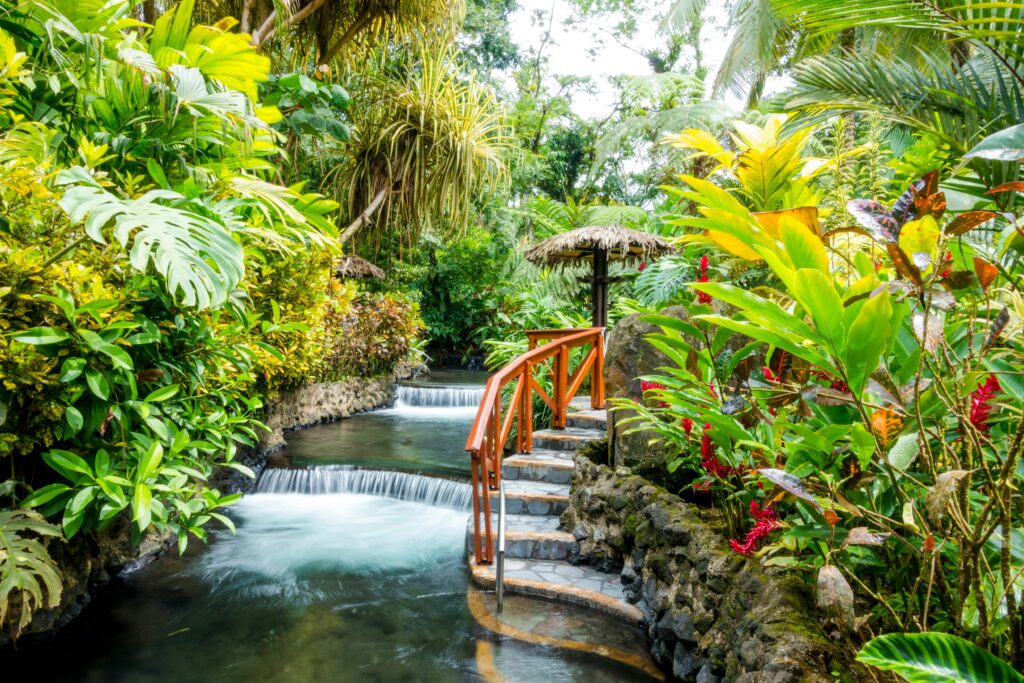
You’re sitting in a thermal pool fed by the runoff of Arenal Volcano. The jungle closes in on both sides — massive ferns, red ginger flowers, the sound of a howler monkey somewhere above you in the canopy. The water is 98°F. A scarlet macaw crosses the sky overhead in a slow, indifferent arc. Tomorrow you’ll be in a tree-canopy yoga class at sunrise. You have not checked your phone in two days. This is what pura vida actually means — and you now understand why people keep coming back.
Costa Rica is not the cheapest wellness destination in the Americas. It’s often called the “Switzerland of Central America” — extraordinary natural beauty at a price point that reflects the investment the country has made in protecting it. Food costs more than neighboring Guatemala or Nicaragua. Activities are priced fairly but not cheaply. And you need a rental car, which adds real cost to the budget. The honest framing: this is a destination that delivers exceptional value for what it charges — just don’t arrive expecting Southeast Asia prices. Budget travelers can manage $45–$70/day on the ground. Mid-range travelers should plan $120–$175/day. Either way, what you get in return — the biodiversity, the hot springs, the surf, the cloud forests, the pura vida pace — justifies every dollar.
What’s In This Guide
📅 Best Time to Visit Costa Rica
The honest take on green season: May–November gets a bad reputation it doesn’t fully deserve. Rain typically arrives in afternoon bursts — mornings are clear, parks are empty, prices are 20–35% lower, and the landscape is intensely green. The rivers run high for their best white water, the waterfalls are at full volume, and whale watching on the Southern Pacific coast peaks in August. If your goal is wellness rather than guaranteed beach days, green season is often the better choice.
Where to Stay in Costa Rica
Costa Rica doesn’t have one base — the country is meant to be moved through. The classic wellness route covers three zones: the Arenal Volcano area (La Fortuna) for hot springs and jungle; Monteverde for cloud forest, canopy tours, and meditation retreats; and a Pacific coast beach destination (Nosara for yoga, Manuel Antonio for accessibility, the Southern Zone for value). Each zone has a distinct character and each has good accommodation at every budget level.
The closest lodge to Arenal Volcano that offers direct, unobstructed views of the cone — built on land originally used by the Smithsonian Institution to monitor the volcano. The property has its own trail network through primary rainforest, an onsite hot spring pool, and consistently excellent birding. Breakfast is included and the buffet is generous. The location is remote enough to genuinely disconnect but the La Fortuna town center is a 20-minute drive for restaurants and tours.
A working horse farm turned hotel on a hillside overlooking the Monteverde cloud forest, with valley views that extend to the Gulf of Nicoya on clear days. The property is sprawling — multiple pools, an onsite restaurant, horseback riding through the farm’s trails — at a price point that would be $250+ at a comparable property in Napa Valley or the Berkshires. The cloud forest at this elevation sits in perpetual mist that thickens and clears throughout the day, giving the property an atmosphere that actively aids whatever decompression you came for.
Nosara is Costa Rica’s yoga and surf capital — a small beach town on the Nicoya Peninsula where the international wellness community has been gathering for decades. Harmony Hotel is the property that anchors it: an onsite yoga shala with daily classes, organic farm-to-table dining, an infinity pool facing the jungle, and direct beach access to Playa Guiones — one of the best surf breaks in Central America for all levels. This is the most complete wellness package on this list. Nothing about it is accidental.
Get the Budget Travel Cheat Sheet
Booking shortcuts, packing hacks, and money-saving moves our readers use on every trip — free when you subscribe.
15 Best Costa Rica Experiences
Costa Rica’s wellness infrastructure runs from the physical to the spiritual to the genuinely wild — hot springs heated by active volcanoes, waterfall hikes through primary rainforest, surf lessons on world-class breaks, and cloud forest walks where you are occasionally the only person on the trail. Grouped by cost to help you plan where the money is genuinely worth spending.
Costa Rica’s Pacific coast beaches are public and free — and several of them rank among the most beautiful in the Americas. Playa Santa Teresa, Playa Guiones (Nosara), Playa Hermosa (near Jacó), and the beaches of the Southern Zone (Dominical, Uvita) all offer world-class conditions without entrance fees. The beaches in the Marino Ballena National Park area near Uvita include the famous whale tail — a natural sandbar formation visible at low tide that extends into the ocean in the shape of a whale’s tail. Getting there at sunrise, before the day-trippers arrive, is one of the great free experiences in Central America.
💡 Check the tide chart before planning a sunrise visit to the Uvita whale tail — it’s only fully visible at low tide. The AllTrails app has the walking paths through the park clearly marked.
Costa Rica contains roughly 5% of the world’s known biodiversity in a country smaller than West Virginia. This means wildlife doesn’t require a guided tour to find — it comes to you. Three-toed sloths hanging from cecropia trees. Howler monkeys announcing dawn from the jungle behind your lodge. Scarlet macaws in pairs, flying low over the canopy. Coatis raiding the fruit bowl on the breakfast table. Jesus Christ lizards running across the surface of the river. Most of this is visible from a hammock at any well-located lodge in the jungle zones. Budget travelers who stay at ecolodges with forest surroundings see as much wildlife as anyone on a $300 guided tour.
💡 The 90 minutes after sunrise and the 90 minutes before sunset are the most active wildlife windows. Be in a chair on your porch during those two windows every day you’re here and you will see things that will take your breath away.
The hanging bridges around Lake Arenal offer a self-guided walk through primary rainforest canopy on a series of suspension bridges up to 100 meters long. You’re moving through the mid-canopy layer — the level where most of the forest’s bird and animal activity occurs — without a guide dictating pace or stopping points. The Mistico Arenal Hanging Bridges Park is the best-managed and most extensive. The 3-kilometer circuit takes 2–3 hours at a relaxed pace. Resplendent quetzal sightings are possible in the higher elevation sections; morpho butterflies are nearly guaranteed.
💡 Go in the morning when the mist is still in the canopy. By 11am the cloud cover burns off and the light flattens. The early light through the forest gaps — and the wildlife activity at that hour — makes the difference between a nice walk and a transcendent one.
A soda is a Costa Rican family-owned diner — typically a small room, a hand-written menu on the wall, a few plastic tables, and a kitchen run by one person who has been making the same dishes for decades. The casado is the national lunch plate: rice, black beans, a protein (chicken, beef, fish, or heart of palm for vegetarians), salad, a small vegetable picadillo, and a tortilla. It’s hearty, balanced, genuinely delicious, and typically costs $7–$12. Finding and eating at the best local soda near your accommodation is one of the most reliable ways to eat well and keep Costa Rica’s higher-than-expected food costs in check.
💡 In tourist-heavy areas, the soda is often one street back from the main drag. Ask your hotel staff where they eat lunch — they’ll point you to the right place and often the best casados are nowhere near the tourist strip.
Arenal Volcano heats a network of natural hot springs in the La Fortuna area — geothermally warmed water running through pools surrounded by tropical vegetation at temperatures between 95°F and 104°F. The experience ranges from basic public pools to the elaborate multi-pool resort complexes of Tabacón and Baldi. The honest middle ground: Eco Termales ($45) is the best value — smaller than the resort complexes, limited to 100 guests at a time, set in genuine jungle with excellent landscaping and food. Tabacón ($60) has the best overall setting but the most people. The free Rio Cholín hot spring pools require a short hike and don’t have amenities but they’re fed by the same geothermal source.
💡 Book Eco Termales in advance — the 100-person limit means it sells out, especially on weekends. Evening sessions (after 5pm) are the most atmospheric: dark jungle, lit pools, the volcano occasionally glowing above you.
Costa Rica has world-class surf breaks on both coasts and the Pacific side has the infrastructure for learners. Jacó, Tamarindo, and Santa Teresa all have multiple surf schools running daily lessons. Santa Teresa is the best combination of beginner-friendly waves and genuinely good surf culture — the breaks at Playa Carmen are consistent, the instructors are experienced, and the beach is beautiful. A 2-hour lesson with board rental and instruction from a certified school runs $45–$75 and most first-timers stand up by the end of the first session. Nosara’s Guiones beach is also excellent for beginners — longer paddle-out but more space and less crowd.
💡 Book a lesson on your second or third day, not your first — spending a morning watching the waves and the break before you paddle out makes you significantly more prepared. Walk the beach at low tide the morning before your lesson.
The Monteverde Cloud Forest Biological Reserve is 10,500 hectares of protected cloud forest at 1,440–1,800 meters elevation — a permanently mist-wrapped environment where the trees are draped in epiphytes, orchids grow from every surface, and the air feels like breathing through a cool, living sponge. Entry is $25 for foreigners; the reserve limits daily visitors to protect the ecosystem. A self-guided walk takes 2–3 hours. A guided walk with a licensed naturalist ($25–$40 more) dramatically improves what you see — the guides have 20+ years of forest experience and know where the quetzals are nesting that week.
💡 The reserve has a strict daily visitor limit and sells out during peak season. Buy your ticket online at least 2 days ahead. Early morning (8am opening) gives you the best wildlife activity and the quietest trails before tour groups arrive mid-morning.
The Río Pacuare is consistently ranked among the top white water rivers in the world — a 28-kilometer run through a roadless rainforest canyon with Class III–IV rapids, crystalline water, and wildlife visible from the river that you’d spend hours trying to find on a land trail. The canyon is inaccessible by road, which means the forest along the river is primary and undisturbed. Full-day trips include transport, lunch on a riverside beach, and the full length of the canyon. Rios Tropicales and Exploradores Outdoors are the established operators with the best safety records.
💡 The Pacuare is most powerful July–October when the rains fill the tributaries. If Class IV rapids concern you, April–June offers the same canyon with slightly lower water and more forgiving conditions. The scenery is identical regardless of season.
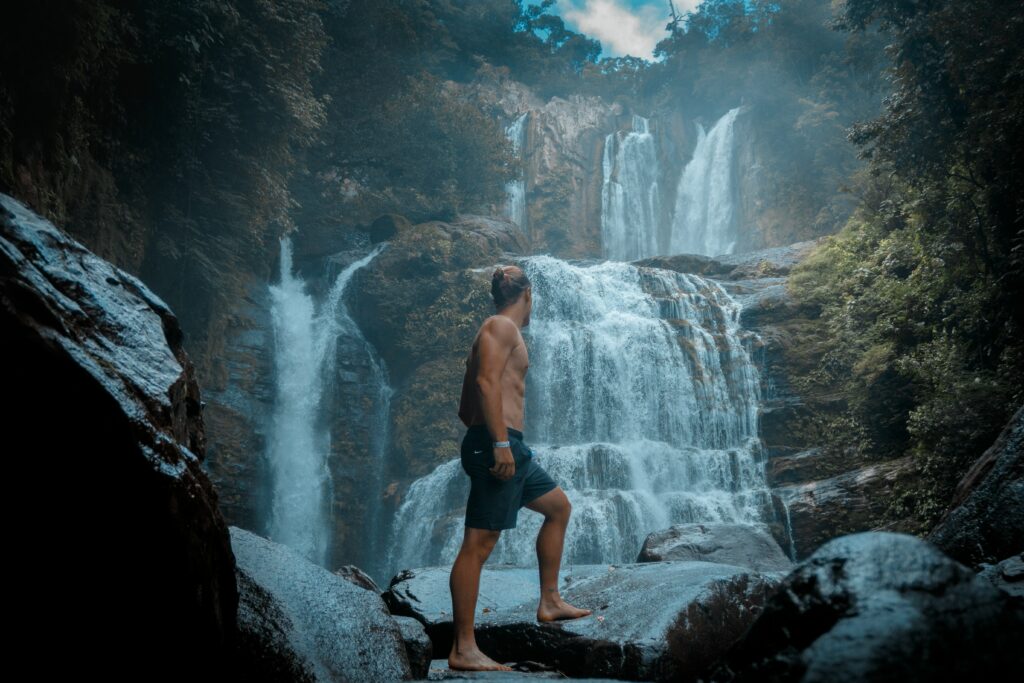
The La Fortuna Waterfall plunges 70 meters from a basalt cliff into an emerald pool at the base of the Arenal Volcano. The hike in is 500 steps down a maintained path through rainforest — 15–20 minutes. The pool at the base is swimmable (and cold, from the highland runoff). The swimming here is genuinely extraordinary — the waterfall volume, the green walls of the jungle canyon, the volcanic rock — and $20 is a complete bargain for the experience. The hike back up is the harder part; allow 30 minutes. The whole visit takes 2–3 hours.
💡 Go early — the waterfall path opens at 7:30am and the pool is nearly empty before 9am. By 11am tour buses have arrived and the pool is crowded. Bring water shoes — the volcanic rock at the base is slippery and ankle-deep wading to reach the best swimming spot is unavoidable.
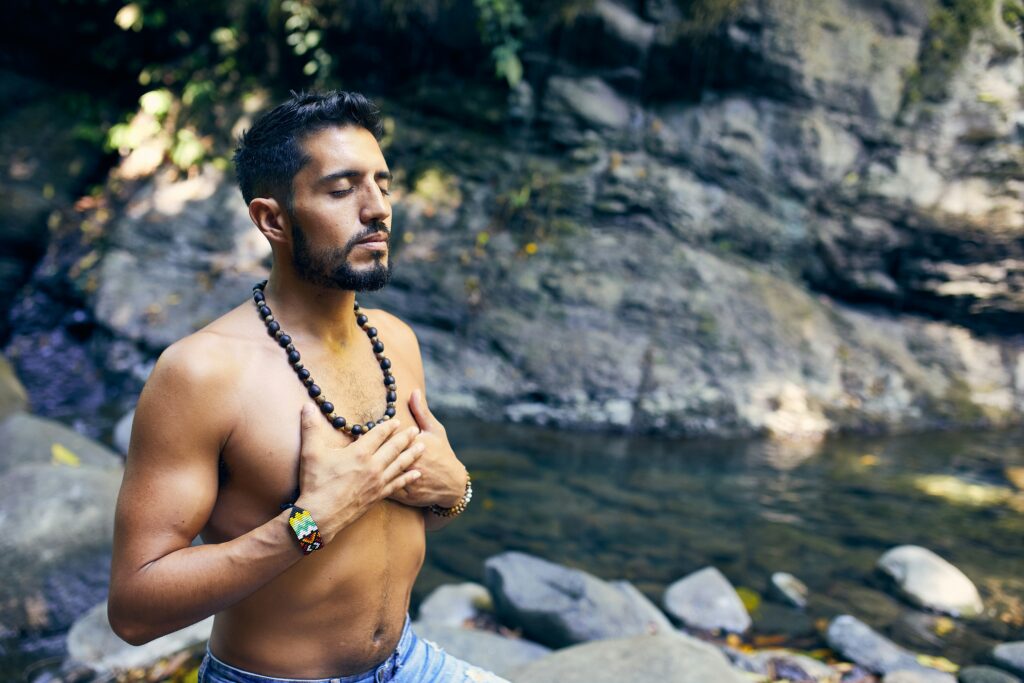
Nosara has the highest concentration of qualified yoga instruction outside of major North American cities — the Nosara Yoga Institute has been training teachers here since 1994 and the town has accumulated decades of serious practice culture around it. Drop-in classes at the institute or at the studios attached to Harmony Hotel and Blue Spirit Retreat run $15–$30. The instruction level is genuinely high — these are not resort yoga classes where the instructor repeats the same sequence every morning. Elsewhere in the country: Blue Spirit Retreat (Nosara), Samasati Retreat (Caribbean Coast), and Danyasa Eco-Retreat (Dominical) all offer multi-day programs for serious practitioners.
💡 Nosara’s beach yoga at dawn — practiced on Playa Guiones as the surf rolls in 50 meters away — is one of the most complete wellness experiences in the country. No retreat infrastructure required. Just arrive, find a spot on the sand, and join whatever practice is happening.
Zip-lining as a tourism activity was essentially born in Costa Rica — the original canopy tour in Monteverde opened in 1994 and the concept spread globally from there. Doing it here, in a genuine cloud forest, is meaningfully different from doing it at a resort zip line elsewhere. The Original Canopy Tour in Santa Elena and Sky Adventures Monteverde are the established operators with the best safety records and most extensive lines. Arenal’s zip-line operations offer the added element of volcano views on clear days. A full canopy tour runs 2–3 hours with 8–12 lines of varying length.
💡 Book the earliest available time slot — by 10am the morning mist that makes the Monteverde canopy extraordinary has usually burned off. The cloud forest in fog, with the zip lines disappearing into white ahead of you, is the experience that justifies coming to Monteverde specifically.
Rio Celeste is a river that runs a vivid, unreal shade of turquoise — the color caused by a chemical reaction between volcanic minerals and the river’s pH. The effect is one of the most visually striking natural phenomena in Central America: a swimming-pool blue river running through deep jungle, with a 30-meter waterfall and a series of hot springs feeding into it from volcanic vents. The park is 3–4 hours from Arenal by car. The hike to the waterfall is 4km round trip through primary rainforest. The color is most intense at midday when direct sunlight hits the water.
💡 Rio Celeste is one of the most photographed places in Costa Rica and the main viewpoint gets crowded by 10am on weekends. Go mid-week and arrive when the park opens at 8am. The trail continues past the waterfall to lesser-visited sections of the river that are as beautiful and often completely empty.
Costa Rica has a developed, serious wellness retreat infrastructure that operates at a completely different level from the pop-up retreat economy in Tulum or Bali. Blue Spirit Retreat Center in Nosara, Samasati on the Caribbean coast, and Anamaya Resort (Santa Teresa) have been running multi-day programs for over a decade with resident teachers rather than rotating instructors. Programs cover yoga, meditation, breathwork, and somatic practices in jungle or ocean settings. All-inclusive 3-day programs run $250–$400 at mid-tier retreats; 5-day programs at premium centers run $400–$600. These prices are genuinely competitive with comparable programs in the US — for dramatically better natural settings.
💡 Anamaya Resort in Santa Teresa sits on a hilltop above the Pacific with an infinity pool facing the ocean. The yoga platform is open-air and faces the sunset. The retreats sell out months ahead — if you’re planning a dedicated wellness trip, this is the property to plan the rest of your itinerary around.
Corcovado National Park on the Osa Peninsula is one of the most biologically intense places on earth. Accessible only by boat or on foot through the jungle, the park requires a licensed guide (mandatory since 2014) and advance reservations. A 2-day guided trek covers tapirs, peccaries, four species of monkey, scarlet macaws, harpy eagles, and bull sharks in the river crossings. The cost ($100–$200 all-in for a 2-day guided program from Puerto Jiménez) covers the guide, park fees, and basic accommodation at the ranger station. Getting there requires either flying to Puerto Jiménez ($100–$150 from San José) or a 6-hour drive.
💡 Corcovado is the correct answer to “what’s the most extraordinary natural experience in Costa Rica.” The effort and cost to get there are exactly proportional to what you find. Don’t skip it on a longer trip because it requires planning — that planning is what keeps the experience extraordinary.
Costa Rica’s Southern Pacific coast (Bahía Drake, Marino Ballena National Park near Uvita) hosts humpback whale populations from both hemispheres — the Northern Hemisphere population migrates south July–November, and the Southern Hemisphere population migrates north December–April. This means the Southern Pacific coast has the longest whale season of any location in the Americas, with humpbacks present for roughly 8 months of the year. Boat tours run 3–4 hours, cover the primary whale zone, and also typically encounter dolphins, sea turtles, and scarlet macaws from the water. The whale density in peak season (August–October) is as high as anywhere in the Americas.
💡 Tours depart early (7–8am) to maximize calm morning conditions. Book with operators based in Drake Bay or Uvita rather than the larger tour companies in San José — local operators have better local knowledge and smaller group sizes.
Worth It / Skip It
Don’t Make These Mistakes
Skipping the rental car insurance and underestimating road conditions. Costa Rica’s roads outside the Central Valley and main tourist corridors range from rough to genuinely treacherous — unpaved river crossings, steep mountain grades, and potholes that appear without warning. The mandatory minimum insurance from the national INS (Instituto Nacional de Seguros) is included in every rental; the supplemental Collision Damage Waiver from the rental company is strongly advised on top of it. Declining the CDW to save $15–$20/day and then needing it on a rural road is one of the most common and most expensive mistakes travelers make here.
Planning too many destinations in too little time. Costa Rica looks small on a map. The roads do not reflect the map. San José to Arenal is 3.5 hours on a good day. Arenal to Monteverde is 2–3 hours on a road that is partially unpaved. Monteverde to Manuel Antonio is 4+ hours. Driving between regions eats full days, and travelers who plan a different destination every night spend more time in the car than in the jungle. The correct approach for a 7-day trip: two nights Arenal, two nights Monteverde, three nights at a beach. Anything more ambitious requires 10+ days.
Arriving in high season without reservations for popular lodges and the Monteverde Reserve. The Monteverde Cloud Forest Reserve has a strict daily visitor limit and sells out completely during peak season (December–April). Top ecolodges in the Arenal and Nosara areas book up 2–3 months ahead for December–February travel. Costa Rica in peak season is one of the most in-demand eco-tourism destinations in the Americas — treating it like somewhere you can show up and figure it out on arrival will result in significantly worse options at significantly higher prices.
Underestimating food costs and not eating at sodas. Costa Rica is regularly described as cheap by travel content written years ago or by people who ate street food every meal. In 2026, a sit-down restaurant dinner in a tourist area runs $18–$35 per person. Imported wine, craft beer, and cocktails add up fast. The correct budget move — eating a casado for lunch at a local soda ($8–$12), keeping breakfast simple, and reserving the restaurant budget for one good dinner — cuts daily food costs roughly in half without sacrificing quality. The casado at a good soda is genuinely excellent; there is no quality penalty for eating locally.

VacayValue Scorecard — Costa Rica
Packing List — Costa Rica
Every Sunday: One Destination. One Honest Take.
Join travelers who plan smarter. One email per week — real costs, specific advice, no filler.
Costa Rica Is the Most Complete Wellness Destination in the Americas. It Costs More Than You Expect — and Delivers More Than You Imagine.
The honest truth about Costa Rica is that it is not cheap. Food surprises people. Activities add up. The rental car is non-negotiable and comes with insurance costs. And the best regions — Nosara, the Osa Peninsula, the cloud forest zones — require planning, driving, and a tolerance for infrastructure that is deliberately rustic in places. None of this is the marketing version of Costa Rica. But none of it changes what Costa Rica actually is: a country that has protected 25% of its land area as national parks, that has more biodiversity per square kilometer than nearly anywhere on earth, and that has built a world-class wellness infrastructure — hot springs heated by active volcanoes, yoga centers with decades of teaching history, surf breaks used by serious practitioners from around the world — in a setting of genuine natural beauty.
The comparison that holds up: Costa Rica is to the Americas what Chiang Mai is to Asia — a place where the wellness infrastructure is the real thing rather than a packaged imitation of it, and where the natural setting amplifies every experience. The price difference is real. So is the difference in what you get.
Fly into San José. Spend one night maximum. Drive to Arenal first. Stay near the hot springs. Move to Monteverde. Take the cloud forest seriously. End on a Pacific beach. Eat the casado every day. Do the waterfall. Add a day to whatever you planned. You will not regret the extra time.